Revised Theory Suggests Carbon Dioxide Levels Already in Danger Zone
November 7th, 2008
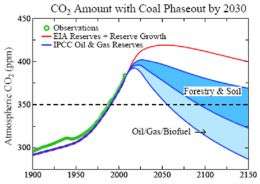
Atmospheric CO2 if coal emissions are phased out linearly between 2010 and 2030, calculated using a version of the Bern carbon cycle model.
(PhysOrg.com) -- If climate disasters are to be averted, atmospheric carbon dioxide (CO2) must be reduced below the levels that already exist today, according to a study published in Open Atmospheric Science Journal by a group of 10 scientists from the United States, the United Kingdom and France.
The authors, who include two Yale scientists, assert that to maintain a planet similar to that on which civilization developed, an optimum CO2 level would be less than 350 ppm — a dramatic change from most previous studies, which suggested a danger level for CO2 is likely to be 450 ppm or higher. Atmospheric CO2 is currently 385 parts per million (ppm) and is increasing by about 2 ppm each year from the burning of fossil fuels (coal, oil, and gas) and from the burning of forests.
“This work and other recent publications suggest that we have reached CO2 levels that compromise the stability of the polar ice sheets,” said author Mark Pagani, Yale professor of geology and geophysics. “How fast ice sheets and sea level will respond are still poorly understood, but given the potential size of the disaster, I think it’s best not to learn this lesson firsthand.”
The statement is based on improved data on the Earth’s climate history and ongoing observations of change, especially in the polar regions. The authors use evidence of how the Earth responded to past changes of CO2 along with more recent patterns of climate changes to show that atmospheric CO2 has already entered a danger zone.
According to the study, coal is the largest source of atmospheric CO2 and the one that would be most practical to eliminate. Oil resources already may be about half depleted, depending upon the magnitude of undiscovered reserves, and it is still not practical to capture CO2 emerging from vehicle tailpipes, the way it can be with coal-burning facilities, note the scientists. Coal, on the other hand, has larger reserves, and the authors conclude that “the only realistic way to sharply curtail CO2 emissions is phase out coal use except where CO2 is captured and sequestered.”
In their model, with coal emissions phased out between 2010 and 2030, atmospheric CO2 would peak at 400-425 ppm and then slowly decline. The authors maintain that the peak CO2 level reached would depend on the accuracy of oil and gas reserve estimates and whether the most difficult to extract oil and gas is left in the ground.
The authors suggest that reforestation of degraded land and improved agricultural practices that retain soil carbon could lower atmospheric CO2 by as much as 50 ppm. They also dismiss the notion of “geo-engineering” solutions, noting that the price of artificially removing 50 ppm of CO2 from the air would be about $20 trillion.
While they note the task of moving toward an era beyond fossil fuels is Herculean, the authors conclude that it is feasible when compared with the efforts that went into World War II and that “the greatest danger is continued ignorance and denial, which could make tragic consequences unavoidable.”
“There is a bright side to this conclusion” said lead author James Hansen of Columbia University, “Following a path that leads to a lower CO2 amount, we can alleviate a number of problems that had begun to seem inevitable, such as increased storm intensities, expanded desertification, loss of coral reefs, and loss of mountain glaciers that supply fresh water to hundreds of millions of people.”
In addition to Hansen and Pagani, authors of the paper are Robert Berner from Yale University; Makiko Sato and Pushker Kharecha from the NASA/Goddard Institute for Space Studies and Columbia University Earth Institute; David Beerling from the University of Sheffield, UK; Valerie Masson-Delmotte from CEA-CNRS-Universite de Versaille, France Maureen Raymo from Boston University; Dana Royer from Wesleyan University and James C. Zachos from the University of California at Santa Cruz.
Citation: Open Atmospheric Science Journal, Volume 2, 217-231 (2008)
http://www.bentham.org/open/toascj/openaccess2.htm
Provided by Yale University


/s
next.
Plants only sequester carbon in so far as they build new soil; all the other CO2 is just released back to the atmosphere by the action of fungi, bacteria, mites, worms and oxidation.
pfft that would never work. You can't make money off of it.
Ok. Grow more plants and then cut them down and bury them...deep...then grow more plants...
Maybe they know something about climate, maybe they don't. The results aren't in on that one. But boy are they out to lunch when it comes to public policy. This doesn't even pass the sniff test. Go back to your labs and stop embarassing yourselves. The source of 50% of our electricity is not going to be replaced by unicorn farts.
La Nina is expected to continue this winter, with resulting colder temperatures (and more deaths from cold and sickness) over most of the Northern hemisphere....
So, since global warming has stopped, what is Hansen worried about? Other than his funding and future Nobel Prize?
http://wattsupwit...er-rate/
Has it ever occured to you that when unfounded theories are forwarded they might be wrong?
Have you ever figured that a scientist is a person and is just as interested in money as an oil baron?
Why dont you go tell that to all other sections?
You forgot. Cooling is caused by warming...
... He he he!
Where in Ontario? Parts of it are at the same latitude as Northern California.
Velanarris is a caring human being. He is not evil. He thinks differently than you do. And that is a good thing.
CO2 in the atmosphere seems to have an extremely long half life, and it is our duty to curtail our pollution of this planet.
Hopefully, one day, the place can be turned into utopia. To get there though we have to start from here. Where we are at right now and the path we have taken to get here cannot be the same path we want to travel in the future, can it?
It is a good plan to look at what level of pollution we want to finish at. The only task ahead then, is to determine how we are going to get there, and how long we intend to take to get there.
So lets some researchers research. Let them determine the type of atmosphere we want to breath, let a debate take place. I am in favour of setting the aim at a clean atmosphere on a planet with plenty of green space, somewhere where you can get away from other people from time to time, without having to travel to Antarctica to do it.
How do we develop a clean, green, stress free planet and lifestyle without having to find some way to escape from the world? I for one don't want to spend my life contemplating my navel just so I don't have to look up and see smog filled skies all around.
Re RobertACookPE statement "In the mean time, the earth's global temperatures have been declining for the past ten years, and have decreased to their 1970-80's levels in the past 2 years. "
Below is the link to a report and graph that show that statement to be untrue.
http://www.metoff...s_on.pdf
http://scienceand...pped.pdf
Besides climate what about our own health?? How many of you would love to live down wind from a coal plant? "Hey kids go outside and get some fresh grey air"
I'll find my heart after you find your brain. Difference is, compassion isn't necessary to determine fraud.
Its worth the pro AGW (or all of us) reading the whole of that link.
Isn't Ontario around LA? Where do you live? Up in the Grapevine?
what if they are wrong and we do manage to drop global temperatures? Kind of a connundrum.
I don't agree with this. He is constantly rejecting any argument what so ever, any, all, nothing is good enough for him. However the arguments that he comes up with are odd (like the earth quakes theory). If he would be consistant and be as critical on both side, I would think he has a heart and cares about human being, but he is very very far from that. He is 100% biased, so much that this is past common sense, it has become emotional and selfish, unkind to only want to see what is a direction against one where lives, in the end, are at play.
Or maybe the number ramped up but even then it'd be hard to stretch back to the begining of the industrial revolution. Maybe the numbers are right and the original pre industrial number was closer to 180ppm. Then we're all screwed because we'd starve all the trees at some point plus as against acid rain as I am, a certain acidity to rainwater is neccisary for soil life.
Has anyone looked at the abstract, here are some gems:
"Decreasing CO2 was the main cause of a cooling trend that began 50 million years ago, the planet being nearly ice-free until CO2 fell to 450 ± 100 ppm" plus or minus 25% are you kidding me?
"there is a possibility of seeding irreversible catastrophic effects." "Equilibrium sensitivity, including slower surface albedo feedbacks, is %u223C6°C for doubled CO2 for the range of climate states between glacial conditions and ice-free Antarctica. Decreasing CO2 was the main cause of a cooling trend that began 50 million years ago, the planet being nearly ice-free until CO2 fell to 450 ± 100 ppm"
hmm, irreversably repeat previous climate changes that reversed? If we've been to 550 and didn't dy, then why is 385 a scary number now?
They cite 200PPM swings, but 50PPM will kill us all? This isn't even good science fiction.
http://video.goog...36508883
By the way, who says the planet is at its optimum temperature and ice levels, etc.Or were the best conditions 10 years ago? Oh, that would be 1998, it's cooler now. Or was it 1988 when Hansen had his performance in Congress? And just where is all this CO2 coming from? Does Henry's law still apply? Besides changes in CO2 levels lag temperature changes.The average Ph of the oceans is about 8.1, so just how much CO2 is needed to bring the oceans below a Ph of 7?
Finally, is it true more taxpayer money is spent on "global warming" research than Cancer research? That would be a very interesting fact indeed!
You do have a point. Even if we do something we might in addition have volcanoes errupting etc. On the other hand species survive if they do not overtax the eco-system. Thus if you excrete more than your surroundings can rework and renew you are bound to end up in trouble. We have lived for the past 200 years as if the world's resources are unlimited and if it can absorb all the excrement we throw at it. It definitely worries me.
They are also ignoring the role played by the oceans as a sink for CO2 and a thermal reservoir.
But, how do we know that CO2 at lower levels than now is better? For much of earths history CO2 has been higher than now.
Sure the world has been getting warmer and may now be getting cooler.
We are polluting the world - much of it is particulate which causes cloud cover and thus has a cooling effect.
We are building cities which creates localized heating and also changes the local precipitation.
We are cutting down forests and creating agriculture or suburban sprawls. These things are not fixed by concentrating on global warming.
Lets solve some of the most pressing problems, most are social like starvation and disease, some are Green like deforestation, extinction.
Actually, the amount of forestation in the contiguous 48 states has risen in recent decades and is now higher than it was in the 1920s.
http://www.pnas.o...full.pdf html
According to the former head and founder of Greenpeaced we now sit on a greater reserve of natural forests than the country had prior to colonization, due to our agriculture and irrigation efforts I agree.
California was a desert for the most part, now there are areas of Cali that are majestic forests. Bring the logging industry back, it'd fix half of our economic problems, all of our housing problems, and a lot of our environmental problems (at least the ones that think CO2 is responsible).
Look how successful this was in in Germany and the USSR - at least until the massive backlog of reality burst through the psychobabble dams they built.
I'm pretty sure the trend you'll find, when graphed, will look exactly like a sine wave.
I know this, because I did it.
Climate change is real, it will forever be a part of the human experience and the best way to approach it is with calm, rational, intelligent adaptation.
I suspect what offends most people is the strain to impose a sense of immediate crisis and emergency upon a phenomenon that is quite natural and has been ongoing forever.
Further negativity is generated when certain interest groups try to hijack the social response to climate change and force it to their own ideologies and political aspirations.
So terrorism for the sake of conversation?
Sounds rather misguided to me.
But when those facts are false, and you continue to cite excessive alarm it's the same thing as yelling FIRE inside a crowded theater.
They might not see the flames or smoke, but someone is getting trampled to death. Perhaps terrorism is too harsh a word but, it's not that far off.
Please don't start with that. Climate change is not like astrology. The specialists in that field all agree that it's happening.
I also don't think that the Earth ending up looking like Venus is a probable outcome, but as long as the possibility is there, however remote everyone has the right to know that their grandchildren just might get roasted because of them.
In the field of climatology there would be only one constant. That constant is change.
The possibility is not there. We cannot absorb anywhere near the sun's energy that Venus does without changing the orbit of the planet. The differences between Earth and Venus are so numerous that a comparision other than in the most general of terms isn't logical.
Please understand the concentrations and volumes at play as well as the reponses of aqueous methane hydrate under several atmospheres of pressure at depth.
This was several hundred years ago and the climate has still not warmed back up to that level yet. But it may happen soon. And if it does will it have anything to do with Man produced CO2?