Engineered killer T cell recognizes HIV-1's lethal molecular disguises
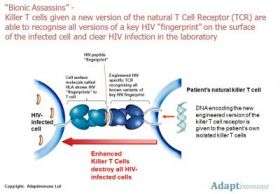
Researchers at the University of Pennsylvania School of Medicine and colleagues in the United Kingdom have engineered T cells able to recognize HIV-1 strains that have evaded the immune system. The findings of the study, published online in the journal Nature Medicine, have important implications for developing new treatments for HIV, especially for patients with chronic infection who fail to respond to antiretroviral regimens.
When viruses enter the body, they hijack the machinery of host cells to replicate and spread infection. When the body's cells are infected with a virus they expose small parts of the virus on their surface, offering a molecular fingerprint called an epitope for killer T-cells from the immune system to see. This triggers an immune response, eliminating the virus and any cells involved in its production. However, HIV has the ability to mutate quickly, swiftly disguising its fingerprints to allow it to hide from killer T-cells.
Natural T cells recognize their targets through weak molecular interactions mediated by the T cell receptor. Through a clever molecular process, the investigators were able to isolate a group of T cell receptor encoding genes that bind to HIV-1 about 450-fold more strongly.
"Not only could T cells engineered to express the strongly binding T cell receptor see HIV strains that had escaped detection by natural T cells, but the engineered T cells responded in a much more vigorous fashion so that far fewer T cells were required to control infection," says co-senior author James Riley, PhD, Research Associate Professor of Pathology and Laboratory Medicine at Penn.
What's more, adds first author Angel Varela-Rohena, PhD, who recently completed these studies as part of his PhD dissertation, "With the present availability of potent systems to replicate and deliver high-affinity HIV-1 specific T-cell receptors, billions of these anti-HIV-1 warriors can be generated in two weeks."
"As soon as we saw over a decade ago how quickly the virus can evade the immune system we knew there would never be a conventional vaccine for HIV," explains Professor Andy Sewell from Cardiff University, United Kingdom, co-senior author of the study. "In the face of our engineered assassin cells, the virus will either die or be forced to change its disguises again, weakening itself along the way. We'd prefer the first option but I suspect we'll see the latter."
"We hope to begin clinical trials using the engineered T cells in patients with advanced HIV infection next year, a group for whom many drug regimens have stopped working" says co-author Carl June, MD, Professor of Pathology and Laboratory Medicine and Director of Translational Research at the Abramson Family Cancer Research Institute at Penn. "If the therapy in that group proves successful, we will treat patients with early-stage, well-controlled HIV infection. The goal of these studies is to establish whether the engineered killer T cells are safe, and to identify a range of doses of the cells that can be safely administered."
"We have managed to engineer a receptor that is able to detect HIV's key fingerprints and is able to clear HIV infection in the laboratory," says Bent Jakobsen, PhD, co-lead author and Chief Scientific Officer at Adaptimmune Ltd, the United Kingdom-based company which owns the rights to the technology. "If we can translate those results in the clinic, we could at last have a very powerful therapy on our hands."
Source: University of Pennsylvania School of Medicine


