Flexible charge pump: New small-scale generator produces alternating current by stretching zinc oxide wires
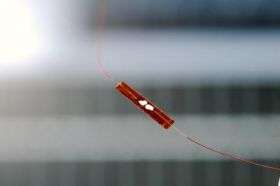
(PhysOrg.com) -- Researchers have developed a new type of small-scale electric power generator able to produce alternating current through the cyclical stretching and releasing of zinc oxide wires encapsulated in a flexible plastic substrate with two ends bonded.
The new "flexible charge pump" generator is the fourth generation of devices designed to produce electrical current by using the piezoelectric properties of zinc oxide structures to harvest mechanical energy from the environment. Its development was scheduled to be reported November 9, 2008 in the advance online publication of the journal Nature Nanotechnology.
"The flexible charge pump offers yet another option for converting mechanical energy into electrical energy," said Zhong Lin Wang, Regent's professor and director of the Center for Nanostructure Characterization at the Georgia Institute of Technology. "This adds to our family of very small-scale generators able to power devices used in medical sensing, environmental monitoring, defense technology and personal electronics."
The new generator can produce an oscillating output voltage of up to 45 millivolts, converting nearly seven percent of the mechanical energy applied directly to the zinc oxide wires into electricity. The research has been supported by the U.S. Department of Energy, the National Science Foundation, the Air Force Office of Scientific Research and the Emory-Georgia Tech Center for Cancer Nanotechnology Excellence.
Earlier nanowire nanogenerators and microfiber nanogenerators developed by Wang and his research team depended on intermittent contact between vertically-grown zinc oxide nanowires and an electrode, or the mechanical scrubbing of nanowire-covered fibers. These devices were difficult to construct, and the mechanical contact required caused wear that limited how long they could operate. And because zinc oxide is soluble in water, they had to be protected from moisture.
"Our new flexible charge pump resolves several key issues with our previous generators," Wang said. "The new design would be more robust, eliminating the problem of moisture infiltration and the wearing of the structures. From a practical standpoint, this would be a major advantage."
To boost the current produced, arrays of the flexible charge pumps could be constructed and connected in series. Multiple layers of the generators could also be built up, forming modules that could then be embedded into clothing, flags, building decorations, shoes – or even implanted in the body to power blood pressure or other sensors.
When the modules are mechanically stretched and then released, because of the piezoelectric properties, the zinc oxide material generates a piezoelectric potential that alternately builds up and then is released. A Schottky barrier controls the alternating flow of electrons, and the piezoelectric potential is the driving force of the charge pump.
"The electrons flow in and out, just like AC current," Wang explained. "The alternating flow of electrons is the power output process."
Constructed with zinc oxide piezoelectric fine wires with diameters of three to five microns and lengths of 200 to 300 microns, the new generator no longer depends on nanometer-scale structures. The larger size was chosen for easier fabrication, but Wang said the principles could be scaled down to the nanometer scale.
"Nanoscale materials are not required for this to work," he said. "Larger fibers work better and are easier to work with to fabricate devices. But the same principle would apply at the nanometer scale."
The wires are grown using a physical vapor deposition method at approximately 600 degrees Celsius. Using an optical microscope, the wires are then bonded onto a polyimide film and silver paste applied at both ends to serve as electrodes. The wires and electrodes were then encased in polyimide to protect them from wear and environmental degradation.
To measure the electric energy generated, the researchers subjected the substrate and attached zinc oxide wires to periodic mechanical bending created by a motor-driven mechanical arm. The bending induced tensile strain which created a piezoelectric potential field along the laterally-packaged wires. That, in turn, drove a flow of electrons into an external circuit, creating the alternating charge and discharge cycle – and corresponding current flow.
Increasing the strain rate increased the magnitude of the output electricity, both in voltage and current. Wang believes the frequency of the current is limited only by the mechanical properties of the polyimide substrate.
The researchers conducted a number of tests to verify that the current measured was produced by the generator – and not an external measurement artifact. Using the same experimental setup, they stretched carbon fibers and Kevlar fibers coated with polycrystalline zinc oxide, and did not observe current flow. The research team also developed two criteria and eight tests for ruling out experimental artifacts, Wang noted.
In addition to Wang, the research team included Rusen Yang and Yong Qin from Georgia Tech and Liming Dai of the Department of Chemical and Materials Engineering at the University of Dayton.
For the future, Wang sees the family of small-scale generators enabling development of a new class self-powered wireless sensing systems. The devices could gather information, store it and transmit the data – all without an external power source.
"Self-powered nanotechnology could be the basis for a new industry," he said. "That's really the only way to build independent systems."
Provided by Georgia Institute of Technology


