UK fingerprint 'developer' can read a letter from its envelope
November 10, 2008 UK fingerprint 'developer' can read a letter from its envelope

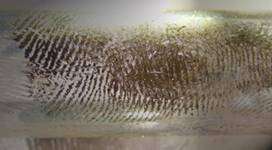
(PhysOrg.com) -- UK scientists have discovered a fingerprint'“developer' which can highlight invisible prints on almost any surface – and read the text of a letter just from the envelope it was sent in.

Paul Kelly and colleagues at Loughborough University found that a disulfur dinitride (S2N2) polymer turned exposed fingerprints brown, as the polymer reaction was initiated from the near-undetectable remaining residues.

Traces of inkjet printer ink can also initiate the polymer. The detection limit is so low that details of a printed letter previously in an envelope could be read off the inside of the envelope after being exposed to S2N2.

“A one-covers-all versatile system like this has obvious potential,” says Kelly.

“This work has demonstrated that it is possible to obtain fingerprints from surfaces that hitherto have been considered extremely difficult, if not impossible, to obtain,” says Colin Lewis, scientific advisor at the UK Ministry of Defence. “The method proposed has shown that this system could well provide capabilities which could significantly enhance the tools available to forensic scientists in the future.”

Original article: Paul F. Kelly, Chem. Commun., 2008, DOI: 10.1039/b815742a

Provided by Royal Society of Chemistry


print this article email this article download pdf blog this article bookmark this article     Stumble it Digg this share on Facebook retweet share on Reddit add to delicious
Rate this story - 4.3 /5 (40 votes)


November 10, 2008 all stories

Comments: 0

4.3 /5 (40 votes)
  • Stumble this up

  • Digg this

  • share this

  • hide
  • Related Stories

  • Nanoparticles for gene therapy improve
    created Nov 06, 2009 | popularity not rated yet | comments 0
  • What Comes After Hard Drives?
    created Oct 23, 2009 | popularity not rated yet | comments 0
  • Water quality in orbit: Scientists test H2O disinfection on International Space Station
    created Sep 14, 2009 | popularity not rated yet | comments 0
  • Braille Displays Get New Life With Artificial Muscles
    created Aug 14, 2009 | popularity not rated yet | comments 0
  • New Nanoparticles Could Revolutionize Therapeutic Drug Discovery
    created Jul 24, 2009 | popularity not rated yet | comments 0


Other News

Toward home-brewed electricity with 'personalized solar energy'

Toward home-brewed electricity with 'personalized solar energy'

Chemistry / Materials Science

created Nov 04, 2009 | popularity 3.4 / 5 (9) | comments 4

New scientific discoveries are moving society toward the era of "personalized solar energy," in which the focus of electricity production shifts from huge central generating stations to individuals in their ...


Scientists Reproduce a Building Block of Life in Laboratory

Scientists Reproduce a Building Block of Life in Laboratory

Chemistry / Biochemistry

created Nov 06, 2009 | popularity 4.8 / 5 (22) | comments 0

(PhysOrg.com) -- NASA scientists studying the origin of life have reproduced uracil, a key component of our hereditary material, in the laboratory.


Newly Discovered Fat Molecule: An Undersea Killer with an Upside

Newly Discovered Fat Molecule: An Undersea Killer with an Upside

Chemistry / Biochemistry

created Nov 05, 2009 | popularity 4.8 / 5 (9) | comments 0

(PhysOrg.com) -- A chemical culprit responsible for the rapid, mysterious death of phytoplankton in the North Atlantic Ocean has been found by collaborating scientists at Rutgers University and the Woods Hole ...


CU-Boulder map of human bacterial diversity shows wide interpersonal differences

Map of Human Bacterial Diversity Shows Wide Interpersonal Differences

Chemistry / Biochemistry

created Nov 05, 2009 | popularity 4.7 / 5 (11) | comments 0

(PhysOrg.com) -- A University of Colorado at Boulder team has developed the first atlas of bacterial diversity across the human body, charting wide variations in microbe populations that live in different ...


Mimicking nature, scientists can now extend redox potentials

Mimicking nature, scientists can now extend redox potentials

Chemistry / Biochemistry

created Nov 04, 2009 | popularity 4.8 / 5 (5) | comments 0

(PhysOrg.com) -- New insight into how nature handles some fundamental processes is guiding researchers in the design of tailor-made proteins for applications such as artificial photosynthetic centers, long-range ...