New method can capture catalysis, one molecule at a time
November 10, 2008 New method can capture catalysis, one molecule at a time

Enlarge

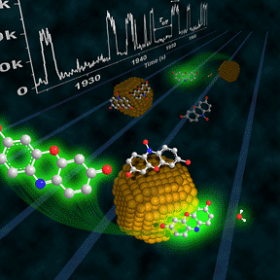
When a molecule of resazurin dye (on top of the particle) binds to the gold nanoparticle it is changed to highly fluorescent resorufin (in front of the particle) by removal of an oxygen atom (moving away to the right). Resorufin glows under ultraviolet light. A graph of the time it spends before releasing from the gold surface reveals details about how the reaction takes place. Graphic by Aleksandr Kalininskiy

(PhysOrg.com) -- Cornell researchers have developed an ingenious microscopic method to observe the behavior of single nanoparticles of a catalyst, down to the resolution of single catalytic events.

Their observations have shown that not all nanoparticles in a batch are created equal: Some carry out their reactions in different ways than others. The researchers have also directly observed that every nanoparticle changes the speed of its catalytic reaction over time, and they have measured the time scale.

There is intense interest in nanocatalysts for such applications as fuel cells and pollutant removal, because nanoparticles provide a larger surface area to speed reactions, and in some cases, materials that are not catalytic in bulk become so at the nanoscale.

"Understanding the fundamental principles that govern the catalyst activity can help us to design new catalysts," said Peng Chen, Cornell assistant professor of chemistry and chemical biology. "Nanoparticles are dynamic entities. Maybe we can think about designing smart catalysts that can adapt to different conditions."

The research by Chen and colleagues is described in the online edition of the journal Nature Materials and will appear in a forthcoming print edition.

The researchers immobilized spherical gold nanoparticles about 6 nanometers in diameter on a glass surface and flowed a solution of a dye over them. The gold catalyst changes molecules of the dye into a new fluorescent form. Using a microscope that focuses on a very thin plane, the researchers made a "movie" with one frame every 30 milliseconds.

A dye molecule briefly binds to the surface of the gold, where an oxygen atom is removed. The new molecule fluoresces, and a blip of light appears in the microscope image, remaining until the molecule releases from the catalyst. The researchers were able to isolate the blips from individual nanoparticles and identify single catalytic events.

They saw two slightly different reaction patterns: On some nanoparticles the dye molecule binds to the surface, is changed and then releases. On others, after the change the molecule moves to a new position before it releases. And on some nanoparticles, both types of reaction occur. The nanoparticles, Chen explained, are not perfectly spherical, and different parts of the gold crystal are exposed at different places on the surface; this may account for the different reaction patterns.

Reactions at the same sites also varied in their timing. The time a fluorescent molecule remains at a given site might be short, then longer, then short again. The explanation, the researchers said, is that the catalytic reaction also causes a restructuring of the surface of the gold, and this causes the subsequent reactions to take place faster or slower. Later, the gold surface recovers to its original structure, and the reaction returns to its original timing.

"For the first time, we could provide a quantitation on the restructuring timescales at tens to hundreds of seconds," the researchers said.

Provided by Cornell University


print this article email this article download pdf blog this article bookmark this article     Stumble it Digg this share on Facebook retweet share on Reddit add to delicious
Rate this story - 4.6 /5 (14 votes)


November 10, 2008 all stories

Comments: 0

4.6 /5 (14 votes)
  • Stumble this up

  • Digg this

  • share this

  • hide
  • Related Stories


  • hide
  • Relevant PhysicsForums posts

  • moment of inertia and friction
    created 9 hours ago
  • two-dimensional collision
    created 11 hours ago
  • The acceleration of mass using light
    created 13 hours ago
  • Badminton
    created 15 hours ago
  • More from Physics Forums - General Physics

Other News

Peptides control crystal growth with 'switches, throttles and brakes'

Peptides control crystal growth with 'switches, throttles and brakes'

Nanotechnology / Bio & Medicine

created 20 hours ago | popularity 5 / 5 (3) | comments 0

(PhysOrg.com) -- By producing some of the highest resolution images of peptides attaching to mineral surfaces, scientists have a deeper understanding how biomolecules manipulate the growth crystals. This research ...


Water droplets direct self-assembly process in thin-film materials

Nanotechnology / Nanomaterials

created 19 hours ago | popularity 5 / 5 (4) | comments 2

You can think of it as origami - very high-tech origami. Researchers at the University of Illinois have developed a technique for fabricating three-dimensional, single-crystalline silicon structures from thin films by coupling ...


Nanoparticles used in common household items caused genetic damage in mice

Nanotechnology / Bio & Medicine

created Nov 16, 2009 | popularity 4.8 / 5 (24) | comments 11

Titanium dioxide (TiO2) nanoparticles, found in everything from cosmetics to sunscreen to paint to vitamins, caused systemic genetic damage in mice, according to a comprehensive study conducted by researchers at UCLA's Jonsson ...


Nanotube defects equal better energy and storage systems

Nanotube defects equal better energy and storage systems

Nanotechnology / Nanomaterials

created Nov 19, 2009 | popularity 4.4 / 5 (10) | comments 2

(PhysOrg.com) -- Most people would like to be able to charge their cell phones and other personal electronics quickly and not too often. A recent discovery made by UC San Diego engineers could lead to carbon ...


Using superconducting probes to get a picture of what it's like inside CNTs

Nanotechnology / Nanophysics

created Nov 20, 2009 | popularity 4.4 / 5 (9) | comments 0

(PhysOrg.com) -- "Carbon nanotubes are exciting for fundamental physics, and for potential technological applications," Nadya Mason tells PhysOrg.com. "However, we are generally limited in the way that we can study them. ...