Researchers discover method for mass production of nanomaterial graphene
November 10, 2008
Graphene sheet

Enlarge

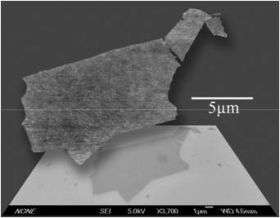
Two overlapping images of the same graphene sheet produced by hydrazine reduction; the top image was produced using atomic force microscopy, while the bottom was produced with scanning electron microscopy. This is the first reported instance of a graphene sheet being large enough for both tests to be run on the same specimen. (Image credit: Vincent Tung, Matthew Allen, Adam Stieg)

(PhysOrg.com) -- Graphene is a perfect example of the wonders of nanotechnology, in which common substances are scaled down to an atomic level to uncover new and exciting possibilities.

Graphene is created when graphite — the mother form of all graphitic carbon, which is used to make the pigment that allows pencils to write on paper — is reduced down to a one-atom-thick sheet. Graphene is among the strongest materials known and has an attractive array of benefits. These sheets — single-layer graphene — have potential as electrodes for solar cells, for use in sensors, as the anode electrode material in lithium batteries and as efficient zero-band-gap semiconductors.

Research on graphene sheets has been restricted, though, due to the difficulty of creating single-layer samples for use in experiments. But in a study published online Nov. 9 in the journal Nature Nanotechnology, researchers from UCLA's California NanoSystems Institute (CNSI) propose a method which can produce graphene sheets in large quantities.

Led by Yang Yang, a professor of materials science and engineering at the UCLA Henry Samueli School of Engineering, and Richard Kaner, a UCLA professor of chemistry and biochemistry, the researchers developed a method of placing graphite oxide paper in a solution of pure hydrazine (a chemical compound of nitrogen and hydrogen), which reduces the graphite oxide paper into single-layer graphene.

Such methods have been studied by others, but this is the first reported instance of using hydrazine as the solvent. The graphene produced from the hydrazine solution is also a more efficient electrical conductor. Field-effect devices display output currents three orders of magnitude higher than previously reported using chemically produced graphene.
Kaner and Kang's co-authors on the research were doctoral students Vincent Tung, from Yang's lab, and Matthew Allen, from Kaner's lab.

"We have discovered a route toward solution processing of large-scale graphene sheets," Tung said. "These breakthroughs represent the future of graphene nanoelectronic research."

The coverage of the graphene sheets can be controlled by altering the concentration and composition of the hydrazine solution. This hydrazine method also preserves the integrity of the sheets, producing the largest-area graphene sheet yet reported, 20 micrometers by 40 micrometers. A micrometer is one-millionth of a meter, while a nanometer is one billionth of a meter.

"These graphene sheets are by far the largest produced, and the method allows great control over deposition," Allen said. "Chemically converted graphene can now be studied in depth through a variety of electronic tests and microscopic techniques not previously possible."

"Interdisciplinary research of this sort is a benefit of collaborative institutes like the CNSI," said Kaner, who is also an associate director of the CNSI. "Graphene is a cutting-edge nanomaterial and one which has great potential to revolutionize electronics and many other fields."

There are two methods currently used for graphene production — the drawing method and the reduction method, each with its own drawbacks. In the drawing method, layers are peeled off of graphite crystals until one is produced that is only one-atom thick. When likely graphene suspects are identified from the peeled layers, they must be extensively studied to conclusively prove their identity. In the reduction method, silicon carbide is heated to high temperatures (1100° C) to reduce it to graphene. This process produces a small sample size and is unlikely to be compatible with fabrication techniques for most electronic applications.

"This technology (hydrazine reduction) utilizes a true solution process for graphene, which can dramatically simplify preparing electronic devices," said Yang, who is also faculty director of the Nano Renewable Energy Center at the CNSI. "It thus holds great promise for future large-area, flexible electronics."

Source: University of California - Los Angeles

4.4 /5 (30 votes)  

Filter


Move the slider to adjust rank threshold, so that you can hide some of the comments.


Display comments: newest first

ChemEng
Nov 11, 2008

Rank: not rated yet
Using hydrazine to reduce graphene oxide has been known for quite some time. Most people however use it in a mixture with an alcohol or water due to safety issues with hydrazine.
Mercury_01
Nov 16, 2008

Rank: not rated yet
hydrazine dissolved my testicles and upper respiratory tract.
NeilFarbstein
Dec 07, 2008

Rank: 1 / 5 (1)
Another overexaggeration! Don't call 20 micrometer pieces of graphene mass production. They are incredible. There is no way you can produce standardized electronic chips from irregularly shaped and irregularly sized flakes of graphene.
Rank 4.4 /5 (30 votes)
Tags

Relevant PhysicsForums posts

More news stories

New kind of solar cell could capture significantly more energy than current cells

New solar cells could increase the maximum efficiency of solar panels by over 25%, according to scientists from the University of Cambridge.

Nanotechnology / Nanophysics

created 4 hours ago | popularity 4.8 / 5 (5) | comments 9 | with audio podcast

Revealing how a battery material works

Since its discovery 15 years ago, lithium iron phosphate (LiFePO4) has become one of the most promising materials for rechargeable batteries because of its stability, durability, safety and ability to deliver ...

Nanotechnology / Nanomaterials

created 9 hours ago | popularity 5 / 5 (4) | comments 0 | with audio podcast

'Shish kebab' structure provides improved form of 'buckypaper'

Scientists are reporting development of a new form of buckypaper, which eliminates a major drawback of these sheets of carbon nanotubes -- 50,000 times thinner than a human hair, 10 times lighter than steel, ...

Nanotechnology / Nanomaterials

created 2 hours ago | popularity not rated yet | comments 0 | with audio podcast

Will bubble-powered microrockets zoom through the human stomach?

Scientists have developed a new kind of tiny motor — which they term a "microrocket" — that can propel itself through acidic environments, such as the human stomach, without any external energy source, ...

Nanotechnology / Nanomaterials

created 3 hours ago | popularity not rated yet | comments 0

Nanoshell whispering galleries improve thin solar panels

Visitors to Statuary Hall in the U.S. Capitol Building may have experienced a curious acoustic feature that allows a person to whisper softly at one side of the cavernous, half-domed room and for another on ...

Nanotechnology / Nanomaterials

created Feb 07, 2012 | popularity 4.2 / 5 (5) | comments 6 | with audio podcast


Short fasting cycles work as well as chemotherapy in mice

Man may not live by bread alone, but cancer in animals appears less resilient, judging by a study that found chemotherapy drugs work better when combined with cycles of short, severe fasting.

Gene therapy for inherited blindness succeeds in patients' other eye

Gene therapy for congenital blindness has taken another step forward, as researchers further improved vision in three adult patients previously treated in one eye. After receiving the same treatment in their ...

Physicists build highly efficient 'no-waste' laser

A team of University of California, San Diego researchers has built the smallest room-temperature nanolaser to date, as well as an even more startling device: a highly efficient, "thresholdless" laser that ...

Study shows how DNA finds its match

It's been more than 50 years since James Watson and Francis Crick showed that DNA is a double helix of two strands that complement each other. But how does a short piece of DNA find its match, out of the millions ...

Transparent iron? For the first time, an experiment shows that atomic nuclei can become transparent

At the high-brilliance synchrotron light source PETRA III, a team of DESY scientists headed by Dr. Ralf Röhlsberger has succeeded in making atomic nuclei transparent with the help of X-ray light. At the ...

'Explorers,' who embrace the uncertainty of choices, use specific part of cortex

Life shrouds most choices in mystery. Some people inch toward a comfortable enough spot and stick close to that rewarding status quo. Out to dinner, they order the usual. Others consider their options systematically ...