Females compensate for unattractive partners
November 10th, 2008 Females compensate for unattractive partners

Enlarge

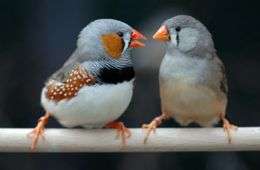
The zebra finch forms long-term pair bonds. Female zebra finches pull out all the stops to compensate for the shortcomings of unattractive partners. Image: Max Planck Institute for Ornithology

(PhysOrg.com) -- Attractive males promise quality offspring. Most female birds therefore invest a lot of energy in their attempts to breed with attractive partners. Not so the female zebra finch. If they have unattractive male partners, the females lay particularly big eggs that contain a lot of nutrients. Because the finch pairs stay together for their entire lifespan, the female has no reason to save up resources for a subsequent and better partner. The low genetic quality of the male is compensated for by good egg quality, as discovered by the scientists at the Max Planck Institute for Ornithology in Seewiesen.

Female birds usually breed several times over the course of their lives. At each breeding attempt they face the question as to what level of resources they should invest in the process. The genetic quality of their breeding partners plays an important role here as attractiveness is associated with the promise of healthy offspring. If the male bird is particularly attractive, the females summon up a particularly high level of energy for their breeding attempts. As a result, the eggs are relatively large or contain a particularly high level of nutrients like carotenoids, for example.

However, as the scientists at the Max Planck Institute for Ornithology in Seewiesen have discovered, in the case of zebra finches, the opposite approach can also be advantageous. The explanation for this lies in the way in which zebra finches live together: the couples usually remain together for their entire lifespan and are, therefore, monogamous. Thus, it does not pay for the females to economize with their resources as there is little likelihood that they will team up with a real "superman" for their next breeding attempt.

In order to find this out, Elisabeth Bolund in Seewiesen paired females with two different males at intervals of four months. One of the males was known to the researchers to be particularly attractive from previous experiments, while the other was viewed as particularly unattractive. Attractive males had other "affairs" in addition to their relationships with their "permanent" partners - and thus fathered significantly more offspring.

When a female was placed in a cage with an unattractive male, she laid particularly large eggs with more contents than the egg she laid when paired with a highly attractive male. Thus, in the experiment, the female zebra finches pulled out all the stops for the unattractive males: "The offspring require more ‘seed capital’ as the partner does not provide as much quality," explains Elisabeth Bolund. "The female tries to compensate for the deficits her male partner brings to the long-term pair bond." Similar behaviour has already been observed among other bird species, for example the house finch (Carpodacus mexicanus), which also belongs to the finch family.

Citation: Elisabeth Bolund, Holger Schielzeth and Wolfgang Forstmeier, Compensatory investment in zebra finches: females lay larger eggs when paired to sexually unattractive males, Proceeding of the Royal Society B, November 5th, 2008; doi:10.1098/rspb.2008.1251

Provided by Max Planck Institute for Ornithology


print this article email this article download pdf blog this article bookmark this article     Digg this Stumble it share on Facebook share on Reddit add to delicious save to Yahoo! bookmarks
4.3/5 after 15 votes


November 10th, 2008 all stories
Biology /

Comments: 0
Rank: 4.3/5 after 15 votes

  • Stumble this up

  • Digg this

  • Share it:
  • share on Facebook
  • share on MySpace
  • share on Slashdot
  • rss-newsfeed
  • share on Google
  • share on Reddit
  • add to delicious
  • save to Yahoo! bookmarks
  • share on Windows Live
  • Add to Mixx!
Rating: 4.3/5 after 15 votes


  • Physicists Demonstrate Quantum Memory with Matter Qubits
    Physicists Demonstrate Quantum Memory with Matter Qubits
    Physics / General Physics
    created Jul 03, 2009 | popularity 4.4 / 5 (17) | comments 1
  • 'Holey' Nanosheets for Wastewater Dye Removal
    Nanotechnology / Nanomaterials
    created Jul 01, 2009 | popularity 5 / 5 (5) | comments 1
  • Jellyfish Robot Swims Like its Biological Counterpart
    Jellyfish Robot Swims Like its Biological Counterpart
    Electronics / Robotics
    created Jun 26, 2009 | popularity 4.4 / 5 (8) | comments 1
  • Could Maxwell's Demon Exist in Nanoscale Systems?
    Could Maxwell's Demon Exist in Nanoscale Systems?
    Physics / General Physics
    created Jun 24, 2009 | popularity 4.4 / 5 (18) | comments 29
  • Living Safely with Robots, Beyond Asimov's Laws
    Living Safely with Robots, Beyond Asimov's Laws
    Electronics / Robotics
    created Jun 22, 2009 | popularity 4.6 / 5 (53) | comments 40
  • Other News

    Battle of the sexes benefits offspring, says research

    Battle of the sexes benefits offspring, says research

    Biology / Plants & Animals

    created 1hour ago | popularity not rated yet | comments 0

    Parents compensate for a lazy partner by working harder to bring up their offspring, but not enough to completely make up for the lack of parenting, says research by bird biologists at the University of Bath.


    Researchers uncover the potential for super-sized abalone

    Biology / Microbiology

    created 5 hours ago | popularity not rated yet | comments 0

    (PhysOrg.com) -- Designer abalone could be an option in the foreseeable future, thanks to a project conducted at UQ's Heron Island Research Station and the St Lucia campus.


    Scientists 'rebuild' giant moa using ancient DNA

    Biology / Plants & Animals

    created Jul 01, 2009 | popularity 5 / 5 (10) | comments 12

    (PhysOrg.com) -- Scientists have performed the first DNA-based reconstruction of the giant extinct moa bird, using prehistoric feathers recovered from caves and rock shelters in New Zealand.


    Pacific Giant Salamander (Dicamptodon tenebrosus)

    Salamanders, regenerative wonders, heal like mammals, people

    Biology / Microbiology

    created Jul 01, 2009 | popularity 5 / 5 (20) | comments 11

    The salamander is a superhero of regeneration, able to replace lost limbs, damaged lungs, sliced spinal cord -- even bits of lopped-off brain. But it turns out that remarkable ability isn't so mysterious after ...


    California water plan aims to save Puget Sound orcas

    Biology / Ecology

    created 21 hours ago | popularity 4 / 5 (1) | comments 0

    A plan to restore salmon runs on California's Sacramento River also could help revive killer whale populations 700 miles to the north in Puget Sound, as federal scientists struggle to protect endangered species in a complex ...