The Sun Shows Signs of Life
November 10, 2008 The Sun Shows Signs of Life

Enlarge

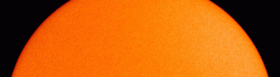
New-cycle sunspot group 1007 emerges on Halloween and marches across the face of the sun over a four-day period in early November 2008. Credit: the Solar and Heliospheric Observatory (SOHO).

After two-plus years of few sunspots, even fewer solar flares, and a generally eerie calm, the sun is finally showing signs of life. "I think solar minimum is behind us," says sunspot forecaster David Hathaway of the NASA Marshall Space Flight Center.

His statement is prompted by an October flurry of sunspots. "Last month we counted five sunspot groups," he says. That may not sound like much, but in a year with record-low numbers of sunspots and long stretches of utter spotlessness, five is significant. "This represents a real increase in solar activity."

Even more significant is the fact that four of the five sunspot groups belonged to Solar Cycle 24, the long-awaited next installment of the sun's 11-year solar cycle. "October was the first time we've seen sunspots from new Solar Cycle 24 outnumbering spots from old Solar Cycle 23. It's a good sign that the new cycle is taking off."

Old Solar Cycle 23 peaked in 2000 and has since decayed to low levels. Meanwhile, new Solar Cycle 24 has struggled to get started. 2008 is a year of overlap with both cycles weakly active at the same time. From January to September, the sun produced a total of 22 sunspot groups; 82% of them belonged to old Cycle 23. October added five more; but this time 80% belonged to Cycle 24. The tables have turned.

At first glance, old- and new-cycle sunspots look the same, but they are not. To tell the difference, solar physicists check two things: a sunspot's heliographic latitude and its magnetic polarity. (1) New-cycle sunspots always appear at high latitude, while old-cycle spots cluster around the sun's equator. (2) The magnetic polarity of new-cycle spots is reversed compared to old-cycle spots. Four of October's five sunspot groups satisfied these two criteria for membership in Solar Cycle 24.

The biggest of the new-cycle spots emerged at the end of the month on Halloween. Numbered 1007, or "double-oh seven" for short, the sunspot had two dark cores each wider than Earth connected by active magnetic filaments thousands of kilometers long. Amateur astronomer Alan Friedman took this picture from his backyard observatory in Buffalo, New York:

On Nov. 3rd and again on Nov. 4th, double-oh seven unleashed a series of B-class solar flares. Although B-flares are considered minor, the explosions made themselves felt on Earth. X-rays bathed the dayside of our planet and sent waves of ionization rippling through the atmosphere over Europe. Hams monitoring VLF radio beacons noticed strange "fades" and "surges" caused by the sudden ionospheric disturbances.

Hathaway tamps down the excitement: "We're still years away from solar maximum and, in the meantime, the sun is going to have some more quiet stretches." Even with its flurry of sunspots, the October sun was mostly blank, with zero sunspots on 20 of the month's 31 days.

But it's a start. Stay tuned for solar activity.

Source: Science@NASA, by Dr. Tony Phillips


print this article email this article download pdf blog this article bookmark this article     Stumble it Digg this share on Facebook retweet share on Reddit add to delicious
Rate this story - 4.4 /5 (28 votes)

Rank Filter

Move the slider to adjust rank threshold, so that you can hide some of the comments.


Display comments: newest first

  • E_L_Earnhardt - Nov 11, 2008
    • Rank: 1 / 5 (1)
    That's a relief! (I think!)! Beach gowers can now expect more skin cancers, but the Dermatologist can get rid of them with Liquid Nitrogen freezing! Too bad they are not allowed to use this "sure cure" a little deeper!

November 10, 2008 all stories

Comments: 1

4.4 /5 (28 votes)
  • Stumble this up

  • Digg this

  • share this

  • hide
  • Related Stories

  • A lightning strike in Africa helps take the pulse of the sun
    created Nov 11, 2009 | popularity not rated yet | comments 0
  • The Sun's Sneaky Variability
    created Oct 28, 2009 | popularity not rated yet | comments 0
  • EVE: Measuring the Sun's hidden variability
    created Sep 22, 2009 | popularity not rated yet | comments 0
  • Solar Cycle Driven by More than Sunspots
    created Sep 17, 2009 | popularity not rated yet | comments 0
  • Are Sunspots Disappearing?
    created Sep 03, 2009 | popularity not rated yet | comments 0


  • hide
  • Relevant PhysicsForums posts

  • Sideral question
    created 16 hours ago
  • Doppler shifted blackbody spectrum
    created 19 hours ago
  • Earth v. Moon
    created 21 hours ago
  • help me with coordinates and orbits
    created 21 hours ago
  • More from Physics Forums - General Astronomy

Other News

Astronauts finish another spacewalk, still no baby (AP)

Astronauts finish another spacewalk, still no baby

Space & Earth / Space Exploration

created 7 hours ago | popularity 3 / 5 (2) | comments 0

(AP) -- A spacewalking astronaut put aside the impending birth of his daughter and blazed through his first-ever venture outside the International Space Station on Saturday.


Unseasonably hot and dry weather combined with strong winds to fan scores of blazes in the country's southeastern states

Australia issues 'catastrophic' alerts as fires rage

Space & Earth / Environment

created 14 hours ago | popularity 4.5 / 5 (2) | comments 0

Australia has issued "catastrophic" alerts after record-breaking temperatures and wild lightning storms sparked more than 100 fires across the country, officials said Saturday.


Commuters wait on the platform shrouded by fog in London

Climate change not man-made, say majority of Britons: poll

Space & Earth / Environment

created Nov 15, 2009 | popularity 3.3 / 5 (15) | comments 46

Less than half of Britons believes that human activity is to blame for global warming, according to a poll carried out for The Times newspaper and published on Saturday.


Mysteriously warm times in Antarctica

Mysteriously warm times in Antarctica

Space & Earth / Earth Sciences

created Nov 18, 2009 | popularity 4.2 / 5 (21) | comments 28

(PhysOrg.com) -- A new study of Antarctica's past climate reveals that temperatures during the warm periods between ice ages (interglacials) may have been higher than previously thought. The latest analysis ...


UN: Fight climate change with free condoms (AP)

UN: Fight climate change with free condoms

Space & Earth / Environment

created Nov 18, 2009 | popularity 3.1 / 5 (11) | comments 24

(AP) -- The battle against global warming could be helped if the world slowed population growth by making free condoms and family planning advice more widely available, the U.N. Population Fund said Wednesday.