CU-Boulder to launch butterfly, spider K-12 experiments Nov. 14 on space shuttle
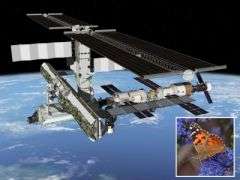
A NASA space shuttle mission carrying a University of Colorado at Boulder payload of web-spinning spiders and wannabe butterflies will be closely monitored by hundreds of K-12 students from Colorado's Front Range after Endeavour launches from Florida for the International Space Station Nov. 14.
The two educational experiments flying on Endeavour were designed and built at CU-Boulder's BioServe Space Technologies, said BioServe Director Louis Stodieck, principal investigator on the project. One will be used to compare how "space" spiders differ from Earth spiders in web spinning and feeding. The second experiment will chart the life cycle of butterflies in the low gravity of space -- from larvae to pupa to butterfly to egg -- and compare it with that of earthbound butterflies, said Stodieck.
This will be the third shuttle flight of BioServe's K-12 educational program known as CSI, which "brings actual space flight experiments into the K-12 classroom," said Stodieck, a faculty member in CU-Boulder's aerospace engineering sciences department, home of BioServe. "This program is an excellent example of using a national asset like the International Space Station to inspire K-12 students in science, technology, engineering and math."
More than a dozen middle schools from Colorado's Front Range will be participating in the educational project, including schools in the Denver Public School system and the St. Vrain Valley School District, said BioServe Payload Mission Manager Stefanie Countryman. Several Texas middle schools also will be participating, she said.
BioServe will downlink video, still images and data from the space station to its educational partners, including the Denver Museum of Nature and Science, the Butterfly Pavilion in Westminster, Colo., and the Baylor College of Medicine's Center for Education Outeach.
Baylor has provided participating schools with a teacher's guide containing lesson plans and classroom activities featuring butterflies and spiders, said Countryman. A training session for participating teachers was held Nov. 8 at the Denver Museum of Nature and Science in partnership with the Butterfly Pavilion in Westminster.
The objective of the first experiment is to achieve one full life cycle for painted lady butterflies in the microgravity of space and compare it to a life cycle of the butterfly in normal, Earth-bound conditions in the classrooms, said Countryman. The experiments in space and Earth will begin with four-day-old larvae and include provisions of nectar for butterflies emerging from the pupa stage into adulthood.
The second objective is to compare the ability of an orb-weaving spider to spin webs and catch food in the nearly weightless environment of space and compare it to orb-weaving spiders performing those tasks on Earth, Countryman said. The spiders will be provided with live fruit flies and water to sustain them during the experiments.
The CU payload is made up of habitats designed by BioServe to house the spiders and the butterflies, said Countryman, also BioServe's business development manager. The experiments will fly on BioServe's Commercial Generic Bioprocessing Apparatus, or CGBA, a suitcase-sized payload that has been used to carry out BioServe experiments in space since the early 1990s.
BioServe also has been working closely with science advisers on the project, including Denver Museum Invertebrate Zoology Curator Paula Cushing, Curator Mary Ann Hamilton from the Butterfly Pavilion in Westminster and Mark Stowe, a spider expert and mission spider supplier from Gainesville, Fla. Ken Werner of Gulf Cast Butterflies in Naples, Fla., supplied BioServe with the butterfly larvae for the Endeavour flight.
BioServe flew two educational CSI payloads on shuttle missions in 2006 and 2007 that reached more than 10,000 students around the world, according to Stodieck.
BioServe payloads -- including biomedical and life science experiments conducted in conjunction with industrial partners -- have been manifested on every shuttle flight until the space shuttle program is retired in 2011. "Between now and then, we are seeking sponsors for our educational payloads to enhance the learning opportunities for the K-12 community in Colorado and around the world," said Countryman.
Source: University of Colorado at Boulder


