New Research on Darwin's Finches Offers Rare Glimpse Into How Species Diverge
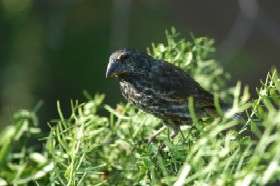
(PhysOrg.com) -- Some of the latest research on Darwin’s finches of the Galapagos Islands shows an unexpected pattern of natural selection that is allowing researchers “a rare glimpse into what the early stages of speciation might look like,” and emphasizing the central role of environmental conditions, according to Jeff Podos, a behavioral ecologist at the University of Massachusetts Amherst. Speciation refers to the way new species arise from a common ancestor.
An expert in bird song, mating behavior and their relationship to evolution, Podos is one of a handful of researchers who still study the role of environmental factors in evolution among the island finches made famous by Charles Darwin. His research team included UMass Amherst colleagues who are now at other institutions – OEB Darwin fellow Andrew Hendry of McGill University and Sarah Huber of Randolph Macon College. Their paper appears in the current issue of Proceedings of the Royal Society.
“Up to now,” says Podos, “scientists have speculated and made predictions about how we might explain the rise of different species in the same geographic area from a common ancestor, or sympatrically, but it’s rare to actually be able to watch a population as it pulls apart. In our study on Santa Cruz, we’re seeing some situations that fit the predictions. Witnessing this dynamic tug of war among environmental factors is very exciting.”
Normally, for a given trait, bird populations are unimodal. That is, there’s one central point of most common beak size, for example, where most individuals are grouped (the mode) and there are fewer at each edge. Further, natural selection on a trait is typically stabilizing or directional. The textbook example of directional selection is beak size: Large-beaked Darwin’s finches may enjoy an advantage over medium- and small-beaked ones because they can eat thicker-husked seeds, enhancing survival and reproductive success in only one direction.
A less common form of natural selection, called disruptive, may occur when there are two modes in a single distribution, such as both large and small beaks A bimodal pattern is of intense interest to biologists because it sometimes represents the early stages of a population splitting into multiple descendent species, helping to generate biodiversity.
However, disruptive selection has rarely been observed in nature, especially between modes within a single population at a given site. This pattern has now been observed by Podos and colleagues, who unexpectedly encountered it in two beak size modes of medium ground finches on Santa Cruz Island in the Gal?pagos archipelago off the coast of Ecuador.
The three-year study that began in 2004 was conducted at a dry forest site known as El Garrapatero. In the first season, Podos and colleagues caught hundreds of finches in mist nets during the spring, measured their beak size, banded and released them. At this time they noted a strong pattern of bimodality, one peak in numbers of large-beaked and one in small-beaked birds, although “there were plenty of individuals with intermediate-size beaks as well,” Podos points out.
During the next two years, he and colleagues recaptured as many of the original birds as possible in the same area. They noted a fairly sharp decline in the number of intermediate-beaked birds, whereas birds with small or large beaks had survived and stayed on site. Rainfall was extremely low throughout the study period and competition for seeds was unusually high, Podos notes, which intensified the selective pressure on these birds.
Because of the unusually severe drought, the authors note that high mortality in the population may have been due to low seed production. Nevertheless, their data clearly suggest that in times of high environmental stress, birds in the middle of the distribution of a trait linked to fitness faced a disadvantage, probably because they were competing for limited food against individuals better equipped to access that food. By contrast, competition was less intense and survival higher for individuals at the edges of the trait distribution, according to Podos’ and colleagues’ findings.
The behavioral ecologist points out that this process has been known to change in the other direction; one species can emerge where once there had been two, if environmental factors press in that direction. Thus Podos and colleagues have not necessarily witnessed the birth of a new finch species at El Garrapatero. In wetter years with more abundant food, selection may be less intense and medium-beaked populations may rebound. But the researchers suggest that understanding the relative strength of disruptive selection in different environmental directions could provide key insights into the speciation process.
Provided by University of Massachusetts Amherst


