Optical illusions: caused by eye or brain?
November 11, 2008 By Lisa Zyga feature
Optical illusions: caused by eye or brain?

Enlarge

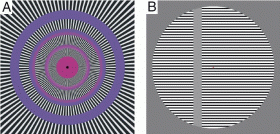
(Left) Isia Leviant’s Enigma. Most viewers say the purple rings appear to fill with rapid illusory motion. (Right) A simplified version that the researchers used in the study. Most viewers report illusory motion lengthwise along the gray stripe. Image credit: Xoana G. Troncoso, et al. ©2008 PNAS.

When viewing the famous optical illusion painting Enigma by Isia Leviant, many people claim to see motion within the colored circles moving against the black and white striped background. Although this optical illusion has been known for a long time, its physiological origins are still unknown.

For the past 200 years, researchers have debated whether the illusion of motion in a static image is caused by mechanisms in the eye, in the brain, or by a combination of both. Because measuring these kinds of physiological responses is difficult, no study has successfully measured direct and tightly timed correlations between a kinetic illusion and a physiological precursor.

But recently, a team of researchers from the Barrow Neurological Institute in Phoenix, Arizona, and the University of Vigo in Vigo, Spain, has found a direct correlation between illusory motion and microsaccades, which are tiny eye movements that involuntarily occur several times per second during visual fixation. Although the team hasn’t determined the neural mechanism behind the correlation, the finding rules out the hypothesis that the origin of the kinetic optical illusion is purely cortical.

“These results revealed a direct link between the eye motions and the perception of illusory motion, and ruled out the hypothesis that the Enigma illusion originates solely in the brain,” Susana Martinez-Conde, Director of the Laboratory of Visual Neuroscience at the Barrow Neurological Institute, told PhysOrg.com. “Our study provides a possible explanation for an entire family of visual illusions central to the fields of visual art and visual science. It would be quite unexpected if Enigma turned out to be the only motion illusion affected by eye movements.”

In tests, the researchers tracked subjects’ eye positions with a video-based eye movement monitor, while asking the subjects to release a button when they perceived fast movement, and press the button when they perceived slow to no movement (no illusion). The results showed that microsaccade rates increased shortly before subjects reported seeing fast movement. Conversely, microsaccade rates decreased shortly before subjects reported seeing slower movement.

These findings show a direct correlation between microsaccades and the perception of illusory motion, but the researchers also wanted to know if microsaccades might actually cause the illusion. To investigate this possibility, the team tested an alternative hypothesis: that, rather than microsaccades causing the illusion, the illusion causes both the microsaccades and subjects’ perceived illusory motion (reported by pressing and releasing the button).

In this control test, subjects were shown real moving images and asked to indicate changes in motion. Results from the eye movement monitor showed that, unlike when viewing the static images, subjects’ microsaccade rates did not increase before transitions to faster movement, nor did microsaccade rates decrease before transitions to slower movement. Further, microsaccade rates actually decreased after a change in motion, whether faster or slower. These findings show that perceptual motion changes do not cause changes in microsaccade rate, answering the first part of the alternative hypothesis.

From this data, the researchers could also determine the time delay between the actual change in motion and the subjects’ reported change in motion, which was about 520 microseconds. Because the measured changes in microsaccade rates occurred about 740 microseconds before this reported change, the researchers concluded that microsaccades may potentially drive the illusion, but not the other way around.

If microsaccades do indeed drive the Enigma illusion, future research will still need to investigate whether the cause is direct or indirect, and what neural mechanisms may be at its root. In previous studies, researchers have proposed a few possibilities based on the idea of “phi movement,” which is the illusion of apparent motion caused by switching off one stimulus and immediately turning on another in close proximity.

For example, microsaccades may cause parts of the image to shift, which could cause the black and white lines to continuously reverse, resulting in phi movement. Another possibility is that microsaccades may displace after-images of the black and white stripes, also causing phi movement. A more complex eye-brain explanation is also possible, and the researchers will continue investigating this intriguing illusion.

By learning more about how optical illusions work, Martinez-Conde and her colleagues hope to understand more about the brain, and how it creates our sensory reality.

“Visual illusions are defined by the dissociation between physical reality and subjective perception of an object or event,” she said. “When we experience a visual illusion, we may see something that is not there, or fail to see something that is there, or even see something different from what is there. Because of this dissociation between perception and reality, visual illusions demonstrate the ways in which the brain can fail to recreate the physical world. By studying these failings, we can learn about the computational methods that the brain uses to construct visual experience. Presently, one of the most important tools used by neuroscientists to understand how the brain creates its sense of reality is the visual illusion.

“The findings from our recent study may moreover help us to understand the neural mechanisms underlying motion perception, both in the normal brain, and in patients with brain lesions that affect the perception of motion,” she said. “Also, they could help design future neural prosthetics for patients with brain damage.”

More information: Troncoso, Xoana G.; Macknik, Stephen L.; Otero-Millan, Jorge; and Martinez-Conde, Susana. “Microsaccades drive illusory motion in the Enigma illusion.” Proceedings of the National Academy of Sciences, October 14, 2008, vol. 105, no. 41, 16033-16038.

Copyright 2008 PhysOrg.com.
All rights reserved. This material may not be published, broadcast, rewritten or redistributed in whole or part without the express written permission of PhysOrg.com.

4.1 /5 (80 votes)  

Filter


Move the slider to adjust rank threshold, so that you can hide some of the comments.


Display comments: newest first

magpies
Nov 11, 2008

Rank: 1 / 5 (6)
Dude I'll go ask my mind something useful now thanks...
velvetpink
Nov 12, 2008

Rank: 1 / 5 (5)
And you have found nothing!No! You havent even found nothing!
velvetpink
Nov 12, 2008

Rank: 1 / 5 (5)
And to visualize your process it looks like this.

http://www.instab...e_69.jpg
velvetpink
Nov 12, 2008

Rank: 1 / 5 (5)
Hey definitionists and what is time anyway if numbers posses no universal meanings?
velvetpink
Nov 12, 2008

Rank: 1 / 5 (5)
And to visualize your process it looks like this.

http://www.instab...e_69.jpg


And sorry your process is not eco yet!I must have missed the type of the machine.Sorry.
velvetpink
Nov 12, 2008

Rank: 1 / 5 (5)
Hey definitionists and what is time anyway if numbers posses no universal meanings?


And how can you say you were debating if there is no time?And if there is time is your debating included in your time definition?Are all your codes included in time definition?How come some then dont fit together?Is religious god included in your time definition?It should be. But maybe is it your whole time definition that is not important? What is important anyway?Money?I guess money is the most important. If so have you included money in your time definition? You should. But if so the best your existance can be is just a part of time definition. So are you trying to tell me that you are trying to explain a time definition with a part of the same time definition? If so Thank you.
rubberman
Nov 13, 2008

Rank: 3 / 5 (2)
I think you might have looked at the picture for a bit too long there VP.....
velvetpink
Nov 13, 2008

Rank: 1 / 5 (5)
Might be. But i bet everything i have that you dont understand a single word you are saying.
velvetpink
Nov 13, 2008

Rank: 1 / 5 (5)
Or it would be nice if you try to prove me that you do?
velvetpink
Nov 13, 2008

Rank: 1 / 5 (5)
And i have one question also for you. You think equation exist universally?
velvetpink
Nov 13, 2008

Rank: 1 / 5 (5)
I think...


And you care to explain me what thinking process is universally?If not, then im not sure what are you trying to tell me that you think.
velvetpink
Nov 13, 2008

Rank: 1 / 5 (6)
And if your thinking process is the same as mine(as if you would know what it is or as if its already defined) how come we are not thinking the same then?
legendsaber
Nov 13, 2008

Rank: not rated yet
velvetpink, don't you have anything better to do than spend an entire morning spamming an Internet article? Seriously, get a girl/boyfriend and start living a little.
velvetpink
Nov 13, 2008

Rank: 1 / 5 (5)
And dont you have anything more interesting to say?So you just came here to help me prove my point?If so thank you. And dont worry for my life too much.I was born dead anyway.And may you have a great life my friend and dont care too much cause it may harm your beauty.
velvetpink
Nov 13, 2008

Rank: 1 / 5 (5)
And why you reading anyway if you arent interested in my words.So you really think you are totally controlling your body?Oh no!You thought you are controlling the universe with your mind?Hehe.Not so fast my lovely little humans.There is a long long way to go.And this planet was not made for that way anyway so just keep pushing, your own destruction.Congratultions.
Noumenon
Nov 15, 2008

Rank: 5 / 5 (25)
Typical GW nut case.
Ivan2
Nov 17, 2008

Rank: 2 / 5 (1)
The optical illusion above is probably caused by heat in the eyeballs that becomes an interference in an electrical process. To be certain I would have to remember to look at it again when I have walked outside for a long time in freezing weather. Unfortunately, I am not too likely to remember it any time soon... and I don't walk in the cold.

However, some other concentric illusions are likely caused by the movement of the vitreous humour affecting the hyaloid canal. The hyaloid canal is where external light input from the eye is concentrated by the lenses and is turned into electrical processing from the original light input.

Does that check?
Rank 4.1 /5 (80 votes)
Relevant PhysicsForums posts
  • Is Everyday Technology Killing Us?
    createdFeb 08, 2012
  • Exercise and weight loss
    createdFeb 08, 2012
  • Why do we have head aches? Our brains can't feel anything.
    createdFeb 07, 2012
  • "The end of diseases" by David Agus, interview from Daily Show with Jon Stewart
    createdFeb 04, 2012
  • Oncolytic adenovirus
    createdFeb 04, 2012
  • Nutrition label stuffs and diets
    createdFeb 02, 2012
  • More from Physics Forums - Medical Sciences

More news stories

Researchers develop gene therapy to boost brain repair for demyelinating diseases

(Medical Xpress) -- Our bodies are full of tiny superheroes—antibodies that fight foreign invaders, cells that regenerate, and structures that ensure our systems run smoothly. One such structure is myelin—a ...

Medicine & Health / Neuroscience

created 58 minutes ago | popularity not rated yet | comments 0 | with audio podcast

Study suggests use of managed care plan for uninsured may significantly reduce costs, ED visits

(Medical Xpress) -- The cost of caring for the uninsured population who will gain coverage through the Affordable Care Act of 2014 can be reduced by almost half once the act is implemented, according to a new study from Virginia ...

Medicine & Health / Health

created 1 hour ago | popularity not rated yet | comments 0

'Do your best' not a good enough goal to improve diabetes diet

(Medical Xpress) -- A specific goal to eat a set number of daily servings of low-glycemic-index foods can improve dietary habits of people with Type 2 diabetes, according to new research.

Medicine & Health / Health

created 1 hour ago | popularity not rated yet | comments 0

Heavy lifting for cancer research

Many patients with advanced cancer suffer from cachexia, a condition also called body-wasting or wasting syndrome, which causes significant weight loss, extreme fatigue and reduces quality of life.

Medicine & Health / Cancer

created 36 minutes ago | popularity not rated yet | comments 0

Rare subset of diseases involving the lymphatic system

A clinically challenging and under-studied subset of diseases affecting the lymphatic system and grouped under the disease spectrum lymphangiomatosis and Gorham's disease is the focus of a special issue of ...

Medicine & Health / Diseases

created 49 minutes ago | popularity not rated yet | comments 0


Tidal forces could squeeze out planetary water

Alien planets might experience tidal forces powerful enough to remove all their water, leaving behind hot, dry worlds like Venus, researchers said.

Google launches Chrome browser for Android smartphones

With more and more people connecting to the Internet through a phone or a tablet instead of a PC, Google Inc. is bringing its fast-growing browser, Chrome, to the newest Android-powered mobile devices.

Young stars at home in ancient cluster

(PhysOrg.com) -- Looking like a hoard of gems fit for an emperor's collection, this deep sky object called NGC 6752 is in fact far more worthy of admiration. It is a globular cluster, and at over 10 billion ...

NASA small explorer mission celebrates ten years and forty thousand X-ray flares

(PhysOrg.com) -- On February 5, 2002, NASA launched what was then called the High Energy Solar Spectroscopic Imager (HESSI) into orbit. Renamed within months as the Ramaty High Energy Solar Spectroscopic Imager ...

Some formerly cohabiting couples with children keep romantic relationship

(PhysOrg.com) -- When low-income cohabiting couples with children decide to no longer live together, that doesn’t necessarily mean the end of their romantic relationship.

Kodak to stop making cameras, digital frames

Kodak says it will stop making digital cameras, pocket video cameras and digital picture frames in order to focus on its more profitable businesses.