Fatty diet during pregnancy makes new cells in fetal brain that cause early onset obesity
November 11, 2008 Fatty diet during pregnancy makes new cells in fetal brain that cause early onset obesity

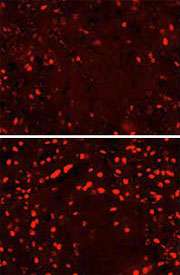
Food for thought. Offspring of rats fed a high-fat diet during pregnancy have more fat-sensitive neurons (bottom) than those whose mothers ate a balanced diet (top). Researchers say the fattier diet stimulates the generation of new neurons that cause the rat pups to overeat.

A study in rats shows that exposure to a high-fat diet during pregnancy produces permanent changes in the offspring's brain that lead to overeating and obesity early in life, according to new research by Rockefeller University scientists. This surprising finding, reported in the Nov. 12 issue of the Journal of Neuroscience, provides a key step toward understanding mechanisms of fetal programming involving the production of new brain cells that may help explain the increased prevalence of childhood obesity during the last 30 years.

"We've shown that short-term exposure to a high-fat diet in utero produces permanent neurons in the fetal brain that later increase the appetite for fat," says senior author Sarah F. Leibowitz, who directs the Laboratory of Behavioral Neurobiology at Rockefeller. "This work provides the first evidence for a fetal program that links high levels of fats circulating in the mother's blood during pregnancy to the overeating and increased weight gain of offspring after weaning."

Research in adult animals by Leibowitz and others has shown that circulating triglycerides stimulate brain chemicals known as orexigenic peptides, which in turn spur the animals to eat more. Scientists also have shown that obese and diabetic mothers produce heavier children and that exposure to fat-rich foods early in life leads to obesity in adulthood. These studies suggested that food intake and body weight may be programmed during fetal development. But little was known about the mechanism underlying this programming.

Leibowitz and her colleagues have identified mechanisms in the brain that explain this programming. They looked at the effects of feeding pregnant rats a high fat diet for two weeks compared with a balanced diet containing a moderate amount of fat. The researchers found that rat pups born to mothers who consumed the high fat diet, even after the diet had been removed at birth, ate more, weighed more throughout life, and began puberty earlier than those born to mothers who ate a balanced diet for the same two week period. They also had higher levels of triglycerides in the blood at birth and as adults and greater production of brain peptides that stimulate eating and weight gain.

Leibowitz and her colleagues then looked at the pups' brain development during the last week of pregnancy. They examined the number and types of neurons being born and made a surprising discovery: The pups from the mothers fed high fat diets had, in utero, a much larger number of neurons that produce the appetite-stimulating orexigenic peptides - and they kept them throughout their lives. During gestation, the mother's fat-rich diet also stimulated the proliferation of neuronal precursor cells and their differentiation and migration to obesity-promoting centers in the brain. In rats on a balanced diet, these neurons were much fewer in number and appeared much later after birth.

"We believe the high levels of triglycerides that the fetuses are exposed to during pregnancy cause the growth of the neurons earlier and much more than is normal," says Leibowitz.

The researchers hypothesize that because the mother must prepare her embryos to survive on her diet, they need to be born with the brain mechanisms that allow them to eat and metabolize it.

Leibowitz believes similar mechanisms may be operating in humans.

"We're programming our children to be fat," she says. "I think it's very clear that there's vulnerability in the developing brain, and we've identified the site of this action where new neurons are being born. We now need to understand how the lipids affect these precursor cells that form these fat-sensitive neurons that live with us throughout life."

Source: Rockefeller University


print this article email this article download pdf blog this article bookmark this article     Stumble it Digg this share on Facebook retweet share on Reddit add to delicious
Rate this story - 4.4 /5 (7 votes)

Rank Filter

Move the slider to adjust rank threshold, so that you can hide some of the comments.


Display comments: newest first

  • tkjtkj - Nov 15, 2008
    • Rank: not rated yet
    I fail to see *any* mention of any
    propensity of the baby animals to
    then become obese!

    Are my aging eyes failing me? Or
    is this more 'junk science'?

    If my observation is correct,that
    my point here is not addressed in
    the research article although it
    easily could have been, then one
    might be tempted toconclude that
    perhaps the experiment's designers
    intended to be incomplete. To say
    that "The pups from the mothers fed high fat diets had, in utero, a much larger number of neurons that produce the appetite-stimulating orexigenic peptides - and they kept them throughout their lives" might be
    interesting, but it does not
    touch the issue. I might just as
    well concluded from what's shown
    here that the pregnant rat eating
    fat caused her baby to have more
    brain cells!! Is that a good thing?
    We could never know! .. just as
    we cant know just what was the
    final outcome 'obesity-wise' for
    the progeny.

November 11, 2008 all stories

Comments: 1

4.4 /5 (7 votes)
  • Stumble this up

  • Digg this

  • share this

  • hide
  • Related Stories

  • Study shows how substance in grapes may squeeze out diabetes
    created Oct 15, 2009 | popularity not rated yet | comments 0
  • Vitamin C deficiency impairs early brain development
    created Sep 02, 2009 | popularity not rated yet | comments 0
  • Reduced diet thwarts aging, disease in monkeys
    created Jul 09, 2009 | popularity not rated yet | comments 0
  • Sleep helps build long-term memories
    created Jun 24, 2009 | popularity not rated yet | comments 0
  • Experimental Parkinson's therapy may have robust weight-loss effect
    created Mar 24, 2009 | popularity not rated yet | comments 0


  • hide
  • Relevant PhysicsForums posts

  • Improving the brain through chemistry
    created Nov 07, 2009
  • Sleep / REM Sleep and homeostasis
    created Nov 07, 2009
  • The Biceps Reflex
    created Nov 05, 2009
  • Consequenses of striking a Vein and an artery?
    created Nov 05, 2009
  • More from Physics Forums - Medical Sciences

Other News

Developmental delay could stem from nicotinic receptor deletion

Medicine & Health / Genetics

created 15 hours ago | popularity 4.5 / 5 (2) | comments 0

The loss of a gene through deletion of genetic material on chromosome 15 is associated with significant abnormalities in learning and behavior, said a consortium of researchers led by Baylor College of Medicine in a report ...


House passes health care bill on close vote (AP)

Landmark health bill passes House on close vote

Medicine & Health / Health

created 23 hours ago | popularity 3.8 / 5 (10) | comments 2

(AP) -- The Democratic-controlled House narrowly passed far-reaching health care legislation, handing President Barack Obama a hard-won victory on his chief domestic priority though the road ahead in the ...


Expanding drug treatment: Is US ready to step up? (AP)

Expanding drug treatment: Is US ready to step up?

Medicine & Health / Other

created 10 hours ago | popularity not rated yet | comments 0

(AP) -- Based on the rhetoric, America's war on drugs seems poised to shift into a more enlightened phase where treatment of addicts gains favor over imprisonment of low-level offenders. Questions abound, ...


Children who often drink full-fat milk weigh less

Medicine & Health / Health

created Nov 03, 2009 | popularity 5 / 5 (4) | comments 5

Eight-year-old children who drink full-fat milk every day have a lower BMI than those who seldom drink milk. This is not the case for children who often drink medium-fat or low-fat milk. This is one conclusion of a thesis ...


Turn On, Tune In, Develop?

Turn On, Tune In, Develop? Researchers Examine How Brain Benefits From Musical Training

Medicine & Health / Neuroscience

created Nov 06, 2009 | popularity 5 / 5 (11) | comments 4

For most people music is an enjoyable, although momentary, form of entertainment. But for those who seriously practiced a musical instrument when they were young, perhaps when they played in a school orchestra ...