Researchers show that plants can accumulate nanoparticles in tissues
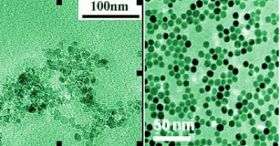
Researchers at the University of Delaware have provided what is believed to be the first experimental evidence that plants can take up nanoparticles and accumulate them in their tissues
The laboratory study, which involved pumpkin plants, indicates a possible pathway for nanoparticles to enter the food chain. The research also reveals a new experimental approach for studying nanoparticles and their potential impacts.
Yan Jin, professor of soil physics in the University of Delaware College of Agriculture and Natural Resources, and John Xiao, professor of physics and astronomy in the College of Arts and Sciences, led the study, working with colleagues Jung-youn Lee and Harsh Bais at the Delaware Biotechnology Institute, a premier research center at the University of Delaware.
The results were published in a cover article in the Journal of Environmental Monitoring and also were highlighted in Chemical Biology, a journal of the Royal Society of Chemistry.
Nanoparticles are bits of chemicals a thousand times smaller than a human cell. While nanoparticles occur naturally in the environment, they increasingly are being manufactured for use in electronics to cosmetics, fuel cells to medical procedures.
Yet the human and environmental health risks associated with these tiny engineered particles are not well known. Because chemical compounds can take on different properties at such a reduced size--lead in a pencil reportedly becomes stronger than steel, for example--there is concern that these invisible particles could easily be breathed in by humans and animals, with damaging or toxic effects.
"Plants serve as a foundation of the food chain," noted Jin, who was recently named a fellow of the Soil Society of America. "We demonstrated this possible route for nanoparticles in the environment--whether it poses potential harm to human health depends on many factors. This is a preliminary study, which we hope will spur additional interdisciplinary research by the scientific community."
The researchers chose pumpkins for the study, Jin said, because they take in a lot of water and are easy to grow.
The plants were grown hydroponically in an aqueous medium to which nanoparticles of iron oxide, or magnetite, a magnetic form of iron ore, were added.
After 20 days of growth, the plants were cut into pieces and dried in a vacuum dessicator. A magnetometer was then used to detect if any of the particles had been absorbed by the plant.
"Our study was a worst-case scenario in order to test the feasibility of our approach in being able to detect the particle," Xiao noted. "It really provides a new technique for doing this kind of research."
Xiao, who directs the Center for Spintronics and Biodetection at the University of Delaware, noted that the magnetometer used in his physics research is similar to magnetic resonance imaging (MRI), which uses a powerful magnetic field and radio-frequency pulses to produce images of internal structures in the human body.
The magnetometer subjected the dried pumpkin plants to a low-frequency monotone to vibrate them. The vibration revealed each tiny particle of magnetite's unique magnetic signal and, thus, exact location inside the plant.
The researchers noted that in their initial screening tests, no magnetic signals were detected in lima bean plants compared to the strong signals in pumpkin plants, which suggests that different plants have varied responses to nanosized particles.
Additionally, while the pumpkins were studied primarily in aqueous media, the researchers also tested the plants in sand to which nanoparticles were added, where there was little uptake, and in soil, where there was no uptake of nanoparticles at all, according to Jin.
Jin noted how important interdisciplinary collaboration has been to the research and said she hopes to see plant scientists and molecular biologists involved in future studies to see how nanoparticles actually get into plants.
"Some believe it is a passive process; others are convinced it is an active one," Jin said. "There could be whole other lines of research," she noted.
"It's like a saying we have in Chinese," Jin added. "You throw out a brick and hope to attract a jade."
The saying, which is a Chinese way of showing humility, demonstrates the speaker's hope that others will improve on an idea.
"We want to stress that our study is very preliminary, and we hope it will stimulate more research in this area," she said.
Source: University of Delaware


