Stem cells with potential to regenerate injured liver tissue identified
November 12, 2008 Liver Stem Cells

Enlarge

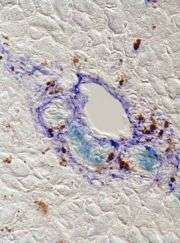
Liver stem cells expressing FoxL1 (aqua blue) in an injured mouse liver near the bile duct. The FoxL1-containing stem cells are encircled by liver fibroblasts (royal blue), suggestive of a stem cell niche. Credit: Linda Greenbaum, M.D., University of Pennsylvania School of Medicine

A novel protein marker has been found that identifies rare adult liver stem cells, whose ability to regenerate injured liver tissue has the potential for cell-replacement therapy. For the first time, researchers at the University of Pennsylvania School of Medicine led by Linda Greenbaum, MD, Assistant Professor of Medicine in the Division of Gastroenterology, have demonstrated that cells expressing the marker can differentiate into both liver cells and cells that line the bile duct.

In the future, this marker will allow for the isolation and expansion of these stem cells, which could then be used to help patients whose livers can no longer repair their own tissue. About 17,000 Americans are currently on a waiting list for a liver transplant, according to the American Liver Foundation. The findings appear online this month in the journal Hepatology.

"In a healthy liver, proliferation of mature liver and bile-duct lining cells is sufficient to maintain the necessary size and function of the organ," explains Greenbaum. "This even works when the liver is confronted with mild and acute injury, but the situation changes when injury to the liver is chronic and severe."

For chronic injury, the liver uses a back-up system that stimulates stem cells to proliferate and eventually differentiate into new liver cells. Greenbaum and colleagues found that these dual-potential stem cells can be identified and potentially isolated from other liver cells because they uniquely express the protein Foxl1. The team showed that in two mice models of liver injury, stem cells and their descendents were marked by the expression of FoxL1. The researchers propose to use this marker to isolate the Foxl1-bearing stem cells and transplant them back into damaged livers to restore function.

"At this point, we haven't identified the molecular targets that are regulated by Foxl1 in the liver stem cell," says Greenbaum. The researchers also do not yet know what signals activate the expression of Fox l1 and how exactly it is related to liver function. But, they finally have a molecular handle on identifying liver stem cells, which have remained elusive to scientists.

"This work has significant implications for cell-replacement therapies of chronic liver disease in the future," says Greenbaum.

Source: University of Pennsylvania School of Medicine


print this article email this article download pdf blog this article bookmark this article     Stumble it Digg this share on Facebook retweet share on Reddit add to delicious
Rate this story - not rated yet


November 12, 2008 all stories

Comments: 0

not rated yet
  • Stumble this up

  • Digg this

  • share this

  • hide
  • Related Stories


  • hide
  • Relevant PhysicsForums posts

  • 23 Years in a Vegetative State....or not?
    created 20 hours ago
  • Has the H1N1 vaccine been scientifically proven to work?
    created Nov 24, 2009
  • nesfatin
    created Nov 22, 2009
  • Obsessive Compulsive Disorder
    created Nov 20, 2009
  • More from Physics Forums - Medical Sciences

Other News

Implant-based cancer vaccine is first to eliminate tumors in mice

Implant-based cancer vaccine is first to eliminate tumors in mice

Medicine & Health / Cancer

created 7 hours ago | popularity 5 / 5 (11) | comments 2

(PhysOrg.com) -- A cancer vaccine carried into the body on a carefully engineered, fingernail-sized implant is the first to successfully eliminate tumors in mammals, scientists report this week in the journal ...


Brain's endocannabinoid signaling pathway kept in check by two enzymes

Medicine & Health / Research

created 4 hours ago | popularity 5 / 5 (2) | comments 0

(PhysOrg.com) -- A research team has shown that blocking the degradation of two naturally occurring cannabinoids in the endocannabinoid signaling pathway of the brain produces marijuana-like behavioral effects in mice, according ...


Engineers, doctors develop novel material that could help fight arterial disease

Medicine & Health / Research

created 4 hours ago | popularity not rated yet | comments 0

A fortuitous discovery that grew out of a collaboration between UCLA engineers and physicians could potentially offer hope to the nearly 10 million Americans who suffer from peripheral arterial disease.


Scientists find emotion-like behaviors, regulated by dopamine, in fruit flies

Medicine & Health / Neuroscience

created 8 hours ago | popularity 5 / 5 (3) | comments 0

Scientists at the California Institute of Technology have uncovered evidence of a primitive emotion-like behavior in the fruit fly, Drosophila melanogaster. Their findings, which may be relevant to the relationship betwee ...


Study sheds light on brain's fear processing center

Medicine & Health / Research

created 9 hours ago | popularity 5 / 5 (1) | comments 0

Breathing carbon dioxide can trigger panic attacks, but the biological reason for this effect has not been understood. A new study by University of Iowa researchers shows that carbon dioxide increases brain acidity, which ...