Researchers trace octopuses' family tree
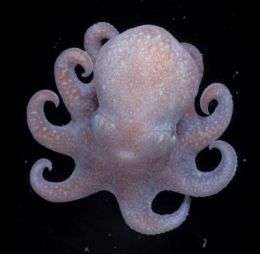
November 12, 2008 Megaleledone setebos

Enlarge

Megaleledon setebos, the closest living relative of the octopuses' common ancestor. Credit: Census of Marine Life

Many of the world's deep-sea octopuses evolved from species that lived in the Southern Ocean, according to new molecular evidence reported by researchers at Queen's University Belfast.

The findings of a study funded by the National Environment Research Council and led by Dr Louise Allcock at Queen's School of Biological Sciences and colleagues from Cambridge University and British Antarctic Survey will be reported at a conference in Spain this week.

The World Conference on Marine Biodiversity is taking place in Valencia between 11 and 15 November.

The Queen's research forms part of a decade-long global research programme to learn more about the world's oceans.

Octopuses started migrating to new ocean basins more than 30 million years ago as Antarctica cooled and large ice-sheets grew.

These huge climatic events created a 'thermohaline expressway' - a northbound flow of deep cold water, providing new habitat for the animals previously confined to the sea floor around Antarctica.

Isolated in new habitat conditions, many different species evolved. Some octopuses lost their defensive ink sacs because there was no need for the defence mechanisms in the pitch black waters more than two kilometres below the surface.

Dr Allcock, who was assisted on the study by Dr Jan Strugnell and Dr Paulo Prodöhl from Queen's, said: "It is clear from our research that climate change can have profound effects on biodiversity, with impacts even extending into habitats such as the deep oceans which you might expect would be partially protected from it.

"If octopuses radiated in this way, it's likely that other fauna did so also, so we have helped explain where some of the deep-sea biodiversity comes from."

This revelation into the global distribution and diversity of deep-sea fauna, to be reported this week in the respected scientific journal Cladistics, was made possible by intensive sampling during International Polar Year expeditions.

The findings form part of the first Census of Marine Life (CoML), set to be completed in late 2010. It aims to assess and explain the diversity, distribution and abundance of marine life in the oceans, past, present and future.

The project, which began in 2000, involves more than 2,000 scientists from 82 nations.

Source: Queen's University Belfast


print this article email this article download pdf blog this article bookmark this article     Stumble it Digg this share on Facebook retweet share on Reddit add to delicious
Rate this story - 3.7 /5 (3 votes)


November 12, 2008 all stories

Comments: 0

3.7 /5 (3 votes)
  • Stumble this up

  • Digg this

  • share this

  • hide
  • Related Stories

  • Research uncovers surprising lion stronghold in war-torn central Africa
    created Jan 29, 2009 | popularity not rated yet | comments 0
  • Biofuel plantations on tropical forestlands are bad for the climate and biodiversity
    created Dec 01, 2008 | popularity not rated yet | comments 0
  • Oil palm plantations are no substitute for tropical rainforests
    created Sep 15, 2008 | popularity not rated yet | comments 0
  • What makes life go at the tropics?
    created May 27, 2008 | popularity not rated yet | comments 0
  • 'Time-sharing' tropical birds key to evolutionary mystery
    created Nov 13, 2007 | popularity not rated yet | comments 0


Other News

Scientists visualize how bacteria talk to one another

Scientists visualize how bacteria talk to one another

Biology / Cell & Microbiology

created 15 hours ago | popularity 4.9 / 5 (8) | comments 1

Using imaging mass spectrometry, researchers at the University of California, San Diego have developed tools that will enable scientists to visualize how different cell populations of cells communicate. Their ...


W. Africa's last giraffes make surprising comeback (AP)

W. Africa's last giraffes make surprising comeback

Biology / Ecology

created Nov 08, 2009 | popularity not rated yet | comments 0

(AP) -- A crisp African dawn is breaking overhead, and Zibo Mounkaila is on the back of a pickup truck bounding across a sparse landscape of rocky orange soil.


W. Africa's last giraffes make surprising comeback (AP)

China sends panda expert to Taiwan to aid breeding

Biology / Plants & Animals

created Nov 08, 2009 | popularity not rated yet | comments 0

(AP) -- Nothing like a little time apart to rekindle the affections that could lead to a baby panda.


Laser etching safe alternative for labeling grapefruit

Laser etching safe alternative for labeling grapefruit

Biology / Other

created Nov 03, 2009 | popularity 4.4 / 5 (14) | comments 8

Laser labeling of fruit and vegetables is a new, patented technology in which a low-energy carbon dioxide laser beam is used to label, or "etch" information on produce, thereby eliminating the need for common ...


Caught in the act: Butterfly mate preference shows how 1 species can become 2

Caught in the act: Scientists find butterflies splitting into two species

Biology / Plants & Animals

created Nov 05, 2009 | popularity 4.5 / 5 (8) | comments 4

(PhysOrg.com) -- Breaking up may actually not be hard to do, say scientists who've found a population of tropical butterflies that may be on its way to a split into two distinct species.