Light triggers a new code for brain cells
November 12, 2008
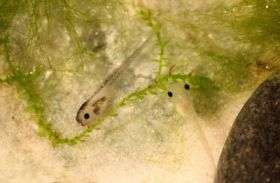
A light adapted tadpole is harder to see against pale sand compared to its dark sibling. Credit: Norma Velazquez Ulloa, Armando de la Torre and Krista Todd
Brain cells can adopt a new chemical code in response to cues from the outside world, scientists working with tadpoles at the University of California, San Diego report in the journal Nature this week.
The discovery opens the possibility that brain chemistry could be selectively altered by stimulating specific circuits to remedy low levels of neural chemicals that underlie some human ailments.
Dark tadpoles don pale camouflage when exposed to bright light. The researchers have now identified cells in the tadpole brain that respond to illumination by making dopamine, a chemical message, or neurotransmitter, recognized by the system that controls pigmentation.
"We used to think activity turned a switch to specify which transmitters a neuron would use only in early development," said co-author Davide Dulcis, a postdoctoral fellow in neurobiology who designed and conducted the experiments. "But this is happening after hatching."
The cells, found in a cluster called the suprachiasmatic nucleus, connect to a gland that releases a hormone that disperses pigments to darken skin. Dopamine squelches hormone release leaving pigments tightly packed in skin cells and the tadpoles nearly transparent.
"The behavior meets an ecological need." Dulcis said. "Pale tadpoles are difficult for predators to see in a bright environment, so the faster the tadpoles change their pigmentation, the better they are able to survive."
Cells in the core of the cluster always make dopamine, but a ring of surrounding cells normally don't, even though they are connected to the gland.
Bright light alters this pattern, however. After just two hours, cells in the surrounding ring show signs of making the new neurotransmitter. Because they are already hooked up to the hormone-producing target, illumination can result in noticeably paler tadpoles in as little as ten minutes.
"The new dopamine neurons are not simply activated at random," said co-author Nicholas Spitzer, a professor of neurobiology who leads the research group. "It's as if they are a kind of national guard, waiting in reserve to be called out. There's a pool of neurons waiting for the right sensory stimulus to be called into action and to adopt a new transmitter."
The signal-switching cells receive a link directly from the eye and are part of a brain circuit shared by a variety of animals from bony fish to humans. Although these cells don't contribute to vision, they do monitor light levels for other purposes, particularly for coordinating daily rhythms of physiology and behavior.
Activity might alter brain chemistry in other circuits as well, the researchers say. Light helps people who experience seasonal affective disorder, for example. Their symptoms of depression, which descend during long winter nights, lift in summer and also abate when they are regularly exposed to bright light, a therapy that can be as effective as anti-depressant drugs.
"Maybe it's the case that for many neurons there is additional circuitry that can be activated under certain circumstances," Spitzer said.
Depleted brain chemistry underlies several diseases, including Parkinson's. If a reserve pool of neurons could be identified and recruited by stimulating particular neural circuitry some of the side effects that stem from flooding the entire brain and body with drugs designed to boost levels of specific neurotransmitters might be avoided, he said.
Source: University of California - San Diego
-
Cosmetic chemical hinders brain development in tadpoles
Jan 10, 2012 |
5 / 5 (2) |
6
-
Researchers discover that changes in bioelectric signals cause tadpoles to grow eyes in back, tail
Dec 08, 2011 |
5 / 5 (5) |
12
-
Researchers link Alzheimer's to lack of specific protein
Aug 16, 2011 |
not rated yet |
0
-
The face of a frog: Time-lapse video reveals never-before-seen bioelectric pattern
Jul 18, 2011 |
4.9 / 5 (21) |
9
-
Studies show importance of visual stimulation in wiring up species' brains to see
Jun 05, 2011 |
5 / 5 (1) |
0
-
Engineers build first sub-10-nm carbon nanotube transistor
Feb 01, 2012 |
4.9 / 5 (33) |
30
-
Something old, something new: Evolution and the structural divergence of duplicate genes
Jan 31, 2012 |
4.6 / 5 (7) |
1
-
The hidden nanoworld of ice crystals: Revealing the dynamic behavior of quasi-liquid layers
Jan 30, 2012 |
5 / 5 (4) |
1
-
Stock market network reveals investor clustering
Jan 27, 2012 |
3.9 / 5 (23) |
8
-
Of microchemistry and molecules: Electronic microfluidic device synthesizes biocompatible probes
Jan 26, 2012 |
5 / 5 (2) |
0
More news stories
A mitosis mystery solved: How chromosomes align perfectly in a dividing cell
Although the process of mitotic cell division has been studied intensely for more than 50 years, Whitehead Institute researchers have only now solved the mystery of how cells correctly align their chromosomes during symmetric ...
10 hours ago |
4.3 / 5 (16) |
0
|
Researchers find extensive RNA editing in human transcriptome
In a new study published online in Nature Biotechnology, researchers from BGI, the world's largest genomics organization, reported the evidence of extensive RNA editing in a human cell line by analysis of RNA-seq data, demons ...
9 hours ago |
5 / 5 (4) |
0
|
The proteins ensuring genome protection
Researchers from the University of Geneva (UNIGE), Switzerland, have discovered the crucial role of two proteins in developing a cell 'anti-enzyme shield'. This protection system, which operates at the level of molecular ...
10 hours ago |
5 / 5 (3) |
0
|
Entire genome of extinct human decoded from fossil
(PhysOrg.com) -- In 2010, Svante Pääbo and his colleagues presented a draft version of the genome from a small fragment of a human finger bone discovered in Denisova Cave in southern Siberia. The ...
Feb 07, 2012 |
4.7 / 5 (60) |
51
|
Why are there so few fish in the Earth's oceans?
(PhysOrg.com) -- A Stony Brook University researcher has found that, contrary to popular belief, there are not plenty of fish in the sea.
Feb 08, 2012 |
4.2 / 5 (18) |
27
|
Scientists discover molecular secrets of 2,000-year-old Chinese herbal remedy
For roughly two thousand years, Chinese herbalists have treated Malaria using a root extract, commonly known as Chang Shan, from a type of hydrangea that grows in Tibet and Nepal. More recent studies suggest that halofuginone, ...
New method to examine batteries -- MRI from the inside
There is an ever-increasing need for advanced batteries for portable electronics, such as phones, cameras, and music players, but also to power electric vehicles and to facilitate the distribution and storage of energy derived ...
Google might launch Drive for cloud storage soon
(PhysOrg.com) -- Google's next big move, according to the Wall Street Journal, is a cloud storage service called Drive. Hardly first to the plate, Google is simply catching up to introducing its cloud reposi ...
Lab study raises questions over nano-particle impact
Tests involving chickens have raised questions about the impact on health from engineered nano-particles, the ultra-fine grains commonly used in drugs and processed foods, scientists said on Sunday.
Starve a virus, feed a cure? Findings show how some cells protect themselves against HIV
A protein that protects some of our immune cells from the most common and virulent form of HIV works by starving the virus of the molecular building blocks that it needs to replicate, according to research published online ...
Overeating may double risk of memory loss
New research suggests that consuming between 2,100 and 6,000 calories per day may double the risk of memory loss, or mild cognitive impairment (MCI), among people age 70 and older. The study was released today and will be ...