Electronic heat trap grips deep Earth
November 12, 2008 Diamond Anvil Cell

Enlarge

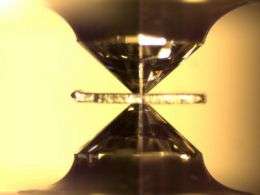
The diamond anvil cell squeezes samples to inner-Earth pressures, between two diamond tips. Image courtesy Alex Goncharov, Carnegie Institution

(PhysOrg.com) -- The key to understanding Earth's evolution, including how our atmosphere gained oxygen and how volcanoes and earthquakes form, is to look deep, really deep, into the lower mantle—a region some 400 to 1,800 miles (660 to 2,900 kilometers) below the surface.

Researchers at the Carnegie Institution's Geophysical Laboratory simulated conditions at these depths and recently discovered that the concentration of highly oxidized (ferric) iron (Fe3+) in the two major mantle minerals is key to moving heat in that region. Such heat transfer affects material movement throughout the planet. They also discovered that less oxidized (ferrous) iron (Fe2+) has much smaller effect than expected. The results, reported in the November 13, issue of Nature, call into question current models of mantle dynamics.

Lead author of the study Alexander Goncharov explains: "The lower mantle sits on top of the core where pressures range from 230,000 to 1.3 million times the pressure at sea level. Temperatures are unimaginable -- from about 2,800 to 6,700 °F. About 80% of the mantle is made of iron-containing silicate perovskite, while the mineral ferropericlase makes up the rest. The iron in both of these minerals strongly influences many properties of matter.

Goncharov and team developed a new optical spectroscopy system to reveal how matter absorbs heat from infrared through ultraviolet wavelengths; in addition they measured how energy is dissipated. They subjected the minerals to mantle pressures—up to 1.3 million atmospheres at room temperature and to 590,000 atmospheres at temperatures up to 1160°F.

The scientists, including a co-author who was an NSF-sponsored summer college intern Benjamin Haugen, found that heat absorption is governed by the concentration of ferric (Fe3+) iron in silicate perovskite and ferropericlase. Their results for silicate perovskite in the visible and near infrared showed that heat absorption is dominated by the transfer of electron charges during oxidation—the process of electron loss—in the oxide O-Fe3+.

"Our results show that the conductivity of heat in this part of the lower Earth is driven by the amount of ferric iron in the mantle and the process of losing and gaining electrons," said co-author Viktor Struzhkin. "We'll need to use this new collection of information to reexamine how mantle plumes and other dynamic features of this remote realm are affected."

Steven Jacobsen, a co-author from Northwestern University, formerly a postdoctoral fellow at Carnegie, and a member of the Carnegie DOE Alliance Center (CDAC), remarked, "The amount of light we are able to see through these mantle materials under extreme pressures and temperatures is telling us a lot about how effectively heat is transported out of the core and through the mantle."

Provided by Carnegie Institution


print this article email this article download pdf blog this article bookmark this article     Stumble it Digg this share on Facebook retweet share on Reddit add to delicious
Rate this story - 4.1 /5 (27 votes)

Rank Filter

Move the slider to adjust rank threshold, so that you can hide some of the comments.


Display comments: newest first

  • SongDog - Nov 12, 2008
    • Rank: 3.5 / 5 (2)
    "Our results show that the conductivity of heat in this part of the lower Earth is driven by the amount of ferric iron in the mantle and the process of losing and gaining electrons," said co-author Viktor Struzhkin. "We'll need to use this new collection of information to reexamine how mantle plumes and other dynamic features of this remote realm are affected."

    So just how is it news that free electrons are involved in heat transport?
  • Avitar - Nov 12, 2008
    • Rank: 2 / 5 (1)
    Doing the basic materials research is not glamorous but inch-by-inch leads to a better understanding of the relationships of the forces involved. Maybe it will be useful for modeling them Magnetic Pole flips?

November 12, 2008 all stories

Comments: 2

4.1 /5 (27 votes)
  • Stumble this up

  • Digg this

  • share this

  • hide
  • Related Stories


  • hide
  • Relevant PhysicsForums posts

  • Which countries around the world cause the most destruction to the rain forest
    created 5 hours ago
  • HadleyCru data hacked
    created Nov 20, 2009
  • Younger Dryas Caused by Ice Dam Collapse?
    created Nov 17, 2009
  • Modeling rainfall and flooding
    created Nov 15, 2009
  • More from Physics Forums - Earth

Other News

Astronauts finish another spacewalk, still no baby (AP)

Astronauts finish another spacewalk, still no baby

Space & Earth / Space Exploration

created 4 hours ago | popularity 3 / 5 (2) | comments 0

(AP) -- A spacewalking astronaut put aside the impending birth of his daughter and blazed through his first-ever venture outside the International Space Station on Saturday.


Unseasonably hot and dry weather combined with strong winds to fan scores of blazes in the country's southeastern states

Australia issues 'catastrophic' alerts as fires rage

Space & Earth / Environment

created 10 hours ago | popularity 4.5 / 5 (2) | comments 0

Australia has issued "catastrophic" alerts after record-breaking temperatures and wild lightning storms sparked more than 100 fires across the country, officials said Saturday.


Commuters wait on the platform shrouded by fog in London

Climate change not man-made, say majority of Britons: poll

Space & Earth / Environment

created Nov 15, 2009 | popularity 3.3 / 5 (15) | comments 45

Less than half of Britons believes that human activity is to blame for global warming, according to a poll carried out for The Times newspaper and published on Saturday.


Mysteriously warm times in Antarctica

Mysteriously warm times in Antarctica

Space & Earth / Earth Sciences

created Nov 18, 2009 | popularity 4.2 / 5 (21) | comments 28

(PhysOrg.com) -- A new study of Antarctica's past climate reveals that temperatures during the warm periods between ice ages (interglacials) may have been higher than previously thought. The latest analysis ...


UN: Fight climate change with free condoms (AP)

UN: Fight climate change with free condoms

Space & Earth / Environment

created Nov 18, 2009 | popularity 3.1 / 5 (11) | comments 22

(AP) -- The battle against global warming could be helped if the world slowed population growth by making free condoms and family planning advice more widely available, the U.N. Population Fund said Wednesday.