Cassini Finds Mysterious New Aurora on Saturn
November 12, 2008 Cassini Finds Mysterious New Aurora on Saturn

Enlarge

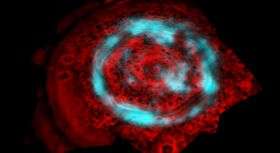
This image of the northern polar region of Saturn shows both the aurora and underlying atmosphere, seen at two different wavelengths of infrared light as captured by NASA's Cassini spacecraft. Image: NASA/JPL/University of Arizona

(PhysOrg.com) -- Saturn has its own unique brand of aurora that lights up the polar cap, unlike any other planetary aurora known in our solar system. This odd aurora revealed itself to one of the infrared instruments on NASA's Cassini spacecraft.

"We've never seen an aurora like this elsewhere," said Tom Stallard, a scientist working with Cassini data at the University of Leicester, England. Stallard is lead author of a paper that appears in the Nov. 13 issue of the journal Nature. "It's not just a ring of auroras like those we've seen at Jupiter or Earth. This aurora covers an enormous area across the pole. Our current ideas on what forms Saturn's aurora predict that this region should be empty, so finding such a bright aurora here is a fantastic surprise."

Auroras are caused by charged particles streaming along the magnetic field lines of a planet into its atmosphere. Particles from the sun cause Earth's auroras. Many, but not all, of the auroras at Jupiter and Saturn are caused by particles trapped within the magnetic environments of those planets.

Jupiter's main auroral ring, caused by interactions internal to Jupiter's magnetic environment, is constant in size. Saturn's main aurora, which is caused by the solar wind, changes size dramatically as the wind varies. The newly observed aurora at Saturn, however, doesn't fit into either category.

"Saturn's unique auroral features are telling us there is something special and unforeseen about this planet's magnetosphere and the way it interacts with the solar wind and the planet's atmosphere," said Nick Achilleos, Cassini scientist on the Cassini magnetometer team at the University College London. "Trying to explain its origin will no doubt lead us to physics which uniquely operates in the environment of Saturn."

The new infrared aurora appears in a region hidden from NASA's Hubble Space Telescope, which has provided views of Saturn's ultraviolet aurora. Cassini observed it when the spacecraft flew near Saturn's polar region. In infrared light, the aurora sometimes fills the region from around 82 degrees north all the way over the pole. This new aurora is also constantly changing, even disappearing within a 45 minute-period.

Provided by NASA


print this article email this article download pdf blog this article bookmark this article     Stumble it Digg this share on Facebook retweet share on Reddit add to delicious
Rate this story - 4.3 /5 (33 votes)

Rank Filter

Move the slider to adjust rank threshold, so that you can hide some of the comments.


Display comments: newest first

  • holmstar - Nov 12, 2008
    • Rank: 3 / 5 (1)
    Dude, seriously, am I crazy for loving this type of stuff so much?!?!? I love space science so much. It is so amazing to me and really blows your mind if you stop to think about it. I LOVE THIS STUFF! Good Article, keep them coming.
    Aaron, COO-OOTWO @ www.ootwo.com


    Dude, seriouly, chill out. Did you just hear yesterday that this thing called "science" exists?
  • alanborky - Nov 12, 2008
    • Rank: 5 / 5 (3)
    What strikes me about this image is how the 'unexpected' aurora clearly reflects the shape of, and thus may be dependent on, if not a direct product of, the hexagon directly below it.

    I'm slightly surprised the article doesn't address this apparent relationship.
  • barakn - Nov 12, 2008
    • Rank: 3.7 / 5 (3)
    Dude, seriously, am I crazy for loving this type of stuff so much?!?!? I love space science so much. It is so amazing to me and really blows your mind if you stop to think about it. I LOVE THIS STUFF! Good Article, keep them coming.
    Aaron, COO-OOTWO @ www.ootwot.com


    Dude, seriouly, chill out. Did you just hear yesterday that this thing called "science" exists?

    Yes, but the whole point was to write something short that took very little thought to put together and then add the usual spam link at the end.
  • General_Haberdashery - Nov 12, 2008
    • Rank: not rated yet
    I second the hexagon remark, random space hexagons deserve more research.

November 12, 2008 all stories

Comments: 4

4.3 /5 (33 votes)
  • Stumble this up

  • Digg this

  • share this

  • hide
  • Related Stories


  • hide
  • Relevant PhysicsForums posts

  • Sideral question
    created 17 hours ago
  • Doppler shifted blackbody spectrum
    created 20 hours ago
  • Earth v. Moon
    created 22 hours ago
  • help me with coordinates and orbits
    created 22 hours ago
  • More from Physics Forums - General Astronomy

Other News

Astronauts finish another spacewalk, still no baby (AP)

Astronauts finish another spacewalk, still no baby

Space & Earth / Space Exploration

created 8 hours ago | popularity 3 / 5 (2) | comments 0

(AP) -- A spacewalking astronaut put aside the impending birth of his daughter and blazed through his first-ever venture outside the International Space Station on Saturday.


Unseasonably hot and dry weather combined with strong winds to fan scores of blazes in the country's southeastern states

Australia issues 'catastrophic' alerts as fires rage

Space & Earth / Environment

created 14 hours ago | popularity 4.5 / 5 (2) | comments 0

Australia has issued "catastrophic" alerts after record-breaking temperatures and wild lightning storms sparked more than 100 fires across the country, officials said Saturday.


Commuters wait on the platform shrouded by fog in London

Climate change not man-made, say majority of Britons: poll

Space & Earth / Environment

created Nov 15, 2009 | popularity 3.3 / 5 (15) | comments 46

Less than half of Britons believes that human activity is to blame for global warming, according to a poll carried out for The Times newspaper and published on Saturday.


Mysteriously warm times in Antarctica

Mysteriously warm times in Antarctica

Space & Earth / Earth Sciences

created Nov 18, 2009 | popularity 4.2 / 5 (21) | comments 28

(PhysOrg.com) -- A new study of Antarctica's past climate reveals that temperatures during the warm periods between ice ages (interglacials) may have been higher than previously thought. The latest analysis ...


UN: Fight climate change with free condoms (AP)

UN: Fight climate change with free condoms

Space & Earth / Environment

created Nov 18, 2009 | popularity 3.1 / 5 (11) | comments 24

(AP) -- The battle against global warming could be helped if the world slowed population growth by making free condoms and family planning advice more widely available, the U.N. Population Fund said Wednesday.