Let the games begin! Nanosoccer at 2009 RoboCup in Austria
November 13, 2008 Let the games begin! Nanosoccer at 2009 RoboCup in Austria

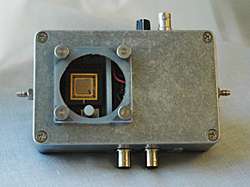
The 2009 RoboCup Nanosoccer competition will be played on the gold-colored microchip seen through the window of the “world's smallest soccer stadium.” The chip is divided into 16 playing fields each the size of a grain of rice. Credit: Talbott, NIST

(PhysOrg.com) -- The World Cup may be two years away, but soccer aficionados can get an early start at satisfying their yen for global competition when the National Institute of Standards and Technology and the RoboCup Federation host the second-ever international nanosoccer contest next summer.

Nanosoccer—the Lilliputian competition where computer-driven "nanobots" the size of dust mites challenge one another on fields no bigger than a grain of rice—will be part of the RoboCup games in Graz, Austria, from June 29-July 5, 2009. NIST is now accepting applications for organizations wishing to field robots in the events.

Viewed under a microscope, the soccer nanobots are operated by remote control and move in response to changing magnetic fields or electrical signals transmitted across the microchip arena. "Nanoscale" refers to their mass. The bots are a few tens of micrometers to a few hundred micrometers long, but their masses range from only a few nanograms to a few hundred nanograms. They are manufactured from materials such as aluminum, nickel, gold, silicon and chromium.

Rules for the "Nanogram 2009" competition and the application form (called the "Team Description Paper") are available at www.nist.gov/public_affairs/calmed/nanosoccer.html. The "NIST and Nanosoccer" Web site also features detailed information on nanosoccer, summaries of past competitions and a short video showing how the contests "road test" agility, maneuverability, response to computer control and the ability to move objects—all skills that future industrial nanobots will need for tasks such as microsurgery within the human body or the manufacture of tiny components for microscopic electronic devices.

NIST is jointly organizing the Nanogram 2009 events with RoboCup, an international organization dedicated to fostering innovations and advances in artificial intelligence and intelligent robotics by using the game of soccer as a testing ground. NIST's goal in coordinating competitions between the world's smallest robots is to show the feasibility and accessibility of technologies for fabricating MicroElectroMechanical Systems (MEMS), tiny mechanical devices built onto semiconductor chips and measured in micrometers (millionth of a meter). The contests also drive innovation in this new field of robotics by inspiring young scientists and engineers to become involved.

Teams wishing to compete in Austria must submit their application materials by Dec. 31, 2008, by either e-mail to nanogram_at_nist.gov or by regular mail to RoboCup Nanogram 2009, c/o Craig McGray, NIST, 100 Bureau Dr., MS 8120, Gaithersburg, Md. 20899-8120.

Provided by National Institute of Standards and Technology


print this article email this article download pdf blog this article bookmark this article     Stumble it Digg this share on Facebook retweet share on Reddit add to delicious
Rate this story - 5 /5 (3 votes)


November 13, 2008 all stories

Comments: 0

5 /5 (3 votes)
  • Stumble this up

  • Digg this

  • share this

  • hide
  • Related Stories

  • Is Your Microrobot Up for the (NIST) Challenge?
    created Oct 20, 2009 | popularity not rated yet | comments 0
  • Public Invited to See Nanosoccer Robots in Action in Pittsburgh
    created May 14, 2008 | popularity not rated yet | comments 0
  • Robots face off on football pitch, in kitchen at RoboCup 2009
    created Jul 01, 2009 | popularity not rated yet | comments 0
  • Hertfordshire team wins Humanoid Simulation League in Robot Football Cup
    created May 06, 2009 | popularity not rated yet | comments 0
  • A first in online gaming: Humans team up with AI software
    created Nov 18, 2008 | popularity not rated yet | comments 0


  • hide
  • Relevant PhysicsForums posts

  • I need some help with this project (optics and lens design)
    created 52 minutes ago
  • black hole gravity
    created 1hour ago
  • Photoelectric effect
    created 3 hours ago
  • Ranges of coherence lengths for......
    created 6 hours ago
  • More from Physics Forums - General Physics

Other News

Findings show nanomedicine promising for treating spinal cord injuries

Findings show nanomedicine promising for treating spinal cord injuries

Nanotechnology / Bio & Medicine

created 17 hours ago | popularity 4.5 / 5 (4) | comments 0

(PhysOrg.com) -- Researchers at Purdue University have discovered a new approach for repairing damaged nerve fibers in spinal cord injuries using nano-spheres that could be injected into the blood shortly ...


New Digital 'Electronics' Concept May Continue Moore's Law

New Digital 'Electronics' Concept May Continue Moore's Law

Nanotechnology / Nanophysics

created Nov 05, 2009 | popularity 4.6 / 5 (55) | comments 9

(PhysOrg.com) -- Computers of the future could be operating not on electrons, but on tiny waves traveling through an electron "fluid," if a new proposal is successful. The new circuit design, recently introduced ...


Nanoparticles for gene therapy improve

Nanoparticles for gene therapy improve

Nanotechnology / Bio & Medicine

created Nov 06, 2009 | popularity 5 / 5 (4) | comments 3

(PhysOrg.com) -- About five years ago, Professor Janet Sawicki at the Lankenau Institute in Pennsylvania read an article about nanoparticles developed by MIT's Robert Langer for gene therapy, the insertion ...


Breakthrough in industrial-scale nanotube processing

Breakthrough in industrial-scale nanotube processing

Nanotechnology / Nanomaterials

created Nov 02, 2009 | popularity 4.9 / 5 (20) | comments 3

(PhysOrg.com) -- Rice University scientists today unveiled a method for the industrial-scale processing of pure carbon-nanotube fibers that could lead to revolutionary advances in materials science, power ...


Nanoparticles may cause DNA damage across a cellular barrier

Nanoparticles may cause DNA damage across a cellular barrier

Nanotechnology / Bio & Medicine

created Nov 05, 2009 | popularity 4.3 / 5 (9) | comments 1

(PhysOrg.com) -- Scientists have shown in the laboratory that metal nanoparticles damaged the DNA in cells on the other side of a cellular barrier. The research, by the University of Bristol, is published ...