Iron-based Materials May Unlock Superconductivity's Secrets
November 13, 2008
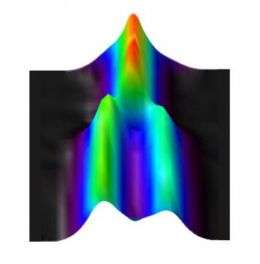
NIST researchers have found that new iron-based high-temperature superconductors subtly change their molecular shape as temperatures decrease. This graphic shows a superconductor transitioning from tetragonal (at top) to orthorhombic at about 220 Kelvin (-53 Celsius). Such physical changes appear to be a precursor to superconductivity, in which electric current can flow without resistance. Credit: NIST
(PhysOrg.com) -- Researchers at the National Institute of Standards and Technology (NIST) are decoding the mysterious mechanisms behind the high-temperature superconductors that industry hopes will find wide use in next-generation systems for storing, distributing and using electricity. In two new papers on a recently discovered class of high-temperature superconductors, they report that the already complicated relationship between magnetism and superconductivity may be more involved than previously thought, or that a whole new mechanism may drive some types of superconductors.
At temperatures approaching absolute zero, many materials become superconductors, capable of carrying vast amounts of electrical current with no resistance. In such low-temperature superconductors, magnetism is a villain whose appearance shatters the fragile superconductive state. But in 1986, scientists discovered "high temperature" (HTc) superconductors capable of operating much warmer than the previous limit of 30 degrees above absolute zero.
In fact, today's copper-oxide materials are superconductive in liquid nitrogen, a bargain-priced coolant that goes up to a balmy 77 degrees above absolute zero. Such materials have enabled applications as diverse as high-speed maglev trains, magnetic-resonance imagers and highly sensitive astronomical detectors. Still, no one really understands how HTc superconductivity works, although scientists have long suspected that in this case, magnetism boosts rather than suppresses the effect.
The beginnings of what could be a breakthrough came in early 2008 when Japanese researchers announced discovery of a new class of iron-based HTc superconductors. In addition to being easier to shape into wires and otherwise commercialize than today's copper-oxides, such materials provide scientists fresh new subjects with which to develop and test theories about HTc superconductivity's origins.
Scientists at NIST's Center for Neutron Research and a team including researchers from the University of Tennessee at Knoxville, Oak Ridge National Laboratory, the University of Maryland, Ames Laboratory and Iowa State University used beams of neutrons to peek into a superconductor's atomic structure. They first found iron-based superconductors to be similar to copper-oxide materials in how "doping" (adding specific elements to insulators in or around a HTc superconductor) influences their magnetic properties and superconductivity.
Then the team tested the iron-based material (CaFe2As2) without doping it. Under moderate pressure, the volume of the material's crystal structure compressed an unusually high 5 percent. Intriguingly, it also became superconductive without a hint of magnetism.
The iron-based material's behavior under pressure may suggest the remarkable possibility of an entirely different mechanism behind superconductivity than with copper oxide materials, NIST Fellow Jeffrey Lynn said. Or it could be that magnetism is simply an ancillary part of HTc superconductivity in general, he saidand that a similar, deeper mechanism underlies the superconductivity in both. Understanding the origin of the superconductivity will help engineers tailor materials to specific applications, guide materials scientists in the search for new materials with improved properties and, scientists hope, usher in higher-temperature superconductors.
Publications:
J. Zhao, Q. Huang, C. de al Cruz, S. Li, J. W. Lynn, Y. Chen, M. A. Green, G. F. Chen, G. Li, Z. C. Li, J. L. Luo, N. L. Wang and P. Dai. Structural and magnetic phase diagram of CeFeAsO1-xFx and its relationship to high-temperature superconductivity. Nature Materials (DOI 10.1038/nmat2315).
A. Kreyssig, M. A. Green, Y. B. Lee, G. D. Samolyuk, P. Zajdel, J. W. Lynn, S. L. Budko, M. S. Torikachvili, N. Ni, S. Nandi, J. Lećo, S. J. Poulton, D. N. Argyriou, B. N. Harmon, P. C. Canfield, R. J. McQueeney and A. I. Goldman. Pressure-induced volume-collapsed tetragonal phase of CaFe2As2 as seen via neutron scattering. Phys. Rev. B 78 (in press).
Provided by National Institute of Standards and Technology
-
World's longest superconductor cable
Jan 19, 2012 |
4.5 / 5 (8) |
9
-
Watching a gas turn superfluid
Jan 18, 2012 |
4.8 / 5 (8) |
5
-
Rice's 'quantum critical' theory gets experimental boost
Jan 11, 2012 |
4.1 / 5 (14) |
2
-
New spectroscopy technique enables investigation of two-dimensional electron states
Dec 22, 2011 |
5 / 5 (1) |
1
-
Chemists propose explanation for superconductivity at high temperatures
Dec 15, 2011 |
4.9 / 5 (19) |
27
-
Engineers build first sub-10-nm carbon nanotube transistor
Feb 01, 2012 |
4.9 / 5 (31) |
30
-
Something old, something new: Evolution and the structural divergence of duplicate genes
Jan 31, 2012 |
4.6 / 5 (7) |
1
-
The hidden nanoworld of ice crystals: Revealing the dynamic behavior of quasi-liquid layers
Jan 30, 2012 |
5 / 5 (3) |
1
-
Stock market network reveals investor clustering
Jan 27, 2012 |
3.9 / 5 (23) |
8
-
Of microchemistry and molecules: Electronic microfluidic device synthesizes biocompatible probes
Jan 26, 2012 |
5 / 5 (1) |
0
-
Strength of induced magnetic field inside an inductor
2 hours ago
-
Physical laws .... are they material?!!
3 hours ago
-
increasing time of daylight
3 hours ago
-
Light & Sight
4 hours ago
-
Wind Turbine Power
7 hours ago
-
Steam Table issues
9 hours ago
- More from Physics Forums - General Physics
More news stories
Putting the squeeze on planets outside our solar system
(PhysOrg.com) -- Using high-powered lasers, scientists at Lawrence Livermore National Laboratory and collaborators discovered that molten magnesium silicate undergoes a phase change in the liquid state, abruptly ...
3 hours ago |
5 / 5 (1) |
0
|
Hovering not hard if you're top-heavy, researchers find
Top-heavy structures are more likely to maintain their balance while hovering in the air than are those that bear a lower center of gravity, researchers at New York University's Courant Institute of Mathematical Sciences ...
4 hours ago |
5 / 5 (1) |
1
|
SLAC, Stanford team focuses on high-energy electrons to treat cancer
Accelerator physicists at SLAC and cancer specialists from Stanford are working on a new technology that could dramatically reduce the time needed for cancer radiation treatments. The team ran an initial experiment ...
7 hours ago |
5 / 5 (1) |
0
Measurements from high-energy collisions lead to better understanding of why meson particles disappear
For several years, physicists at the Relativistic Heavy Ion Collider (RHIC) at Brookhaven National Laboratory (BNL), USA, have studied an unusual state of matter called the quarkgluon plasma, which they ...
7 hours ago |
5 / 5 (1) |
0
Quantum physicist explains $100K offer for proof scaled-up quantum computing is impossible
(PhysOrg.com) -- MIT researcher Scott Aaronson has certainly riled the physics community with his offer this past Friday, of $100,000 to anyone who can prove that scaled-up quantum computing is impossible. ...
Complex wiring of the nervous system may rely on a just a handful of genes and proteins
Researchers at the Salk Institute have discovered a startling feature of early brain development that helps to explain how complex neuron wiring patterns are programmed using just a handful of critical genes. ...
CIA website offline, Anonymous takes credit
The website of the Central Intelligence Agency was unresponsive on Friday after the hacker group Anonymous claimed to have knocked it offline.
Q&A: Obama and the birth control controversy
(AP) -- What birth control debate? A half-century after the introduction of the pill, acceptance of birth control by American women is virtually universal.
The power of estrogen -- male snakes attract other males
A new study has shown that boosting the estrogen levels of male garter snakes causes them to secrete the same pheromones that females use to attract suitors, and turned the males into just about the sexiest ...
New error-correcting codes guarantee the fastest possible rate of data transmission
Error-correcting codes are one of the triumphs of the digital age. Theyre a way of encoding information so that it can be transmitted across a communication channel such as an optical fiber o ...
Humans may have helped the decline of African rainforests 3000 years ago
(PhysOrg.com) -- Large areas of rainforests in Central Africa mysteriously disappeared over three thousand years ago, to be replaced by savannas. The prevailing theory has been that the cause was a change ...