Cold atoms could replace hot gallium in focused ion beams
November 13, 2008
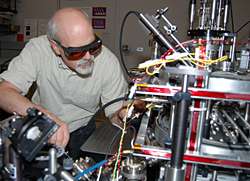
NIST researcher Jabez McClelland makes adjustments on the new magneto-optical trap ion source, capable of focusing beams of ions down to nanometer spots for use as a 'nano-scalpel' in advanced electronics processing. Credit: Holmes, NIST
(PhysOrg.com) -- Scientists at the National Institute of Standards and Technology have developed a radical new method of focusing a stream of ions into a point as small as one nanometer. Because of the versatility of their approach—it can be used with a wide range of ions tailored to the task at hand—it is expected to have broad application in nanotechnology both for carving smaller features on semiconductors than now are possible and for nondestructive imaging of nanoscale structures with finer resolution than currently possible with electron microscopes.
Researchers and manufacturers routinely use intense, focused beams of ions to carve nanometer-sized features into a wide variety of targets. In principle, ion beams also could produce better images of nanoscale surface features than conventional electron microscopy. But the current technology for both applications is problematic. In the most widely used method, a metal-coated needle generates a narrowly focused beam of gallium ions.
The high energies needed to focus gallium for milling tasks end up burying small amounts in the sample, contaminating the material. And because gallium ions are so heavy (comparatively speaking), if used to collect images they inadvertently damage the sample, blasting away some of its surface while it is being observed. Researchers have tried using other types of ions but were unable to produce the brightness or intensity necessary for the ion beam to cut into most materials.
The NIST team took a completely different approach to generating a focused ion beam that opens up the possibility for use of non-contaminating elements. Instead of starting with a sharp metal point, they generate a small "cloud" of atoms and then combine magnetic fields with laser light to trap and cool these atoms to extremely low temperatures. Another laser is used to ionize the atoms, and the charged particles are accelerated through a small hole to create a small but energetic beam of ions. Researchers have named the groundbreaking device "MOTIS," for "Magneto-Optical Trap Ion Source." (For more on MOTs, see: http://www.physorg … 6353403.html)
"Because the lasers cool the atoms to a very low temperature, they're not moving around in random directions very much. As a result, when we accelerate them the ions travel in a highly parallel beam, which is necessary for focusing them down to a very small spot," explains Jabez McClelland of the NIST Center for Nanoscale Science and Technology.
The team was able to measure the tiny spread of the beam and show that it was indeed small enough to allow the beam to be focused to a spot size less than 1 nanometer. The initial demonstration used chromium atoms, establishing that other elements besides gallium can achieve the brightness and intensity to work as a focused ion beam "nano-scalpel." The same technique, says McClelland, can be used with a wide variety of other atoms, which could be selected for special tasks such as milling nanoscale features without introducing contaminants, or to enhance contrast for ion beam microscopy.
Citation: J. L. Hanssen, S. B. Hill, J. Orloff and J. J. McClelland. Magneto-optical trap-based, high brightness ion source for use as a nanoscale probe. Nano Letters 8, 2844 (2008).
Provided by National Institute of Standards and Technology
-
Study adds timing capability to living cell sensors
Feb 08, 2012 |
not rated yet |
0
-
With single laser pulses on single molecules
Feb 07, 2012 |
5 / 5 (1) |
1
-
Electrons in concert: A simple probe for collective motion in ultracold plasmas
Feb 06, 2012 |
4.3 / 5 (6) |
0
-
Using ion beams to detect art forgery
Jan 20, 2012 |
5 / 5 (3) |
0
-
MHI develops 12-inch wafer bonding machine capable of producing 3-D integrated LSI circuits at room temperature
Jan 16, 2012 |
3 / 5 (1) |
0
-
Engineers build first sub-10-nm carbon nanotube transistor
Feb 01, 2012 |
4.9 / 5 (31) |
30
-
Something old, something new: Evolution and the structural divergence of duplicate genes
Jan 31, 2012 |
4.6 / 5 (7) |
1
-
The hidden nanoworld of ice crystals: Revealing the dynamic behavior of quasi-liquid layers
Jan 30, 2012 |
5 / 5 (3) |
1
-
Stock market network reveals investor clustering
Jan 27, 2012 |
3.9 / 5 (23) |
8
-
Of microchemistry and molecules: Electronic microfluidic device synthesizes biocompatible probes
Jan 26, 2012 |
5 / 5 (1) |
0
-
What would happen when a jet travelling at Mach 10 experiences engine failure
3 hours ago
-
Rust from my microwave ruined a nice bowl of soup and also my day
5 hours ago
-
gas leaks in space
8 hours ago
-
Weight required to balance a boom stand?
9 hours ago
-
Questions about Equivalence principle & Einstein Elevator?
11 hours ago
-
Kinetic energy of gas
12 hours ago
- More from Physics Forums - General Physics
More news stories
New kind of solar cell could capture significantly more energy than current cells
New solar cells could increase the maximum efficiency of solar panels by over 25%, according to scientists from the University of Cambridge.
Feb 08, 2012 |
4.5 / 5 (12) |
14
|
Nanoshell whispering galleries improve thin solar panels
Visitors to Statuary Hall in the U.S. Capitol Building may have experienced a curious acoustic feature that allows a person to whisper softly at one side of the cavernous, half-domed room and for another on ...
Nanotechnology / Nanomaterials
Feb 07, 2012 |
4.3 / 5 (6) |
6
|
'Dark plasmons' transmit energy
Microscopic channels of gold nanoparticles have the ability to transmit electromagnetic energy that starts as light and propagates via "dark plasmons," according to researchers at Rice University.
Feb 09, 2012 |
4.8 / 5 (9) |
1
|
Revealing how a battery material works
Since its discovery 15 years ago, lithium iron phosphate (LiFePO4) has become one of the most promising materials for rechargeable batteries because of its stability, durability, safety and ability to deliver ...
Nanotechnology / Nanomaterials
Feb 08, 2012 |
5 / 5 (5) |
0
|
Harnessing plasmonics, engineers weld nanowires with light
At the nano level, researchers at Stanford have discovered a new way to weld together meshes of tiny wires. Their work could lead to exciting new electronics and solar applications. To succeed, they called ...
Feb 06, 2012 |
4.8 / 5 (11) |
1
|
Injured boomers beware: Know when to see doctor
(AP) -- It happened to nurse Jane Byron years after an in-line skating fall, business owner Haralee Weintraub while doing "men's" push-ups, and avid cyclist Gene Wilberg while lifting a heavy box.
Google might launch Drive for cloud storage soon
(PhysOrg.com) -- Google's next big move, according to the Wall Street Journal, is a cloud storage service called Drive. Hardly first to the plate, Google is simply catching up to introducing its cloud reposi ...
Latin America mining boom clashes with conservation
Latin America is experiencing a mining boom as prices rise fuelled by a hike in global demand, but the region is also being hit by a wave of violent protests, strikes and rallies by environmentalists.
Love a click away in Indonesia's Twitter Republic
He was a geeky kid from Yogyakarta, she a glamorous city girl in Jakarta. In a country with one of the world's most vibrant social networking scenes they fell in love on Twitter.
Europeans protest controversial Internet pact
Tens of thousands of people marched in protests in more than a dozen European cities Saturday against a controversial anti-online piracy pact that critics say could curtail Internet freedom.
Walney offshore wind farm is world's biggest (for now)
(PhysOrg.com) -- The Walney wind farm on the Irish Sea--characterized by high tides, waves and windy weather--officially opened this week. The farm is treated in the press as a very big deal as the Walney ...