India's Chandrayaan-1 spacecraft reaches its final orbit
November 13th, 2008 India's Chandrayaan-1 spacecraft reaches its final orbit

Enlarge

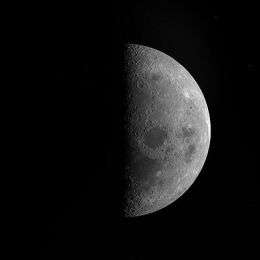
This image of the Moon was taken with by Rosetta's OSIRIS Narrow Angle Camera (NAC) at 07:36 CET on 13 November 2007, about nine hours after Rosetta's closest approach to Earth during one of its gravity assist manoeuvres. OSIRIS has been designed to image faint objects, so a neutral density filter was placed in the optical path to reduce the sensitivity of the camera to one fiftieth. The above image was acquired through the far-focus red filter of the camera (750 nanometres). Credits: ESA ©2007 MPS for OSIRIS Team MPS/UPD/LAM/IAA/RSSD/INTA/UPM/DASP/IDA

India’s Chandrayaan-1 spacecraft successfully reached its final operational orbit around the Moon on 12 November 2008. The spacecraft is now circling the Moon at an altitude of about 100 km.

After being captured into lunar orbit on 8 November, the spacecraft performed three orbit reduction manoeuvres. As a result, the farthest point of Chandrayaan-1’s orbit (aposelene) from the Moon’s surface was first reduced from 7502 to 255 km and then finally to 100 km. The nearest point of the orbit to the Moon (periselene) was reduced from 200 km to 182 km and finally to 100 km.

In this final orbit, the spacecraft flies over the lunar poles and takes about two hours to circle the Moon once.

The spacecraft will perform chemical, mineralogical and photo-geological mapping of the surface, using its 11 scientific instruments. Three of these, the C1XS and SIR-2 X-ray and infrared spectrometers, respectively, and the SARA atom analyser, were provided by Europe through ESA.

The next major event for the mission is the release of Moon Impact Probe (MIP) from the spacecraft and its impact on the Moon’s surface. The impact will provide information on lunar surface properties, and is planned to take place in the next few days, once Chandrayaan-1 selects a proper impact site from orbit.

After the impact, the mission will continue with remote-sensing studies in orbit.

Provided by ESA


print this article email this article download pdf blog this article bookmark this article     Digg this Stumble it share on Facebook share on Reddit add to delicious save to Yahoo! bookmarks
4.4/5 after 5 votes


November 13th, 2008 all stories
Space & Earth / Space Exploration

Comments: 0
Rank: 4.4/5 after 5 votes

  • Stumble this up

  • Digg this

  • Share it:
  • share on Facebook
  • share on MySpace
  • share on Slashdot
  • rss-newsfeed
  • share on Google
  • share on Reddit
  • add to delicious
  • save to Yahoo! bookmarks
  • share on Windows Live
  • Add to Mixx!
Rating: 4.4/5 after 5 votes

  • Related Stories

  • Coolest spacecraft ever in orbit around L2
    created Jul 03, 2009 | popularity not rated yet | comments 0
  • Lunar Reconnaissance Orbiter's first moon images available
    created Jul 02, 2009 | popularity not rated yet | comments 0
  • NASA's new moon probe sends back moon shots
    created Jun 24, 2009 | popularity not rated yet | comments 0
  • LRO lunar mission successfully enters moon orbit
    created Jun 23, 2009 | popularity not rated yet | comments 0
  • New NASA Missions to Reach Moon Tuesday, Sending Back Live Video
    created Jun 22, 2009 | popularity not rated yet | comments 0


  • Physicists Demonstrate Quantum Memory with Matter Qubits
    Physicists Demonstrate Quantum Memory with Matter Qubits
    Physics / General Physics
    created Jul 03, 2009 | popularity 4.4 / 5 (17) | comments 1
  • 'Holey' Nanosheets for Wastewater Dye Removal
    Nanotechnology / Nanomaterials
    created Jul 01, 2009 | popularity 5 / 5 (5) | comments 1
  • Jellyfish Robot Swims Like its Biological Counterpart
    Jellyfish Robot Swims Like its Biological Counterpart
    Electronics / Robotics
    created Jun 26, 2009 | popularity 4.4 / 5 (8) | comments 1
  • Could Maxwell's Demon Exist in Nanoscale Systems?
    Could Maxwell's Demon Exist in Nanoscale Systems?
    Physics / General Physics
    created Jun 24, 2009 | popularity 4.4 / 5 (18) | comments 29
  • Living Safely with Robots, Beyond Asimov's Laws
    Living Safely with Robots, Beyond Asimov's Laws
    Electronics / Robotics
    created Jun 22, 2009 | popularity 4.6 / 5 (55) | comments 40
  • Other News

    Space Station Marathon

    Space Station Marathon

    Space & Earth / Space Exploration

    created 7 hours ago | popularity 3 / 5 (1) | comments 0

    The International Space Station (ISS) is about to make a remarkable series of flybys over the United States. Beginning this 4th of July weekend, the station will appear once, twice, and sometimes three times ...


    New method may help allocate carbon emissions responsibility among nations

    New method may help allocate carbon emissions responsibility among nations

    Space & Earth / Environment

    created 3 hours ago | popularity 2.8 / 5 (4) | comments 0

    Just months before world leaders are scheduled to meet to devise a new international treaty on climate change, a research team led by Princeton University scientists has developed a new way of dividing responsibility ...


    Researchers test new 'space Internet' system on International Space Station

    Researchers test new 'space Internet' system on International Space Station

    Space & Earth / Space Exploration

    created 7 hours ago | popularity 5 / 5 (1) | comments 1

    The University of Colorado at Boulder is working with NASA to develop a new communications technology now being tested on the International Space Station, which will extend Earth's Internet into outer space ...


    California to require sun-blocking car windows

    Space & Earth / Environment

    created 12 hours ago | popularity 1.8 / 5 (5) | comments 13

    New cars sold in California must include windshields that block or absorb the sun's rays beginning in 2012, the state's Air Resources Board recently ruled.


    Hurricane Katrina: Phone home

    Space & Earth / Earth Sciences

    created 5 hours ago | popularity not rated yet | comments 0

    Though New Orleans residents were told to evacuate days before the arrival of Hurricane Katrina, no one could have predicted the real extent of the devastation.