NASA Tests Lunar Rovers and Oxygen Production Technology
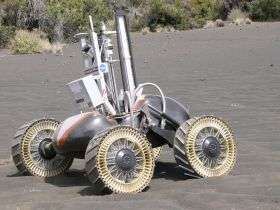
NASA has concluded nearly two weeks of testing equipment and lunar rover concepts on Hawaii's volcanic soil. The agency's In Situ Resource Utilization Project, which studies ways astronauts can use resources found at landing sites, demonstrated how people might prospect for resources on the moon and make their own oxygen from lunar rocks and soil.
The tests helped NASA gain valuable information about systems that could enable a sustainable and affordable lunar outpost by minimizing the amount of water and oxygen that must be transported from Earth. The Pacific International Space Center for Exploration Systems, known as PISCES and based at the University of Hawaii, Hilo, hosted the tests. Research teams and NASA experts held the tests of several NASA-developed systems in Hawaii because its volcanic soil is very similar to regolith, the moon's soil.
NASA's lunar exploration plan currently projects that on-site lunar resources could generate one to two metric tons of oxygen annually. This is roughly the amount of oxygen that four to six people living at a lunar outpost might breathe in a year. The field demonstrations in Hawaii showed how lunar materials might be extracted. It also showcased the hydrogen reduction system used to manufacture oxygen from those materials and how the oxygen would be stored. These experiments help engineers and scientists spot complications that might not be obvious in laboratories.
A prototype system combines a polar prospecting rover and a drill specifically designed to penetrate the harsh lunar soil. The rover's system demonstrates small-scale oxygen production from regolith. A similar rover could search for water ice and volatile gases such as hydrogen, helium, and nitrogen, in the permanently shadowed craters of the moon's poles. Carnegie Mellon University of Pittsburgh built the rover, which carries equipment known as the Regolith and Environment Science and Oxygen and Lunar Volatile Extraction.
Larger, complementary systems that might produce oxygen from soil on an outpost-sized scale are known as ROxygen and the Precursor ISRU Lunar Oxygen Testbed, or PILOT.
A NASA-developed robotic excavator known as Cratos collected soil for the ROxygen system. Also tested was an excavator developed by Lockheed Martin of Denver that uses a bucket drum to collect and deliver soil to PILOT.
Other tested concepts include a new lunar wheel Michelin North America of Greenville, S.C. developed; a lunar sample coring drill the Northern Centre for Advanced Technology in Canada developed for NASA with support from the Canadian Space Agency, or CSA; and a night vision camera called TriDAR for the rover's navigation and drill site selection. Neptec in Canada developed the camera with support from CSA.
Additional instruments that were field tested will be used to improve understanding of minerals found on the moon. They include a Mossbauer spectrometer from NASA's Johnson Space Center in Houston and the University of Mainz in Germany; an X-ray diffraction unit called mini CheMIN from NASA's Ames Research Center at Moffett Field, Calif., and the Los Alamos National Laboratory in New Mexico; and a handheld Raman spectrometer CSA provided.
CSA also provided a utility support vehicle from Ontario Drive Gear for personnel and hardware transportation on site as well as to evaluate mobility attributes for future human and project-related lunar mobility platforms. Representatives of the German Space Agency demonstrated an autonomous mole drill technology developed for Mars exploration that might be used in future lunar robotic missions.
In addition to tests in laboratories and rock yards, NASA conducts tests at sites around the world known as analogs because they simulate the moonscape and other extreme environments. These analog activities take place in remote field locations where NASA can evaluate the interactions of multiple mission systems relating to mobility, infrastructure, and effectiveness in harsh climates. Hawaii's volcanic terrain, rock distribution and soil materials provide a high-quality simulation of the moon's polar region. Early demonstrations provide valuable information for subsequent hardware and mission concept development.
Provided by NASA


