Hormones and brain activity: Study sheds light on facial preferences
November 13, 2008
Hormones and brain activity: Study sheds light on facial preferences

Enlarge

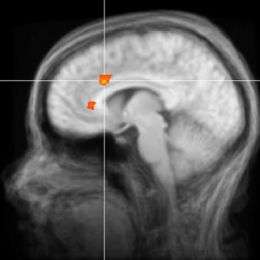
The red marks an area where researchers observed increased activation in response to masculinized compared to feminized faces during the follicular phase, which is closer to ovulation and higher fertility time. This activation is located in the anterior cingulate cortex, which is a region involved in decision-making, specifically the evaluation of potential reward and risk.

(PhysOrg.com) -- Scientists have long known that women's preferences for masculine men change throughout their menstrual cycles. A new study from Indiana University's Kinsey Institute is the first to demonstrate differences in brain activity as women considered masculinized and feminized male faces and whether the person was a potential sexual partner.

The researchers identified regions of the brain that responded more strongly to masculine faces and demonstrated that differences between masculinized and feminized faces appeared strongest when the women were closer to ovulating.

The study, published in an online edition of the journal Evolution and Human Behavior, sheds light on the link between women's hormone levels and their brain responses to masculinized versus feminized male faces, potentially offering insights into female mate preferences. The current study points towards enhancements of both sensory discrimination and risk processing around ovulation in response to masculine faces as possible mediators of women's mate preferences.

"One area of the brain in which we observed a difference in activation in response to masculinized versus feminized faces -- specifically during the follicular phase -- was the anterior cingulate cortex, which is a region involved in decision-making and the evaluation of potential reward and risk," said neuroscientist Heather Rupp, research fellow at the Kinsey Institute for Research in Sex, Gender and Reproduction. "Activation in this region has been previously reported to correlate with 'high risk' nonsocial choices, specifically monetary risk, so it is interesting that it is observed to be more active in response to masculinized male faces, who may be both riskier but more rewarding to women."

Previous studies have shown that women's sexual preference for facial characteristics vary depending on their menstrual phase. These fluctuating preferences are thought to reflect evolutionarily founded changes in women's reproductive priorities. Around the time of ovulation women prefer more masculinized faces -- faces with features that indicate high levels of testosterone. These facial cues predict high genetic quality in the male because only such males can afford the immune-compromising effects of testosterone. Testosterone may be costly for the males' mates as well because high testosterone levels also are associated with high rates of offspring abandonment.

Around the time of ovulation, a female's preference apparently shifts from avoiding negligent parenting to acquiring the best genes for her offspring. At other points during the cycle, women will prefer more feminized male faces, as they might signal a higher willingness of the males to invest in offspring.

Rupp and her team set out to explore the link between hormone levels and brain responses to masculinized versus feminized male faces. Pictures of 56 male faces were masculinized and feminized using standard computer-morphing software. Twelve heterosexual women, averaging about 25 years old, were tested during the follicular phase, which is closer to ovulation and higher fertility time, and the luteal phases of their menstrual cycles. Before each test session their blood was collected for hormone analyses. While brain activity was measured using functional Magnetic Resonance Imaging, women viewed the masculinized and feminized male faces, indicating their interest in the man depicted as a potential sexual partner.

Researchers found differences in brain regions related to face perception, decision making and reward processing that responded more strongly to masculinized than feminized faces, suggesting that "neural activation in response to face stimuli is sensitive to facial masculinization, even in the absence of differences in subjective ratings." Differences between masculinized and feminized faces appeared strongest during the follicular phase, closer to ovulation.

Provided by Indiana University

3.7 /5 (20 votes)  

Filter


Move the slider to adjust rank threshold, so that you can hide some of the comments.


Display comments: newest first

Arikin
Nov 13, 2008

Rank: 5 / 5 (1)
The decision and reward processing is involved because pregnancy and maternal care afterward is a large time and energy investment. The reward is passing on your genetic code but with genes that promote a healthy baby.
superhuman
Nov 14, 2008

Rank: 5 / 5 (3)
Actually there is more to this, this shifting preferences are the result of female politics and evolved cause we evolved from pack animals.

Females use sex not only as a means of reproduction but also as currency.

During their fertile days they focus on masculinity cause it is linked to high testosterone levels higher aggression and therefore higher chances to win the fight for the leader of the pack, which in turn means their genes will be widely spread.

During infertile days OTOH females concentrate on feminized males and use sex to buy their support in pack politics and child care.

Feminized males play a role of babysitters and pawns of females who in turn serve the leader of the pack and hope their children will one day take his position.

Neat, huh?

PS. Bulling which was also mentioned in one of the articles here recently is exactly what defines which males will take on the role of babysitters and which will aspire to the position of the leader in their adult lives, both kinds are needed for a successful pack.

In fact we still are pack animals.
Rank 3.7 /5 (20 votes)
Relevant PhysicsForums posts
  • Is Everyday Technology Killing Us?
    createdFeb 08, 2012
  • Exercise and weight loss
    createdFeb 08, 2012
  • Why do we have head aches? Our brains can't feel anything.
    createdFeb 07, 2012
  • "The end of diseases" by David Agus, interview from Daily Show with Jon Stewart
    createdFeb 04, 2012
  • Oncolytic adenovirus
    createdFeb 04, 2012
  • Nutrition label stuffs and diets
    createdFeb 02, 2012
  • More from Physics Forums - Medical Sciences

More news stories

Overeating may double risk of memory loss

New research suggests that consuming between 2,100 and 6,000 calories per day may double the risk of memory loss, or mild cognitive impairment (MCI), among people age 70 and older. The study was released today and will be ...

Medicine & Health / Neuroscience

created 4 hours ago | popularity 5 / 5 (2) | comments 0 | with audio podcast

Starve a virus, feed a cure? Findings show how some cells protect themselves against HIV

A protein that protects some of our immune cells from the most common and virulent form of HIV works by starving the virus of the molecular building blocks that it needs to replicate, according to research published online ...

Medicine & Health / Research

created 7 hours ago | popularity 5 / 5 (1) | comments 0 | with audio podcast

Declining health-care productivity in England: Who says so?

Reports that the National Health Service in England has been declining in productivity in the last decade appear to have been accepted as fact. However, a Viewpoint published Online First by The Lancet disputes this. The Vi ...

Medicine & Health / Health

created 2 hours ago | popularity not rated yet | comments 0

Injured boomers beware: Know when to see doctor

(AP) -- It happened to nurse Jane Byron years after an in-line skating fall, business owner Haralee Weintraub while doing "men's" push-ups, and avid cyclist Gene Wilberg while lifting a heavy box.

Medicine & Health / Health

created 9 hours ago | popularity 5 / 5 (1) | comments 0

FDA-approved drug rapidly clears amyloid from the brain, reverses Alzheimer's symptoms in mice

Neuroscientists at Case Western Reserve University School of Medicine have made a dramatic breakthrough in their efforts to find a cure for Alzheimer's disease. The researchers' findings, published in the journal Science, show t ...

Medicine & Health / Neuroscience

created Feb 09, 2012 | popularity 4.9 / 5 (58) | comments 17 | with audio podcast


Scientists discover molecular secrets of 2,000-year-old Chinese herbal remedy

For roughly two thousand years, Chinese herbalists have treated Malaria using a root extract, commonly known as Chang Shan, from a type of hydrangea that grows in Tibet and Nepal. More recent studies suggest that halofuginone, ...

New method to examine batteries -- MRI from the inside

There is an ever-increasing need for advanced batteries for portable electronics, such as phones, cameras, and music players, but also to power electric vehicles and to facilitate the distribution and storage of energy derived ...

A mitosis mystery solved: How chromosomes align perfectly in a dividing cell

Although the process of mitotic cell division has been studied intensely for more than 50 years, Whitehead Institute researchers have only now solved the mystery of how cells correctly align their chromosomes during symmetric ...

Google might launch Drive for cloud storage soon

(PhysOrg.com) -- Google's next big move, according to the Wall Street Journal, is a cloud storage service called Drive. Hardly first to the plate, Google is simply catching up to introducing its cloud reposi ...

Lab study raises questions over nano-particle impact

Tests involving chickens have raised questions about the impact on health from engineered nano-particles, the ultra-fine grains commonly used in drugs and processed foods, scientists said on Sunday.

Researchers find extensive RNA editing in human transcriptome

In a new study published online in Nature Biotechnology, researchers from BGI, the world's largest genomics organization, reported the evidence of extensive RNA editing in a human cell line by analysis of RNA-seq data, demons ...