Marine plankton found in amber
November 13, 2008 Marine plankton found in amber

Enlarge

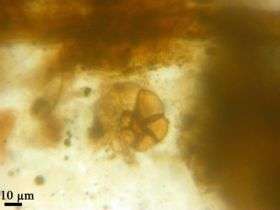
Foraminifer found in amber

(PhysOrg.com) -- Marine microorganisms have been found in amber dating from the middle of the Cretaceous period. The fossils were collected in Charente, in France. This completely unexpected discovery will deepen our understanding of these lost marine species as well as providing precious data about the coastal environment of Western France during the Cretaceous.

This work was carried out by researchers at the Géosciences Rennes laboratory (CNRS/Université de Rennes 1), together with researchers from the Paléobiodiversité et Paléoenvironnement laboratory in Paris (CNRS/Muséum national d'histoire naturelle/Université Pierre et Marie Curie) and the Centre de Géochimie de la Surface in Strasbourg (CNRS/Université de Strasbourg 1). It was published in the 11 November 2008 issue of PNAS.

Amber is a fossil resin with a reputation for preserving even the most minute details of insects and other terrestrial arthropods (spiders, scorpions, mites) that lived in resiniferous trees. The forest-based provenance of amber in theory makes it impossible for marine animals to be trapped in the resin.

Nonetheless, researchers from the Géosciences Rennes laboratory have discovered various inclusions of marine plankton in amber from the Mid-Cretaceous (100 to 98 million years BP). These micro-organisms are found in just a few pieces of amber among the thousands that have been studied, but show a remarkable diversity: unicellular algae, mainly diatoms found in large numbers, traces of animal plankton, such as radiolaria and a foraminifer, spiny skeletons of sponges and of echinoderms.

Carried out together with researchers at the Muséum national d'histoire naturelle, the study of diatoms pushed back by 10 to 30 million years the known date for the appearance of certain marine forms of this type of algae. This new information, taken together with recent data on molecular phylogeny, marks a huge advance in our understanding of the complex evolutionary history of diatoms.

The presence of these marine organisms in the amber is an ecological paradox. How did these marine species become stuck and then trapped in the conifers' resin? The most likely scenario is that the forest producing the amber was very close to the coast, potentially shrouded by plankton-bearing mist or flooded by sea water during storms.

The preservation of marine organisms in amber is an exceptional asset, allowing us to deepen our understanding of these lost species and to have a clear idea about the coastal environment of Western France during the Cretaceous.

Citation: Evidence for marine microfossils from amber, V. Girard, A. R. Schmidt, S. Saint Martin, S. Struwe, V. Perrichot, J-P. Saint Martin, D. Grosheny, G. Breton and D. Néraudeau, PNAS, 11 November 2008.

Provided by CNRS


Rate this story - 4.4 /5 (35 votes)

Rank Filter

Move the slider to adjust rank threshold, so that you can hide some of the comments.


Display comments: newest first

  • wawadave - Nov 13, 2008
    • Rank: 1.8 / 5 (4)
    tree may have fallen in rive washed down to sea.reason may have landed in river washed into the sea.
    More likely things flow from land to sea then sea to land.
  • KB6 - Nov 16, 2008
    • Rank: not rated yet
    Very cool discovery. And yes, anyone who's been anywhere that forests meet the sea can see how it could have happened.
  • kuczman - Nov 16, 2008
    • Rank: not rated yet
    Just as recent studies duplicated how these minute organisms get into fresh water submerged liquid resin. Done in Florida's swamp forests to see how amoebas and other organisms could possibly get trapped in amber.

November 13, 2008 all stories

Comments: 3

4.4 /5 (35 votes)

  • hide
  • Related Stories

  • NASA Studies Nanomechanics of Inner Ear
    created Feb 05, 2010 | popularity not rated yet | comments 0
  • Solar Dynamics Observatory: The 'Variable Sun' Mission
    created Feb 05, 2010 | popularity not rated yet | comments 0
  • Scientists complete color palette of a dinosaur for the first time
    created Feb 04, 2010 | popularity not rated yet | comments 0
  • Researcher to track spread of disease, malware and power outages
    created Feb 04, 2010 | popularity not rated yet | comments 0
  • New malaria vaccine is safe and protective in children, scientists find
    created Feb 04, 2010 | popularity not rated yet | comments 0


  • hide
  • Relevant PhysicsForums posts

Other News

Study challenges bird-from-dinosaur theory of evolution - was it the other way around?

Study challenges bird-from-dinosaur theory of evolution - was it the other way around?

Other Sciences / Archaeology & Fossils

created 16 hours ago | popularity 3.7 / 5 (11) | comments 4 | with audio podcast

(PhysOrg.com) -- A new study just published in the Proceedings of the National Academy of Sciences provides yet more evidence that birds did not descend from ground-dwelling theropod dinosaurs, experts say, a ...


New research reveals burglars have changed their 'shopping list'

Other Sciences / Social Sciences

created 4 hours ago | popularity 3.5 / 5 (2) | comments 3

Globalisation, and particularly cheaper electronic goods from China and the Far East, has altered behaviour among Britain's burglars according research in progress at the University of Leicester.


TED takes on 'What the world needs now'

Other Sciences / Other

created 4 hours ago | popularity not rated yet | comments 0

Let the mind-bending begin! A TED conference that attracts brilliant minds and challenges them to solve humanity's ills got underway Tuesday in the southern California city of Long Beach.


'Counterfactual' thinkers are more motivated and analytical, study suggests

Other Sciences / Social Sciences

created 20 hours ago | popularity 4.4 / 5 (5) | comments 6 | with audio podcast

(PhysOrg.com) -- "If only I had..." Almost everyone has said those four words at some time. Rather than intensifying regret, '"what if" reflection about pivotal moments in the past helps people to weave a coherent life story, ...


Office romance? Not a problem most of time: study

Office romance? Not a problem most of time: study

Other Sciences / Social Sciences

created 18 hours ago | popularity not rated yet | comments 1

(PhysOrg.com) -- Pam and Jim on The Office. Meredith and McDreamy on Grey's Anatomy. Television shows depict many workplace romances, but in the real world how do co-workers view love on the job? According ...