Putting a new spin on current research
November 15th, 2008 QuantumSpin

Enlarge

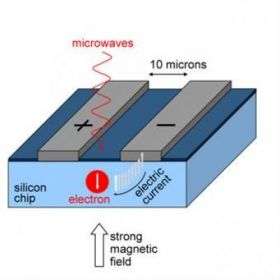
Microwaves are used to control the spin state of electrons held in silicon. This spin state can be watched in real time by measuring the electric current flowing between the (gray) electrodes. Credit: UCL/London Centre for Nanotechnology

Physicists in the USA and at the London Centre for Nanotechnology have found a way to extend the quantum lifetime of electrons by more than 5,000 per cent, as reported in this week's Physical Review Letters. Electrons exhibit a property called 'spin' and work like tiny magnets which can point up, down or a quantum superposition of both. The state of the spin can be used to store information and so by extending their life the research provides a significant step towards building a usable quantum computer.

"Silicon has dominated the computing industry for decades," says Dr Gavin Morley, lead author of the paper. "The most sensitive way to see the quantum behaviour of electrons held in silicon chips uses electrical currents. Unfortunately, the problem has always been that these currents damage the quantum features under study, degrading their usefulness."

Marshall Stoneham, Professor of Physics at UCL (University College London), commented: "Getting the answer from a quantum computation isn't easy. This new work takes us closer to solving the problem by showing how we might read out the state of electron spins in a silicon-based quantum computer."

To achieve the record quantum lifetime the team used a magnetic field twenty-five times stronger than those used in previous experiments. This powerful field also provided an additional advantage in the quest for practical quantum computing: it put the electron spins into a convenient starting state by aligning them all in one direction.

For more information, see the paper published in Physical Review Letters, November 14 2008, by G. W. Morley (London Center for Nanotechnology), D. R. McCamey (University of Utah), H. A. Seipel (University of Utah), L.-C. Brunel (National High Magnetic field Laboratory), J. van Tol (National High Magnetic field Laboratory) and C. Boehme (University of Utah). (http://link.aps.org/abstract/PRB/v78/e045303)

Source: University College London


print this article email this article download pdf blog this article bookmark this article     Digg this Stumble it share on Facebook share on Reddit add to delicious save to Yahoo! bookmarks
4.7/5 after 13 votes


November 15th, 2008 all stories
Physics / General Physics

Comments: 0
Rank: 4.7/5 after 13 votes

  • Stumble this up

  • Digg this

  • Share it:
  • share on Facebook
  • share on MySpace
  • share on Slashdot
  • rss-newsfeed
  • share on Google
  • share on Reddit
  • add to delicious
  • save to Yahoo! bookmarks
  • share on Windows Live
  • Add to Mixx!
Rating: 4.7/5 after 13 votes

  • Related Stories

  • Physicists Detect Single-Electron Tunneling with Quantum Dots
    created May 06, 2009 | popularity not rated yet | comments 0
  • Quantum ghosts are helpful
    created Apr 27, 2009 | popularity not rated yet | comments 0
  • New Research Promises Better Atomic Clocks
    created Apr 22, 2009 | popularity not rated yet | comments 0
  • Entangled Light in Bose-Einstein Condensates
    created Apr 08, 2009 | popularity not rated yet | comments 0
  • Secrets behind high temperature superconductors revealed
    created Feb 22, 2009 | popularity not rated yet | comments 0


  • Physicists Demonstrate Quantum Memory with Matter Qubits
    Physicists Demonstrate Quantum Memory with Matter Qubits
    Physics / General Physics
    created Jul 03, 2009 | popularity 4.4 / 5 (17) | comments 1
  • 'Holey' Nanosheets for Wastewater Dye Removal
    Nanotechnology / Nanomaterials
    created Jul 01, 2009 | popularity 5 / 5 (5) | comments 1
  • Jellyfish Robot Swims Like its Biological Counterpart
    Jellyfish Robot Swims Like its Biological Counterpart
    Electronics / Robotics
    created Jun 26, 2009 | popularity 4.4 / 5 (8) | comments 1
  • Could Maxwell's Demon Exist in Nanoscale Systems?
    Could Maxwell's Demon Exist in Nanoscale Systems?
    Physics / General Physics
    created Jun 24, 2009 | popularity 4.4 / 5 (18) | comments 29
  • Living Safely with Robots, Beyond Asimov's Laws
    Living Safely with Robots, Beyond Asimov's Laws
    Electronics / Robotics
    created Jun 22, 2009 | popularity 4.6 / 5 (52) | comments 40
  • Other News

    UQ researchers break the law -- of physics

    Physics / General Physics

    created 1hour ago | popularity 4.3 / 5 (3) | comments 0

    (PhysOrg.com) -- Two UQ Science researchers have proved two famous physical laws that have been widely used for the past 25 years do not always work.


    Scientists create first electronic quantum processor

    Scientists create first electronic quantum processor

    Physics / General Physics

    created Jun 28, 2009 | popularity 4.8 / 5 (54) | comments 41

    A team led by Yale University researchers has created the first rudimentary solid-state quantum processor, taking another step toward the ultimate dream of building a quantum computer.


    Science journals

    How to Spot an Influential Paper Based on its Citations

    Physics / General Physics

    created Jul 04, 2009 | popularity 4 / 5 (9) | comments 6

    (PhysOrg.com) -- At first it may seem that the number of citations received by a published scientific paper is directly related to that paper's quality of content. The higher the quality, the more people read ...


    Fermilab's CDF observes Omega-sub-b baryon

    Fermilab's CDF observes Omega-sub-b baryon

    Physics / General Physics

    created Jun 29, 2009 | popularity 4.7 / 5 (17) | comments 7

    (PhysOrg.com) -- At a recent physics seminar at the Department of Energy’s Fermi National Accelerator Laboratory, Fermilab physicist Pat Lukens of the CDF experiment announced the observation of a new particle, ...


    New insights, and a new angle, on high-temperature superconductivity

    New insights, and a new angle, on high-temperature superconductivity

    Physics / Superconductivity

    created Jun 29, 2009 | popularity 4.8 / 5 (13) | comments 6

    (PhysOrg.com) -- A Princeton-led research team has revealed surprising information about how electron behavior influences the conduction of electricity in a class of high-temperature superconductors. An increased ...