Glacial Erosion Changes Mountain Responses To Plate Tectonics
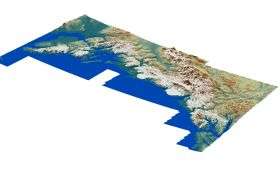
(PhysOrg.com) -- Intense glacial erosion has not only carved the surface of the highest coastal mountain range on earth, the spectacular St. Elias range in Alaska, but has elicited a structural response from deep within the mountain.
This interpretation of structural response is based on real-world data now being reported, which supports decades of model simulations of mountain formation and evolution regarding the impact of climate on the distribution of deformation associated with plate tectonics.
A team of researchers from seven universities report the results of their field studies, on the structural response of the St. Elias range to glacial erosion, in Nature Geosciences. The paper was a partnership of Aaron L. Berger, whose Ph.D. research it encompassed, his major professor, James A. Spotila, both with the Virginia Tech geosciences department; Sean P.S. Gulick of the Institute for Geophysics, Jackson School of Geosciences, at the University of Texas at Austin; and other colleagues. Berger and Spotila headed the land-based erosion research team. Gulick headed the ocean-based seismic reflection and sedimentation research team. The project is part of the National Science Foundation-funded St. Elias Erosion-Tectonics Project (STEEP), lead by Terry L. Pavlis of the University of Texas, El Paso.
The St. Elias range is a result of 10 million years of the North American plate pushing material up as it overrides the Pacific plate, then the material being worn down by glaciers. A dramatic cooling across the earth about three million years ago resulted in the onset of widespread glaciation. A million years ago, glacial conditions became more intense and glaciers grew larger over longer periods, and transitioned into more erosive ice streams that changed the shape and evolution of the mountains. The process continues today, resulting in the particularly active and dramatic St. Elias "orogen" – geologists' word for mountains that grow from collision of tectonic plates.
"The collisions of tectonic plates over millions of years leave a record in the sediments, but it is a history that is difficult to extract. The signals of the impact of climate are even more difficult to track. Which is why scientists have used mathematical models," said Spotila.
Models create a simplified numeric version of an orogen. Then scientists can change variables in the mathematical formula to determine what happens as a result of climate – whether rain or glaciers. "Models are important in that they showed us that climate change can effect mountain growth," Spotila said. "And the St. Elias orogen behaves very differently than ones that are at lower latitudes and receive most of their precipitation as rain," he said.
Armed with the insight of the models, Spotila, his Virginia Tech students, and colleagues at other universities have braved the mountain over many years to collect physical evidence. They have been dropped in remote and dangerous locations by helicopter to place instruments and collect samples to determine bedrock cooling rates and sedimentation.
"But our data set wouldn't have shown the complete picture," said Spotila. "We looked at the erosion history onshore and Gulick's team looked at the record off shore – the shelf where the eroded sediment rest."
Offshore seismic and borehole data indicate that the increase in offshore sedimentation corresponds to a one-million-year ago change in glaciation and deformation.
How does a change of the mountain surface result in a change of its internal structure? Spotila explained, "If you push snow with a plow, it will always pile up in front of the plow with the same shape," called the Coulomb wedge when applied to the making of mountains. As the North America plate slips over the Pacific plate, it piles up material for the St Elias orogen with a short side toward the plow inland and a long slope down to the ocean, with the toe dipping into the sea.
Enter the glacier. As glacial conditions took hold across the St. Elias orogen, the landscape began to be defined by glacial landforms left on its surface. However, the more extreme glacial cycles, and associated increased erosion, of the last million years pushed the orogen to a tipping point, beyond which the orogen was forced to totally restructure itself, Berger said. There are deformation zones where as much as half of the wedge was removed, the researchers report in the journal article.
Due the onset of accelerated glacial erosion, the St. Elias orogen struggled to maintain its wedge shape. "Rock faulting and folding has become more intense as the orogen internally deforms to adjust to the intensified erosion," said Spotila. "The flux of rock from the mountains to the sea is increasing dramatically."
Berger uses an analogy of a bulldozer pushing sand across the ground. "As the glaciers erode the top of the mountains (the top of the pile of sand), the orogen – or entire body of sand, begins readjusting itself internally to maintain its wedge-shape. If you could remove the glaciers and watch the process, the flank of the mountain range where the largest glaciers are located would begin to get planed away by erosion, reducing mean elevation. The removal of this rock would change the local tectonic stress fields, resulting in focused deformation, which would begin to push the mountains back up to replace the eroded material.".
The research showed how a change in climate led to a change in the way the motion of tectonic plates is accommodated by structural deformation within the orogen, Spotila said. "The wedge is still present but has narrowed with the eroded material deposited across the toe. Some faults, which previously responded to the push of the plow or tectonic plate, are relocated to respond to the erosion."
Spotila concludes, "It is remarkable that climate and weather and the atmosphere can have such a profound impact on tectonics and the behavior of the solid earth."
References:
The article, Quaternary tectonic response to intensified glacial erosion in an orogenic wedge, was written by Berger, a Virginia Tech geosciences Ph.D. graduate, now a geoscientist with ConocoPhillips; Gulick; Spotila; Phaedra Upton, post-doctoral fellow at the University of Maine, now a research fellow at the University of Otago; John M. Jaeger, associate professor of geology, University of Florida; James B. Chapman of the University of Texas, El Paso; Lindsay A. Worthington, a graduate student at the University of Texas at Austin; Pavlis; Kenneth D. Ridgway, professor of earth and atmospheric sciences at Purdue University; Bryce A. Willems, Ph.D. candidate in the geological and environmental geosciences at Northern Illinois University; and Ryan J. McAleer, a Virginia Tech geosciences M.S graduate, now a geoscientist with the U.S. Geological Survey. Published online: October 26, 2008 (www.nature.com/ngeo/journal/v1 … n11/abs/ngeo334.html).
The research by Berger and Spotila is also the cover story in the July 2008 issue of Geology: geology.geoscienceworld.org/cg … nt/abstract/36/7/523
Provided by Virginia Tech


