Scientists Discover Another Reason for Glacial Acceleration
November 17, 2008 Antarctica, which seemed to have largely escaped global warming, is melting too, a study shows

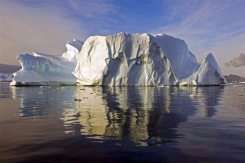
File photo of an iceberg in North Bay, Rothera Point, Adelaide Island, Antarctica. Scientists unveiled Sunday the first direct evidence that massive floods deep below Antarctica's ice cover are accelerating the flow of glaciers into the sea.

(PhysOrg.com) -- Using nearly 50 years of data, University of Maine researchers have determined that subglacial floods in East Antarctica caused a rapid and short-lived acceleration of a major outlet glacier.

Leigh Stearns and Gordon Hamilton of UMaine's Climate Change Institute, along with Benjamin Smith of the University of Washington, observed that the flow rate of a large outlet glacier in East Antarctica increased by about 10 percent in response to the flooding of two subglacial lakes.

The team's findings are based on a 48-year record of ice velocities along Byrd Glacier, East Antarctica along with recent satellite observations of ice surface elevation and ice velocities from NASA's Advanced Spaceborne Thermal Emission and Reflection Radiometer instrument on NASA's Terra satellite; the Ice, Cloud and Land Elevation Satellite; and Landsat; as well as SPOT and Japan's Advanced Land Observing Satellite, and have been reported in a Nature Geoscience paper.

"We saw that there was this very rapid acceleration of the glacier that we didn't initially have an explanation for," Hamilton said.

It wasn't until Stearns presented these observations at a conference last year that we recognized the connection between the glacier acceleration and the subglacial drainage event.

"After my presentation," explains Stearns, "Ben [Smith, co-author] and I compared the timing of the flooding event that he measured, and the acceleration of Byrd Glacier, and were excited to find that they occurred at roughly the same time."

The increase in ice flow speed coincides with rapid changes in ice surface elevation about 200 km upstream, which the research team interprets as the filling and draining of two subglacial lakes.

"Our work shows that the speed of the glacier can change by a very large amount," Hamilton said. "It only lasted for a year, but if the same process happens again at a larger scale, sea level could rise much quicker."

For the past year, some of the team's colleagues have been mapping subglacial lakes and discovered that they are quite prevalent.

"Our understanding of why they occur is minimal," Hamilton said, noting that it previously was thought that these lakes were stable and relatively inactive.

"The more we look, the more we see that these lakes fill up and drain," Hamilton said.

"One of the implications of this work," explains Stearns, "is that the addition of even a small amount of water to the bottom of a glacier can cause significant acceleration. While the changes taking place on Byrd Glacier are not caused by climate-driven processes, they highlight the sensitivity of glaciers to small changes."

Future investigations are expected to look at other subglacial lakes to measure their activity and determine how to include subglacial flooding in current ice sheet models for more accurate predictions of sea level changes.

"We need to include all the important processes that cause the ice sheets to grow and shrink," Hamilton said.

Provided by University of Maine


print this article email this article download pdf blog this article bookmark this article     Stumble it Digg this share on Facebook retweet share on Reddit add to delicious
Rate this story - 3.9 /5 (31 votes)

Rank Filter

Move the slider to adjust rank threshold, so that you can hide some of the comments.


Display comments: newest first

  • Arkaleus - Nov 17, 2008
    • Rank: 2.9 / 5 (10)
    Another example of hysterical, anecdotal information created to generate an unwarranted sense of urgency. The planet has been warming for thousands of years, and will continue to warm until the cycle reaches its maxima.

    The oceans have been rising for tens of thousands of years, and have varied by hundreds of meters over time. It is ignorant to attribute any sort of crisis to this phenomenon, and it is downright malicious to use it for political and economic gain.

    Governments find themselves desperate to erect a new framework for their massive, defunct cold war bureaucracies, and the more devious within them have latched onto ecology as a means to unify their efforts and generate the new crisis needed to justify their power schemes.

    Along with terrorism, eco-hysteria seems to be the engine the powers-that-be want to drive for their own profit and power.

    Not a single governmental mandate can alter earth's climate, and no one can claim we even begin to understand the great number of variables or the relationships between them. It is irresponsible and dangerous for political (read: UNSCIENTIFIC) figures to make policy based on fallacious and incomplete data.
  • dbren - Nov 17, 2008
    • Rank: 3.2 / 5 (9)
    There is nothing in this article to tie the subglacial water flows to global warming. We're fast reaching the point that any unexpected change anywhere on the Earth is going to be tied to global warming simply by assertion. That's not science.
  • Velanarris - Nov 17, 2008
    • Rank: 3 / 5 (7)
    The ice sheet that sits atop Greenland, for example, contains enough water to raise world ocean levels by seven metres (23 feet).
    No it doesn't. If you assume that the oceans are a vertical walled glass then you can get up to 6.5 meters, but no knowledgable person expects the entire Greenland ice sheet to melt within our lifetimes, our childrens, or their children's lifetimes.
  • lengould100 - Nov 27, 2008
    • Rank: 2.3 / 5 (3)
    Arkaelus: "The planet has been warming for thousands of years, and will continue to warm until the cycle reaches its maxima."

    Don't suppose you have a reference for that little error? No, of course not.
  • Velanarris - Nov 28, 2008
    • Rank: 1 / 5 (1)
    Arkaelus: "The planet has been warming for thousands of years, and will continue to warm until the cycle reaches its maxima."

    Don't suppose you have a reference for that little error? No, of course not.
    Well he does.

    The Ice Age was thousands of years ago. Had to be pretty cold for that I'd say.

November 17, 2008 all stories

Comments: 5

3.9 /5 (31 votes)
  • Stumble this up

  • Digg this

  • share this

  • hide
  • Related Stories

  • In Greenland, warming fuels dream of hidden wealth
    created 11 hours ago | popularity not rated yet | comments 0
  • Climate experts debate strategies for reducing atmospheric carbon and future warming
    created Nov 25, 2009 | popularity not rated yet | comments 0
  • From Greenhouse to Icehouse
    created Nov 24, 2009 | popularity not rated yet | comments 0
  • Antarctic ice loss vaster, faster than thought: study
    created Nov 22, 2009 | popularity not rated yet | comments 0
  • Mysteriously warm times in Antarctica
    created Nov 18, 2009 | popularity not rated yet | comments 0


  • hide
  • Relevant PhysicsForums posts

  • Climate Science Update
    created 10 hours ago
  • The IPCC and the term "most"
    created Nov 23, 2009
  • Is global warming a fact?
    created Nov 23, 2009
  • Random variability of wind patterns
    created Nov 23, 2009
  • More from Physics Forums - Earth

Other News

Fermi Telescope Peers Deep into Microquasar

Fermi Telescope Peers Deep into Microquasar (w/ Video)

Space & Earth / Astronomy

created 7 hours ago | popularity 4.3 / 5 (3) | comments 0

(PhysOrg.com) -- NASA's Fermi Gamma-ray Space Telescope has made the first unambiguous detection of high-energy gamma-rays from an enigmatic binary system known as Cygnus X-3. The system pairs a hot, massive ...


The Energy Sources of Ultraluminous Galaxies

The Energy Sources of Ultraluminous Galaxies

Space & Earth / Astronomy

created 7 hours ago | popularity 4.3 / 5 (7) | comments 0

(PhysOrg.com) -- Ultraluminous infrared galaxies ((ULIRGs) are galaxies whose luminosity exceeds that of a trillion suns; for comparison, the Milky Way galaxy has a typical (and much more modest) luminosity ...


Space shuttle Atlantis, 7 astronauts back on Earth (AP)

Space shuttle Atlantis, 7 astronauts back on Earth

Space & Earth / Space Exploration

created 8 hours ago | popularity not rated yet | comments 0

(AP) -- Space shuttle Atlantis and its seven astronauts returned to Earth with a smooth touchdown Friday to end an 11-day flight that resupplied the International Space Station.


Herschel takes a peek at the ingredients of the galaxies

Herschel takes a peek at the ingredients of the galaxies

Space & Earth / Astronomy

created 5 hours ago | popularity 5 / 5 (1) | comments 0

(PhysOrg.com) -- The European Space Agency has today released spectacular new observations from the Herschel Space Observatory, including the UK-led SPIRE instrument. Spectrometers on board all three Hershel ...


China is set to launch its second moon orbiter next October, state media have reported

China to launch second lunar probe: state media

Space & Earth / Space Exploration

created 12 hours ago | popularity 5 / 5 (3) | comments 0

China will launch its second moon orbiter next October, state media reported Friday, as it powers ahead with a space programme that has sparked concerns abroad.