Breaking BubR1 mimics genetic shuffle seen in cancer cells
November 17th, 2008 Breaking BubR1 mimics genetic shuffle seen in cancer cells

Enlarge

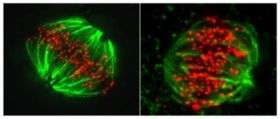
Left: Normal metaphase, kinetochores (red dots) attach to chromosomes (not visible), which are then pulled apart by microtubules (green lines). Right: A mutation in BubR1 cause kinetochores to create aberrant attachments to chromosomes, leading to improper segregation. Credit: Fox Chase Cancer Center

A study of how one protein enzyme, BubR1, helps make sure chromosomes are equally distributed during mitosis might explain how the process of cell division goes so awry in cancer, according to researchers from Fox Chase Cancer Center. Their findings might offer a better understanding of the processes behind cancer-cell survival and drug-resistance.

In an article published online today in the Journal of Cell Biology, the Fox Chase re-searchers demonstrate that the BubR1 protein contains four separate functional areas that take part in cell division. Mutations in these areas, the researchers say, lead to a genetic rearrangement similar to a process that allows cancer cells to evade destruction by medi-cal treatment. Inhibiting BubR1 could be a strategy that enhances the killing power of current therapeutics, co-author Tim J. Yen, Ph.D., believes.

"Improper chromosomal segregation is a hallmark of cancer – it scrambles chromosomes and shuffles the genetic deck in a way that helps some cancer cells to evade destruction," says Yen, a senior member of the Fox Chase scientific staff. "This shuffling can, in ef-fect, push a cancer cell to evolve in a way that allows it to survive drug or radiation ther-apy."

According to Yen, cancer cells survive by playing a risky evolutionary gamble. Improper chromosomal segregation allows cancer cells to shuffle their genetic deck to select for traits that allow them to survive and continue to grow. The downside of this strategy is that some daughter cells are dealt bad hands and die. As long as the genetic alterations are made on a relatively small scale, Yen says, cells within the tumor will continually evolve so that they can readily adapt to drugs.

"But here is an opportunity to force cancer's hand, as it were, by causing more damaging changes on a much larger scale than cancer cells can handle," Yen says. "Given that BubR1 is responsible for properly dealing from the genetic deck, its inhibition would re-sult in catastrophic genetic changes that are incompatible with cancer-cell life."

The BubR1 enzyme has multiple roles as part of the cellular machinery that physically moves each of the 23 pairs of human chromosome into each new daughter cell. The pro-tein also plays a part in regulating the so-called mitotic checkpoints, which serve as qual-ity control for cell division. If the machinery does not function properly or the check-points are ignored, some daughter cells get more than their accustomed share of DNA, which can offer them a competitive advantage, Yen says.

Yen and Haomin Huang, Ph.D., a postdoctoral fellow in Yen's laboratory and lead author of the paper, determined that the structure of the BubR1 protein undergoes four chemical modifications that may be important for turning the activity of this enzyme off or on. By mutating BubR1 at positions within the protein that become chemically modified, the re-searchers were able to determine some of the protein's roles in the process of chromo-some segregation during mitosis.

One position in particular, labeled S670, was found to be essential in preventing division errors. It serves as a means of connecting chromosomes to the microtubule proteins that pull them into the daughter cells. When the researchers prevented S670 from being prop-erly modified, cell-culture studies showed that the chromosomes failed to be distributed equally between the daughter cells during division.

"Our studies show that of all the proteins and protein complexes associated with cell divi-sion, the phosphorylation status of BubR1 is a determining factor in cell-cycle control," Yen says. "Exploiting BubR1's crucial functions may help to increase the efficiency of cancer drugs that disrupt DNA replication, like gemcitabine, or drugs that prevent cell division, like paclitaxel."

Source: Fox Chase Cancer Center


print this article email this article download pdf blog this article bookmark this article     Digg this Stumble it share on Facebook share on Reddit add to delicious save to Yahoo! bookmarks
5/5 after 1 votes


November 17th, 2008 all stories
Medicine & Health / Cancer

Comments: 0
Rank: 5/5 after 1 votes

  • Stumble this up

  • Digg this

  • Share it:
  • share on Facebook
  • share on MySpace
  • share on Slashdot
  • rss-newsfeed
  • share on Google
  • share on Reddit
  • add to delicious
  • save to Yahoo! bookmarks
  • share on Windows Live
  • Add to Mixx!
Rating: 5/5 after 1 votes


  • Physicists Demonstrate Quantum Memory with Matter Qubits
    Physicists Demonstrate Quantum Memory with Matter Qubits
    Physics / General Physics
    created Jul 03, 2009 | popularity 4.4 / 5 (17) | comments 1
  • 'Holey' Nanosheets for Wastewater Dye Removal
    Nanotechnology / Nanomaterials
    created Jul 01, 2009 | popularity 5 / 5 (5) | comments 1
  • Jellyfish Robot Swims Like its Biological Counterpart
    Jellyfish Robot Swims Like its Biological Counterpart
    Electronics / Robotics
    created Jun 26, 2009 | popularity 4.4 / 5 (8) | comments 1
  • Could Maxwell's Demon Exist in Nanoscale Systems?
    Could Maxwell's Demon Exist in Nanoscale Systems?
    Physics / General Physics
    created Jun 24, 2009 | popularity 4.4 / 5 (18) | comments 29
  • Living Safely with Robots, Beyond Asimov's Laws
    Living Safely with Robots, Beyond Asimov's Laws
    Electronics / Robotics
    created Jun 22, 2009 | popularity 4.6 / 5 (53) | comments 40
  • Other News

    Microscopic 'beads' could help create 'designer' immune cells that ignore transplanted organs

    Microscopic 'beads' could help create 'designer' immune cells that ignore transplanted organs

    Medicine & Health / Research

    created 14 minutes ago | popularity not rated yet | comments 0

    The future of organ transplantation could include microscopic beads that create "designer" immune cells to help patients tolerate their new organ, Medical College of Georgia researchers say.


    New discovery points to a new treatment avenue for acute myeloid leukemia

    Medicine & Health / Cancer

    created 1minute ago | popularity not rated yet | comments 0

    Dr. John Dick, Senior Scientist at the Ontario Cancer Institute, the research arm of Princess Margaret Hospital, co-led a multinational team that has developed the first leukemia therapy that targets a protein, CD123, on ...


    Caffeine reverses memory impairment in Alzheimer's mice

    Caffeine reverses memory impairment in Alzheimer's mice

    Medicine & Health / Research

    created 5 hours ago | popularity not rated yet | comments 0

    Coffee drinkers may have another reason to pour that extra cup. When aged mice bred to develop symptoms of Alzheimer's disease were given caffeine - the equivalent of five cups of coffee a day - their memory ...


    Overweight individuals have greater risk of reduced memory and thinking skills in late life

    Medicine & Health / Health

    created 2 hours ago | popularity 1 / 5 (1) | comments 0

    Individuals with higher mid-life Body Mass Index (BMI) in the 1960s have been found to have lower memory and thinking skills and a sharper decline in these abilities in old age, compared to those with lower BMI in mid-life.


    Researchers find possible environmental causes for Alzheimer's, diabetes

    Medicine & Health / Diseases

    created 5 hours ago | popularity 5 / 5 (2) | comments 1

    A new study by researchers at Rhode Island Hospital have found a substantial link between increased levels of nitrates in our environment and food with increased deaths from diseases, including Alzheimer's, diabetes mellitus ...