Gaps in Adhesion
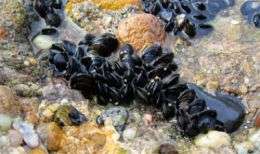
(PhysOrg.com) -- Chemists can learn from some shellfish. Mussels, for example, produce an adhesive that sticks strongly to metal and stone, even under water. Chemists have reproduced the protein responsible for this in a synthetic material that contains the same adhesive elements. Irrespective of whether the adhesive is completely made up of these elements or whether they represent just a tenth of its make-up, adhesion is equally good. These findings were made by researchers at the Max Planck Institute for Polymer Research and at the Johannes Gutenberg University in Mainz. It might be possible to use the 90% of the polymers that are not necessary to create a good bond for other functions by providing them with chemical adjuncts which will allow them to adhere to surfaces other than metal or stone. (Advanced Materials, October 2008)
Some shellfish have a hard life: when they settle at the bottom of the sea close to the coast, the constant surging to and fro of the surf pulls at them. So that they are not washed away by the waves, the shellfish use special proteins to attach themselves firmly to a foundation - an ability that engineers still find difficult to achieve: adhesion under water. The shellfish can do this thanks to the amino acid dihydroxyphenylalanine, also known as dopa. Its chemical structure allows it to form very stable bonds with metals and minerals and is contained in the adhesion proteins with which shellfish attach themselves to the sea bed.
Scientists working with Hans-Jürgen Butt, Director at the Max Planck Institute for Polymer Research in Mainz, and Professor Wolfgang Tremel from the University of Mainz, have now reproduced the adhesive shellfish proteins with artificial polymers. These consist of long chains of molecules and carry the same chemical adjuncts that make the shellfish proteins adhesive. As the researchers in Mainz have now discovered, the number of the links in the chain carrying the binding dopa adjuncts has no overall relevance for the chain's adhesiveness, provided it is not less than 10% of the total.
The researchers measured the force which allowed them to detach different polymer chains from a surface. They tested polymers that consisted completely of links with the binding dopa adjunct and some where it was only present on a fifth or a tenth of the links. The force required to pull a single polymer from the surface was always the same: 67 piconewtons. This is equivalent to a millionth of the weight force of a flea. This force alone could not keep a shellfish on the bottom of the sea. However, the creatures attach themselves firmly with a dab containing innumerable polymer chains, which allows them to brave the movement of the waves.
"The fact that the adhesive effect is, to a certain extent, independent on the number of binding sites could be used to give the other links in the polymer other functions," says Hans-Jürgen Butt. For example, chemists could manufacture a polymer that adheres equally to different materials. Dopa bonds predominantly with metals and minerals. Chemists could provide other links in the polymer chain with adjuncts that adhere to wood, glass or bone. Adhesives which bond metal and bone would be interesting for securing artificial joints," says Wolfgang Tremel.
At first, the researchers in Mainz were puzzled as to why the adhesive strength of the polymer chains was largely independent of the number of adhesive links. "Normally, we imagine that an adhesive polymer is like a strip of scotch tape that adheres over the whole of its length," says Hans-Jürgen Butt. However, the more an adhesive strip bonds to a surface, the harder it is to pull it off. This model, which describes the adhesiveness of a polymer as a continuous force, does not apply to shellfish proteins and their artificial counterparts.
"We see our polymers as chains of single binding sites linked with very loose springs," says Wolfgang Tremel. When they peel them off, he and his team measure only the force with which a single binding site is anchored to the surface. How closely the adhesive links in the chain follow each other is then irrelevant.
The density of the binding sites would have an effect if a weight was pulling evenly across the whole length of the polymer and not from one end. "In practice, this only plays a part when the surface is completely level," explains Butt. "Most surfaces are very rough at nano level, so that a weight on one end always pulls more strongly there than on the other."
The scientists have designed their experiment to correspond to this detachment process. They apply a single layer of the polymer to a titanium surface. Using the titanium tip on an atomic force microscope, which only measures a few nanometers, they pick up a single chain of the polymer in the same way someone would pick up a thread from a table with their finger. Then they pull the tip away from the surface and measure the force required. They need 67 piconewtons to break the bond between the titanium surface and a dopa group on the polymer. As the polymer itself behaves like a loose spring, the force hardly falls before the next bond is broken, but remains almost constant.
The researchers now want to use the findings from this experiment to manufacture polymers with binding sites for different materials. The newly established Max Planck Graduate Center will be particularly suitable in future for pursuing this area of research as it will specialize in interdisciplinary projects of this nature.
Citation: Jijun Wang, Muhammed Nawaz Tahir, Michael Kappl, Wolfgang Tremel, Nadine Metz, Matthias Barz, Patrick Theato, Hans-Jürgen Butt, Influence of Binding-Site Density in Wet Bioadhesion, (Advanced Materials, October 2008)
Provided by Max-Planck-Gesellschaft


