Oak Ridge supercomputer is the world's fastest for science
A Cray XT high-performance computing system at the Department of Energy's (DOE) Oak Ridge National Laboratory is the world's fastest supercomputer for science. The annual ranking of the world's top 500 computers (www.top500.org) will be released Tuesday in Austin at an annual international supercomputing conference.
The Cray XT, called Jaguar, has a peak performance of 1.64 petaflops, (quadrillion floating point operations, or calculations) per second, incorporating a 1.382 petaflops XT5 and 266 teraflops XT4 systems. Each component of the Jaguar system is separately ranked second and eighth on the current list of Top500 supercomputers in the world.
"This accomplishment is the culmination of our vision to regain leadership in high performance computing and harness its potential for scientific investigation," said Undersecretary for Science Raymond L. Orbach. "I am especially gratified because we make this machine available to the entire scientific community through an open and transparent process that has resulted in spectacular scientific results ranging from the human brain to the global climate to the origins of the Universe."
Oak Ridge National Laboratory Director Thom Mason said the real value of the new machine will be measured by the scientific breakthroughs that will now be possible.
"We are proud to be home to the world's most powerful computer dedicated to open science, but we are more excited about the ability of Oak Ridge and the Department of Energy to take a leading role in finding solutions to scientific challenges such as new energy sources and climate change," Mason said.
In June, a DOE supercomputer named Roadrunner at Los Alamos National Laboratory was the first to break the petascale barrier. Built with advanced IBM Cell processors, Roadrunner helps ensure the reliability of America's nuclear weapons stockpile.
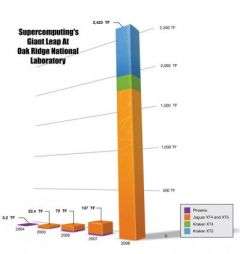
Beginning as a 26-teraflop system in 2005, Oak Ridge embarked upon a three-year series of aggressive upgrades designed to make their machine the world's most powerful computing system. The Cray XT was upgraded to 119 teraflops in 2006 and 263 teraflops in 2007. In 2008, with approximately 182,000 AMD Opteron processing cores, the new 1.64-petaflop system is more than 60 times larger than its original predecessor.
Thomas Zacharia, the laboratory's associate director for Computing and Computational Sciences, says petascale machines like Jaguar help advance critical scientific application areas by enabling researchers to get answers faster and explore complex, dynamic systems. In a matter of few days, Jaguar has already run scientific applications ranging from materials to combustion on the entire system, sustaining petaflops performance on multiple applications. A calculation that once took months can now be done in minutes. A 2008 report from the DOE Office of Science, America's largest funder of basic physical science programs at universities and government laboratories, said six of the top ten recent scientific advancements in computational science used Jaguar to provide unprecedented insight into supernovas, combustion, fusion, superconductivity, dark matter, and mathematics.
The DOE's Office of Science makes Jaguar available to scientists in academia, industry, and government to tackle the world's most complicated projects. Through the agency's Innovative and Novel Computational Impact on Theory and Experiment program, which allocates the supercomputer's resources through a peer-reviewed proposal system, researchers were allocated more than 140 million processor hours to 30 projects.
To date the computer simulations on Jaguar have focused largely on addressing new forms of energy and understanding the impact on climate resulting from energy use. For example, INCITE projects have simulated enzymatic breakdown of cellulose to make production of biofuels commercially viable as well as coal gasification processes to help industry design near-zero-emission plants. Combustion scientists have studied how fuel burns—important for fuel-efficient, low-emission engines. Computer models have helped physicists use radio waves to heat and control ionized fuel in a fusion reactor. Similarly, engineers have designed materials to recover energy escaping from vehicle tailpipes. Simulation insights have enabled biologists to design new drugs to thwart Alzheimer's fibrils and engineer the workings of cellular ion channels to detoxify industrial wastes.
Jaguar's superlative speed is matched by substantial memory that allows scientists to solve complex problems, sizeable disk space for storing massive amounts of data, and unmatched speed to read and write files. High-speed Internet connections enable users from around the world to access the machine, and high-end visualization helps them make sense of the avalanche of data Jaguar generates.
Twice a year, the TOP500 list ranks powerful computing systems on their speed in running a benchmark program called HPL, for High-Performance Linpack. In June of 2007, Jaguar solved the largest HPL challenge ever—a matrix problem with nearly 5 trillion elements. The achievement highlights Jaguar's skill in balancing processor speed and system memory.
Oak Ridge National Laboratory is managed by UT-Battelle for the U.S. Department of Energy.
Jaguar at a glance:
-- Cray XT
-- Top500 rank: 2 + 8
-- 1.64-petaflops peak theoretical performance
-- 1.059 + 0.205-petaflops actual performance on HPL benchmark program
-- 182,000 processing cores
-- AMD quad-core OpteronTM 2.3 gigahertz processors
-- InfiniBand network
-- Cray SeaStar network interface and router
-- 362 terabytes of memory
-- 578 terabytes per second of memory bandwidth
-- 284 gigabytes per second of input/output bandwidth
-- 10-gigabyte-per-second connections to ESnet and Internet 2 networks
-- High-Performance Storage System scales to store increasing amounts of simulation data
-- Spider, a 10-petabyte Lustre-based shared file system, connects to every system in the ORNL computing complex
-- disk subsystem transfers data at greater than 200 gigabytes per second
Source: Oak Ridge National Laboratory


