'Firefly' cubesat to study link between lightning and terrestrial gamma ray flashes
November 17th, 2008 'Firefly' cubesat to study link between lightning and terrestrial gamma ray flashes

Enlarge

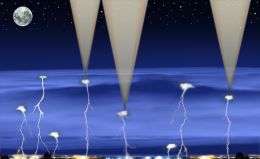
Scientists theorize that TGFs are linked to lightning and result when high-energy electrons are accelerated upward over thunder storms. Credit: NASA/Robert Kilgore

(PhysOrg.com) -- Massive energy releases occur every day in the upper reaches of Earth's atmosphere. Lightning may give rise to these bursts of radiation. However, unlike the well-known flashes of light and peals of thunder familiar to Earth-dwellers, these energy releases are channeled upward and can be detected only from space. Our atmosphere protects us from the effects of this radiation, but the mechanisms at work can impact Earth's upper atmosphere and its space environment.

A new nano satellite mission, called 'Firefly,' sponsored by the National Science Foundation (NSF) and led by NASA's Goddard Space Flight Center in Greenbelt, Md. will explore the relationship between lightning and these sudden bursts, called Terrestrial Gamma Ray Flashes (TGFs).

NASA's Compton Gamma Ray Observatory (CGRO) first discovered TGFs in the 1990s. Designed to look outward at cosmic sources of gamma rays, CGRO also caught rare but tantalizing glimpses of gamma rays coming from Earth.

TGFs are likely produced by beams of very energetic electrons, which are accelerated in the intense electric fields generated by large thunderstorm systems. Before CGRO, many scientists thought these very energetic types of radiation could be generated only near the Sun, or in black holes, large galaxies, or neutron stars.

"These electron beams are more powerful than any produced in near-Earth space, and understanding their acceleration mechanisms will shed light on a physical process that may occur on other planets, or in astrophysical environments, as well as in the sun's corona," said Doug Rowland, principal investigator for the Firefly mission at NASA Goddard's Space Weather Laboratory.

Firefly will explore which types of lightning produce these electron beams and associated TGFs. In addition, Firefly will explore the occurrence rate of TGFs that are weaker than any previously been studied. The result with be a better understanding of the effect that the millions of lightning flashes that occur worldwide each day have on the Earth's upper atmosphere and near-Earth space environment.

"This mission could provide the first direct evidence for the relationship between lightning and TGFs, and addresses an important research question in atmospheric electricity," said Anne-Marie Schmoltner, head of NSF's Atmospheric Sciences Division's Lower Atmosphere Research Section. "Identifying the source of terrestrial gamma ray flashes would be a great step toward fully understanding the physics behind lightning and its effect on the Earth's atmosphere."

The NSF CubeSat program represents a new "low cost access to space" approach to performing high-quality, targeted science on a smaller budget than is typical of larger satellite projects, which have price tags starting at $100 million. In contrast, the CubeSat Firefly will carry out its science mission in a much smaller package and at a considerably lower cost. The nano satellite is about the size of a football (4 by 4 by 12 inches). The cost to develop, launch, and operate Firefly for three years during its science mission is expected to be less than $1 million.

The Firefly mission also emphasizes student involvement as part of the ongoing effort to train the next generation of scientists and engineers. Students at Siena College, in Loudonville, N.Y., and the University of Maryland Eastern Shore, in Princess Anne, Md., will be involved in all phases of the Firefly mission.

"Integrating innovative and creative educational efforts with front-line research is what NSF is all about," said NSF Deputy Director Kathie L. Olsen. "The new CubeSat program uses the transformational technology of CubeSats to do just that. The Firefly mission is a terrific example of a program that will pursue scientific discovery, while providing unique and inspiring educational opportunities."

Firefly is funded and managed by the National Science Foundation, and will be developed as a collaborative effort by NASA Goddard Space Flight Center, Universities Space Research Association (USRA), Columbia, Md.; Siena College; University of Maryland Eastern Shore, Princess Anne, Md.; and the Hawk Institute for Space Sciences, in Pocomoke City, Md.

NASA Goddard, USRA, and Siena College will provide the instrument payload, while the Hawk Institute will build the CubeSat. NASA's Wallops Flight Facility on Wallops Island, Va., will provide technical oversight for the integration of Firefly to the launch vehicle.

Firefly's launch date is likely to be in 2010 or 2011. The micro satellite will fly as a secondary payload inside a Poly-Picosatellite Orbital Deployer (P-POD) provided by California Polytechnic State University, San Luis Obispo, Calif. Firefly will utilize the excess room and lift capacity not required by the primary mission payload.

Provided by NASA's Goddard Space Flight Center


print this article email this article download pdf blog this article bookmark this article     Digg this Stumble it share on Facebook share on Reddit add to delicious save to Yahoo! bookmarks
4.8/5 after 11 votes

Rank Filter

Move the slider to adjust rank threshold, so that you can hide some of the comments.


Display comments: newest first

  • axemaster - Nov 17, 2008
    • Rank: not rated yet
    Someone should find out the orbit of this thing and shine a laser at it.

    Imagine the commotion that would cause - "There's so much radiation! We have to warn the President!"

    -Axemaster
  • ZeroDelta - Nov 18, 2008
    • Rank: not rated yet
    Most lasers available to the public would not even reach it, let alone be confused for gamma rays sir.

November 17th, 2008 all stories
Space & Earth / Space Exploration

Comments: 2
Rank: 4.8/5 after 11 votes

  • Stumble this up

  • Digg this

  • Share it:
  • share on Facebook
  • share on MySpace
  • share on Slashdot
  • rss-newsfeed
  • share on Google
  • share on Reddit
  • add to delicious
  • save to Yahoo! bookmarks
  • share on Windows Live
  • Add to Mixx!
Rating: 4.8/5 after 11 votes

  • Related Stories

  • Electronic nose sniffs hazards
    created Mar 09, 2009 | popularity not rated yet | comments 0
  • Forty years ago man first walked on the moon
    created 23 hours ago | popularity not rated yet | comments 0
  • Coolest spacecraft ever in orbit around L2
    created Jul 03, 2009 | popularity not rated yet | comments 0
  • Lunar Reconnaissance Orbiter's first moon images available
    created Jul 02, 2009 | popularity not rated yet | comments 0
  • NASA: Fuel test a success, shuttle launch day set
    created Jul 01, 2009 | popularity not rated yet | comments 0


  • Physicists Demonstrate Quantum Memory with Matter Qubits
    Physicists Demonstrate Quantum Memory with Matter Qubits
    Physics / General Physics
    created Jul 03, 2009 | popularity 4.4 / 5 (17) | comments 1
  • 'Holey' Nanosheets for Wastewater Dye Removal
    Nanotechnology / Nanomaterials
    created Jul 01, 2009 | popularity 5 / 5 (5) | comments 1
  • Jellyfish Robot Swims Like its Biological Counterpart
    Jellyfish Robot Swims Like its Biological Counterpart
    Electronics / Robotics
    created Jun 26, 2009 | popularity 4.4 / 5 (8) | comments 1
  • Could Maxwell's Demon Exist in Nanoscale Systems?
    Could Maxwell's Demon Exist in Nanoscale Systems?
    Physics / General Physics
    created Jun 24, 2009 | popularity 4.4 / 5 (18) | comments 29
  • Living Safely with Robots, Beyond Asimov's Laws
    Living Safely with Robots, Beyond Asimov's Laws
    Electronics / Robotics
    created Jun 22, 2009 | popularity 4.6 / 5 (52) | comments 40
  • Other News

    Steam billows from the cooling towers at a nuclear power generating station in Byron

    Tropical zone expanding due to climate change: study

    Space & Earth / Earth Sciences

    created 1hour ago | popularity 5 / 5 (2) | comments 0

    Climate change is rapidly expanding the size of the world's tropical zone, threatening to bring disease and drought to heavily populated areas, an Australian study has found.


    US ambitions to send astronauts back to the moon as a prelude to missions to Mars have been put in doubt

    Forty years ago man first walked on the moon

    Space & Earth / Space Exploration

    created 23 hours ago | popularity 4.3 / 5 (4) | comments 2

    Forty years ago on July 20, 1969, American astronaut Neil Armstrong realized the oldest dream of human civilizations when he became the first man to walk on the moon.


    The least sea ice in 800 years

    The least sea ice in 800 years

    Space & Earth / Earth Sciences

    created Jul 01, 2009 | popularity 4.1 / 5 (65) | comments 60

    New research, which reconstructs the extent of ice in the sea between Greenland and Svalbard from the 13th century to the present indicates that there has never been so little sea ice as there is now. The ...


    Gas around young galaxy

    Intense heat killed the Universe's would-be galaxies, researchers say

    Space & Earth / Astronomy

    created Jul 01, 2009 | popularity 3.4 / 5 (21) | comments 27

    (PhysOrg.com) -- Our Milky Way galaxy only survived because it was already immersed in a large clump of dark matter which trapped gases inside it, scientists led by Durham University's Institute for Computational ...


    Scientists' Drill Hits Magma: Only Third Time on Record

    Scientists' Drill Hits Magma: Only Third Time on Record

    Space & Earth / Earth Sciences

    created Jun 29, 2009 | popularity 4.7 / 5 (22) | comments 21

    (PhysOrg.com) -- Scientists drilling a borehole deep into Iceland’s rocky crust to explore new methods of using geothermal energy hit a major roadblock on Thursday: Their drill ran into molten rock at a depth ...