Alzheimer's disease breakthrough
November 17, 2008 Alzheimer's disease breakthrough

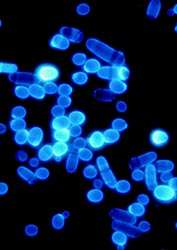
Yeast species like these could be used to develop a rapid screening process for identifying compounds which inhibit Alzheimer's disease. Image: CSIRO

CSIRO scientists have developed a new system to screen for compounds that can inhibit one of the processes that takes place during the progression of Alzheimer’s disease.

In a paper published in the latest edition of the Journal of Alzheimer’s Disease, folate is shown to be beneficial in the screening system.

Lead author, CSIRO’s Dr Ian Macreadie says folate is already well known to have a protective effect against Alzheimer’s disease which is believed to be caused by the loss of neurons in the brain due to a process whereby toxic multimers of a small protein called Aβ are formed.

“However, a team of scientists working within CSIRO’s Preventative Health Flagship has discovered a rapid screening system to identify inhibitors of this process. Compounds that inhibit the formation of the toxic multimers may lead to the prevention or delay of the disease,” Dr Macreadie says.

“Although many other research groups and drug companies around the world are trying to find compounds that act in the same way, the advance by the Flagship team involves using live yeast with the Aβ protein fused to a green fluorescent protein that comes from jellyfish.

“The significance of this development is that the yeast trial we developed could lead to the discovery of new agents which may prove useful in preventing or delaying the onset of Alzheimer’s disease.”

Currently Alzheimer’s disease is an incurable illness and the fourth leading cause of death in people aged 65 years and over.

Although folate is abundant in foods like leafy green vegetables, pulses and liver, CSIRO studies have shown that many Australians do not consume enough folate to benefit from its ability to prevent cell damage. Folate levels can, however, be readily restored by dietary folate supplementation.

Provided by CSIRO


print this article email this article download pdf blog this article bookmark this article     Stumble it Digg this share on Facebook retweet share on Reddit add to delicious
Rate this story - 3.8 /5 (9 votes)


November 17, 2008 all stories

Comments: 0

3.8 /5 (9 votes)
  • Stumble this up

  • Digg this

  • share this

  • hide
  • Related Stories


  • hide
  • Relevant PhysicsForums posts

Other News

eye

Over-the-counter eye drops raise concern over antibiotic resistance

Medicine & Health / Medications

created 16 hours ago | popularity 3.5 / 5 (2) | comments 1

(PhysOrg.com) -- The use of antibiotic eye drops for conjunctivitis has increased by almost half since they became available over the counter at chemists in 2005, data obtained by Oxford University researchers ...


Overeating can set stage for obesity, researchers say

Medicine & Health / Health

created 9 hours ago | popularity not rated yet | comments 1

It doesn't seem like a fair fight. In one corner loomed the Thanksgiving table, groaning with poultry, pie and mashed potatoes.


New tools for prediction of disease progression in acute childhood leukemia

Medicine & Health / Cancer

created 10 hours ago | popularity not rated yet | comments 0

(PhysOrg.com) -- Researchers at Uppsala University and University Children’s Hospital in Uppsala have devised powerful new tools for typing cells from children with acute lymphatic leukemia and for prediction of how children ...


Nuclear science to fight sleeping sickness

Medicine & Health / Diseases

created 12 hours ago | popularity not rated yet | comments 0

The International Atomic Energy Agency on Friday announced an agreement to help African nations battle the tsetse fly, the main carrier of parasites that causes sleeping sickness with its bites.


A costly diagnosis: Alzheimer's disease takes toll on memories, and money too

Medicine & Health / Health

created 13 hours ago | popularity not rated yet | comments 0

Alzheimer's disease takes a devastating emotional toll on families but it also is one of the most expensive conditions to treat because of its progressive nature, requiring increasing assistance with eating, bathing and other ...