Agent-based computer models could anticipate future economic crisis
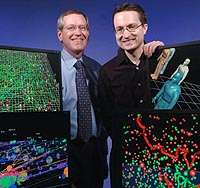
(PhysOrg.com) -- As the stock market continues its dive, economists and business columnists have spilled a lot of ink assigning responsibility for the ongoing financial calamity. While hindsight might be clear as day, researchers at the U.S. Department of Energy's Argonne National Laboratory are trying to create new economic models that will provide policymakers with more realistic pictures of different types of markets so they can better avert future economic catastrophe.
Traditional economic models rely heavily on "equilibrium theory," which holds that markets are influenced by countervailing balanced forces. Because these models assume away the decision-making processes of individual consumers or investors, they do not represent the market's true internal dynamics, said Charles Macal, an Argonne systems scientist.
"The traditional models don't represent individuals in the economy, or else they're all represented the same way – as completely rational agents," Macal said. "Because they ignore many other aspects of behavior that influence how people make decisions in real life, these models can't always accurately predict the dynamics of the market."
Macal and his Argonne colleagues have created a new set of simulations called "agent-based models" to better anticipate how markets behave. These new models rely on information gleaned in part from surveys that ask respondents about the factors that influence the way they make decisions. By gaining a more precise understanding of the behavior patterns of individual actors in a market – for example, how willing they are to accept risk, how strongly they value the future or how much time and effort they are able to spend making decisions – researchers and economists can better predict and avoid meltdowns.
Agent-based models separately calculate likely decisions for each individual actor in a model, then take the results of these decisions and see what impact they have on other agents. By doing so, they have the potential to foresee a panic, a protracted "hot streak," herd mentality or a number of other market phenomena that pure rational-actor models would tend to miss.
Macal and other Argonne researchers have valuable experience creating these agent-based models. At the request of the Illinois Commerce Commission, Macal's group generated a model of the Illinois electrical power market. As Illinois prepared to deregulate the electrical power industry in early 2007, policymakers in Springfield asked Argonne's Decision and Information Sciences Division to examine the likely effects of differential electricity pricing around the state and other issues associated with deregulation.
The model of the Illinois power network contained more than 180 plants and 350 generators, which supplied electricity to customers grouped into 30 "load zones." In all, the model contained thousands of points where producers and consumers interacted with each other and the power grid.
Because these agents have limited time, money and information, they cannot always reach the "optimal" solution dictated by traditional models, Macal said. "The old models assume that the entire system would always be trying to minimize its total cost," he said. "Obviously, in a deregulated market, that's not going to be the case."
The Illinois Commerce Commission wanted to make sure that if they deregulated the power market, individual producers of electricity would not be able to manipulate the market during times of high demand by withholding capacity or charging excessive rates. The Argonne model found that during certain times of heavy load such a situation could emerge, which led to the recommendation that independent monitors maintain some oversight of the power market.
The ability to produce such detailed simulations relies on the availability of high-performance computers that can handle the computational challenges of mathematically representing an enormous number of individual actors. "Just five years ago, we couldn't model more than a couple dozen agents," Macal said. "Now, we can do a couple million."
Macal's expertise in behavioral economics and agent-based modeling attracted the attention of Procter and Gamble (P&G), one of the world's largest producers of consumer products. P&G asked Macal to use models similar to those he used for the Illinois Commerce Commission to anticipate likely trends in consumer behavior. Macal's group used information from P&G's consumer surveys to create simulated shoppers who would react to changes in their marketing strategies and advertising campaigns.
In his efforts to further expand the reach of agent-based modeling, Macal plans to examine how and why Americans use different sources of energy – from coal to natural gas to nuclear to solar. While it might seem like a pipe dream to address a question with so many variables, Macal believes that he can at least shed some light on the country's patterns of energy production and consumption.
"At this point, there's no real framework to understand how all of the pieces of the energy puzzle fit together," he said. "These models will improve the quality of the information that policymakers and organizations use to make decisions."
Provided by Argonne National Laboratory


