Shedding light on the 'dark matter' of genetics: New gene-silencing pathway found in plants
(PhysOrg.com) -- Biologists at Washington University in St. Louis have made major headway in explaining a mechanism by which plant cells silence potentially harmful genes.
Differential gene expression profoundly influences the way in which organisms grow and develop. For instance, although every cell in the human body has the same genetic information, different subsets of the DNA get activated to make an eye different from a toe. RNA polymerases, the enzymes responsible for making RNA from DNA templates, are key players in determining which genes get switched on and which get left off.
A team led by Craig Pikaard, Ph.D., Washington University professor of biology in Arts & Sciences, has been investigating the role of two plant-specific RNA polymerases since playing a leading role in their discovery in 2005. In a paper published Nov. 14, 2008 in Cell, Pikaard and his colleagues explain how these RNA polymerases work together to use the non-coding region of DNA to prevent destructive, virus-derived genes from being activated.
"There's a lot of interest in harnessing this sort of silencing on purpose to be able to silence the genes that you care about," says Pikaard. Understanding the cellular machinery responsible for gene silencing has major implications for gene therapy, where RNA-centric approaches are showing real promise for control of diseases such as cancer and HIV.
Pikaard and his colleagues' work may have important implications for applied medical research. For instance, gene therapy procedures sometimes use retroviral vectors as a way of introducing a foreign gene to replace a function impaired by disease. Often this foreign gene, called a transgene, restores the missing function for a while and then unexpectedly goes silent. Pikaard explains, "It gets inactivated and it's probably the same sort of RNA-directed silencing mechanism." he explains. " If you could prevent the silencing of the transgene or if you could purposefully silence something that you wanted inactivated, that could be a good thing."
Pikaard studies what's known as transcriptional gene silencing. This phenomenon is often regulated by short interfering RNAs, or siRNAs, which University of Cambridge scientist David Baulcombe has called "the dark matter of genetics". By bringing about changes in DNA that interfere with transcription -- the copying of DNA to RNA -- siRNAs can effectively extinguish gene expression at its earliest stage. Pikaard explains, "From yeast to plants to humans these small RNAs can specify the modification of DNA somehow in a way that prevents transcription in the first place." According to Pikaard, most eukaryotes use the same two-pronged method for silencing genes at the transcriptional level: DNA methylation, or adding chemical flags to genes, and modification of proteins called histones that act as spools for DNA.
All eukaryotes share three essential RNA polymerases: Pol I, II, and III. These polymerases are indispensable for expressing biological traits and play a critical role in maintaining basic metabolic functions necessary for survival. "If you're mutated for any of those, you die," says Pikaard. "However, Pol IV and Pol V -- which only plants have -- you don't need them to stay alive but they turn out to be really important for this whole RNA-directed silencing phenomenon."
Since discovering these plant-specific RNA polymerases a few years ago, Pikaard's lab has been on a hunt to figure out what Pol IV and Pol V are making. In 2005, Pikaard and his collaborators published research showing that the major function of Pol IV is to generate siRNAs, thereby singling out this RNA polymerase as a potential player in gene silencing. However, when subsequent genetic tests suggested that Pol V is also needed for gene silencing, but not siRNA production, Pikaard and his colleagues suspected that Pol V and Pol IV cooperate, but work independently.
The Space between Genes
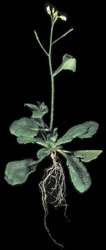
Using Arabidopsis thaliana, the "laboratory rat" of the plant world, Pikaard and his colleagues carried out a series of genetic tests to pinpoint where in the genome Pol V was getting down to business.
Following a hunch, postdoctoral scholar Andrzej Wierzbicki decided to take a closer look at the stretches of DNA that lie between genes, the so-called intergenic regions. Biologists have long been baffled by this alleged "junk DNA" because transcription seems to occur here, and just about everywhere, genes and junk alike.
"This is a hot topic in genetics right now," says Pikaard. "It looks like not just the genes are getting transcribed, but pretty much all of the DNA is getting transcribed. And why? What's the purpose of all this transcription?"
Wierzbicki's instincts paid off. Using high levels of PCR amplification, he determined that Pol V was indeed hard at work within the intergenic region. In this space between genes, Pol V makes noncoding RNA transcripts that he and Pikaard think bind with the siRNAs generated by Pol IV. By acting as a scaffold for these siRNAs, the Pol V transcripts enable silencing of adjacent, virus-derived genes such as retrotransposons (jumping genes) that can be detrimental if activated. Pikaard and colleagues were able to confirm that both Pol IV and Pol V are necessary for silencing by examining mutations that knock out, or disable, the different genes coding for the polymerases.
'Junk' no more
This research adds to a growing body of evidence suggesting that "junk DNA" is in fact a functional part of the genome, since transcription of the intergenic regions is necessary to keep potentially harmful genes turned off. In addition, Pikaard and his colleagues have resolved a paradox that has recently puzzled geneticists: the need for transcription in order to transcriptionally silence the same region. In the case of plants, this paradox is resolved by the interactive effects of Pol IV and Pol V. The combination of Pol IV and Pol V products modify the DNA such that RNA Pol I, II, and II are prevented from transcribing potentially deleterious genes.
Source: Washington University in St. Louis


