Water vapor confirmed as major player in climate change
November 17, 2008
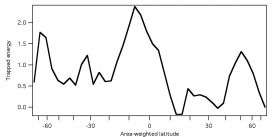
Based on climate variations between 2003 and 2008, the energy trapped by water vapor is shown from southern to northern latitudes, peaking near the equator. Credit: Andrew Dessler
(PhysOrg.com) -- Water vapor is known to be Earth's most abundant greenhouse gas, but the extent of its contribution to global warming has been debated. Using recent NASA satellite data, researchers have estimated more precisely than ever the heat-trapping effect of water in the air, validating the role of the gas as a critical component of climate change.
Andrew Dessler and colleagues from Texas A&M University in College Station confirmed that the heat-amplifying effect of water vapor is potent enough to double the climate warming caused by increased levels of carbon dioxide in the atmosphere.
With new observations, the scientists confirmed experimentally what existing climate models had anticipated theoretically. The research team used novel data from the Atmospheric Infrared Sounder (AIRS) on NASA's Aqua satellite to measure precisely the humidity throughout the lowest 10 miles of the atmosphere. That information was combined with global observations of shifts in temperature, allowing researchers to build a comprehensive picture of the interplay between water vapor, carbon dioxide, and other atmosphere-warming gases. The NASA-funded research was published recently in the American Geophysical Union's Geophysical Research Letters.
"Everyone agrees that if you add carbon dioxide to the atmosphere, then warming will result," Dessler said. "So the real question is, how much warming?"
The answer can be found by estimating the magnitude of water vapor feedback. Increasing water vapor leads to warmer temperatures, which causes more water vapor to be absorbed into the air. Warming and water absorption increase in a spiraling cycle.
Water vapor feedback can also amplify the warming effect of other greenhouse gases, such that the warming brought about by increased carbon dioxide allows more water vapor to enter the atmosphere.
"The difference in an atmosphere with a strong water vapor feedback and one with a weak feedback is enormous," Dessler said.
Climate models have estimated the strength of water vapor feedback, but until now the record of water vapor data was not sophisticated enough to provide a comprehensive view of at how water vapor responds to changes in Earth's surface temperature. That's because instruments on the ground and previous space-based could not measure water vapor at all altitudes in Earth's troposphere -- the layer of the atmosphere that extends from Earth's surface to about 10 miles in altitude.
AIRS is the first instrument to distinguish differences in the amount of water vapor at all altitudes within the troposphere. Using data from AIRS, the team observed how atmospheric water vapor reacted to shifts in surface temperatures between 2003 and 2008. By determining how humidity changed with surface temperature, the team could compute the average global strength of the water vapor feedback.
"This new data set shows that as surface temperature increases, so does atmospheric humidity," Dessler said. "Dumping greenhouse gases into the atmosphere makes the atmosphere more humid. And since water vapor is itself a greenhouse gas, the increase in humidity amplifies the warming from carbon dioxide."
Specifically, the team found that if Earth warms 1.8 degrees Fahrenheit, the associated increase in water vapor will trap an extra 2 Watts of energy per square meter (about 11 square feet).
"That number may not sound like much, but add up all of that energy over the entire Earth surface and you find that water vapor is trapping a lot of energy," Dessler said. "We now think the water vapor feedback is extraordinarily strong, capable of doubling the warming due to carbon dioxide alone."
Because the new precise observations agree with existing assessments of water vapor's impact, researchers are more confident than ever in model predictions that Earth's leading greenhouse gas will contribute to a temperature rise of a few degrees by the end of the century.
"This study confirms that what was predicted by the models is really happening in the atmosphere," said Eric Fetzer, an atmospheric scientist who works with AIRS data at NASA's Jet Propulsion Laboratory in Pasadena, Calif. "Water vapor is the big player in the atmosphere as far as climate is concerned."
Provided by NASA's Goddard Space Flight Center
-
Infrared sounder on NASA's suomi NPP starts its mission
Feb 09, 2012 |
not rated yet |
0
-
New integrated building model may improve fish farming operations
Feb 09, 2012 |
not rated yet |
0
-
A new tool for mapping water use and drought
Feb 08, 2012 |
not rated yet |
0
-
Toward a global microwave standard
Feb 06, 2012 |
5 / 5 (1) |
0
-
Progress and promise in DIAL LIDAR
Feb 06, 2012 |
5 / 5 (4) |
0
-
Fast photon control brings quantum photonic technologies closer
1 minute ago |
not rated yet |
0
-
Engineers build first sub-10-nm carbon nanotube transistor
Feb 01, 2012 |
4.9 / 5 (33) |
30
-
Something old, something new: Evolution and the structural divergence of duplicate genes
Jan 31, 2012 |
4.6 / 5 (7) |
1
-
The hidden nanoworld of ice crystals: Revealing the dynamic behavior of quasi-liquid layers
Jan 30, 2012 |
5 / 5 (5) |
1
-
Stock market network reveals investor clustering
Jan 27, 2012 |
3.9 / 5 (23) |
8
-
Do some geologists actually act a lot like Randy Marsh?
Feb 11, 2012
-
Discrepancy between oxygen and carbon-dioxide levels
Feb 09, 2012
-
where gems are found in the world
Feb 09, 2012
-
Wind Waves in Reservoir ~ Wind run-up and Wind set-up
Feb 08, 2012
-
Balance of oxygen in the atmosphere
Feb 01, 2012
-
The case for a methanol-based economy
Jan 30, 2012
- More from Physics Forums - Earth
More news stories
Transforming galaxies
(PhysOrg.com) -- Many of the Universe's galaxies are like our own, displaying beautiful spiral arms wrapping around a bright nucleus. Examples in this stunning image, taken with the Wide Field Camera 3 on ...
48 minutes ago |
5 / 5 (1) |
0
|
A continent ablaze in auroral and manmade light
The North American continent is literally set ablaze in a confluence of Auroral and Manmade light captured in spectacular new videos snapped by the astronauts serving aboard the International Space Station ...
Space & Earth / Space Exploration
41 minutes ago |
not rated yet |
0
A better picture of clouds
Some of us look at clouds and see animal shapes. Scientists are looking beyond. For the first time, a team of scientists led by Pacific Northwest National Laboratory used actual measurements of clouds and ...
Space & Earth / Earth Sciences
43 minutes ago |
not rated yet |
0
Scientists drill two miles down to ancient Lake Vostok
(PhysOrg.com) -- Russian scientists last week finished penetrating more than two miles through the Antarctic ice sheet to Lake Vostok, a huge freshwater lake that has been buried under the ice for millions ...
Space & Earth / Earth Sciences
32 minutes ago |
5 / 5 (1) |
0
Earth-facing sunspot doubles in size
The latest sunspot region to traverse the face of the Sun has nearly doubled in size as it aims Earthward, as seen in the animation above from NASAs Solar Dynamics Observatory. (Click image to play the ...
Space & Earth / Space Exploration
1 hour ago |
not rated yet |
0
'Smart' microcapsules in a single step
(PhysOrg.com) -- A new, single-step method of fabricating microcapsules, which have potential commercial applications in industries including medicine, agriculture and diagnostics, has been developed by researchers ...
New ability to regrow blood vessels holds promise for treatment of heart disease
(Medical Xpress) -- University of Texas at Austin researchers have demonstrated a new and more effective method for regrowing blood vessels in the heart and limbs a research advancement that could have ...
Ethanol mandate not the best option
Many people are willing to pay a premium for ethanol, but not enough to justify the government mandate for the corn-based fuel, a Michigan State University economist argues.
Nanostructured electrodes for rechargeable sodium-Ion batteries
Highly efficient 3V cathodes for rechargeable sodium-ion batteries have been developed by users from Argonne National Laboratory's Materials Science, Chemical Sciences & Engineering, and X-ray Sciences Divisions, ...
New tumor suppressor gene identified
A recent study published in Clinical Cancer Research suggests that the protein hVps37A suppresses tumor growth in ovarian cancer. The work, which was funded by the Austrian Science Fund FWF, shows, for th ...
A lost world? How zooarchaeology can inform biodiversity conservation
A new study of tropical forests will provide a 50,000-year perspective on how animal biodiversity has changed, explored through an archaeological investigation of animal bones.
Nov 17, 2008
Rank: 4.2 / 5 (5)
Nov 17, 2008
Rank: 3.2 / 5 (6)
Correct. The system is not as simple as the levels of CO2 and H2O. It would be a good guess that the system is fairly insensitive to the forcing from CO2 and H2O (i.e. there are other processes that offset what a simple model would estimate.)
Though it IS nice that someone is finally saying that H2O is the major greenhouse gas.
Nov 18, 2008
Rank: 4 / 5 (5)
Nov 18, 2008
Rank: 5 / 5 (4)
Common sense isn't all that common. -Voltaire
Nov 18, 2008
Rank: 3.5 / 5 (6)
Wow! Here is an article that shows extensive research supporting the idea of positive feedback and you are jumping to the conclusion that: "It has been conclusively shown to be a negative feedback" There is no such conclusion. Instead, the whole subject of clouds is an open area of research. Albedo is an important un-answered question. Please try to keep the arguments about AGW to science not seance. I think you need to read the literature that shows how complex the interaction is and why we can only make approximations at this time. For instance, the reason for the positive feedback with respect to water vapor content (lets leave the cloud issue out for a minute) is due to a relatively small but important IR window in the H2O absorption spectra that is neatly filled by a strong band for CO2. It is really great spectroscopic science that shows why the combination of water vapor and CO2 is so important.
Now back to the clouds. I am pretty sure you are referring to the hypothesis that cosmic rays are controlling the cloud cover. If you will go do some research you will find that there have been multiple independent studies of the hypothesis that show that if it were true it would have gone the opposite direction (from the initial predictions) for the past 20 years based on cosmic ray measurements. There are other experiments underway to look at the hypothesis even more closely and we can expect data from those within another 2 years. However, at this time, there is no consensus on cloud cover (except among ranters).
Ausjin asked a great question and the answer is "we don't know." However, to the best engineering approximations that are available now, the forcing is still positive even taking what we do know about clouds into account.
Nov 18, 2008
Rank: 3 / 5 (2)
You're neglecting that aerial water vapor will also trap incomming visible light.
Thermodynamics may be unaware of this fact but albedo is a rather well understood part of spectometry. Cloud cover and aerosols have had many years of research and science dedicated to them and their role in global climate, one would say more than CO2 for the most part.
Nov 20, 2008
Rank: 4 / 5 (2)
The last line, "Provided by NASA's Goddard Space Flight Center" gives me,as a cynic, an idea that James Hanson's hand is in this. So perhaps this IS half of a paper to suit his devious ends to try to backup discreditted "models".
It presumes that as CO2 itself is not enough to account for temp rise, the increase must be cause by the measured increase in water vapour.
It could have been natural (sun etc) cusing the increase with a negative feed back from water vapour (cloud increase).
Being as temperatures seem to be declining it is now purely academic.
Nov 21, 2008
Rank: 2.7 / 5 (3)
First increased water vapour from increased temperature does not indicate a higher cloud concentrations, clouds are condensation not vapor.
Second yes air at 95 degrees and 80%RH will have less heat in it than air at 96.5 degrees with 80% RH. but that is largely irrelevant because the higher vapor content will go up release energy as it gets into the upper atmosphere and condense lossing the latent heat of vaporization in the form of radiant heat half of which goes away falls back to earth in drops and evaporates again. If you doubt this go turn off your lights it's called the Rankine Cycle and is what is used in most steam turbines... ok all steam turbines.
One more VERY important point. atmospheric humidity is regulated by night time lows not day time highs. That is why places like the desert have such a low humidity even though they get their air from the same atmosphere we do. And places like say Georgia, the US one, in the middle of summer with 90 degree night time lows can stay very high.
And as a last important point this is based on just recent Data collect during the past 5 years.
"Climate models have estimated the strength of water vapor feedback, but until now the record of water vapor data was not sophisticated enough to provide a comprehensive view of at how water vapor responds to changes in Earth's surface temperature. That's because instruments on the ground and previous space-based could not measure water vapor at all altitudes in Earth's troposphere -- the layer of the atmosphere that extends from Earth's surface to about 10 miles in altitude." "Using data from AIRS, the team observed how atmospheric water vapor reacted to shifts in surface temperatures between 2003 and 2008."
Yes, water vapor holds heat. Good, we need that. I'm glad these putzs figured this one out, now we can finally invent the steam engine.
Nov 24, 2008
Rank: 5 / 5 (1)
You have proven my point. If the humidity finally condenses to fall back to earth to evaporate again, we call that RAIN and it comes from CLOUDS.So more water vapour gives rise to more clouds.QED
The reason that humidity is low in deserts is because there is little water to evaporate, thats why we call them deserts.When the sun goes down there is next to no water vapour "greenhouse gas" to hold the heat of the day. Being as CO2 levels are pretty much the same the world over it is not doing much as a greenhouse gas in the desert.
You are right about Georgia, but this effect varies according to humidity levels.
You can, to a certain extent, see the variations in 5 day weather forecasts that show max and min temps with the humidity.The humidity varies during the day so it sometimes is not that obvious.
Nov 28, 2008
Rank: 1 / 5 (1)
Thermo, CO2 concentration on Mars is about 90 times higher than on the Earth. When we sent our last orbiter up there we took the exact same black body shot that we took of the Earth to exemplify CO2 effects on the planet.
When they measured the two signals the absorption was found to be the exact same.
I'll repeat:
385ppm CO2 and 7000ppm CO2 have the exact same spectometry graph as evidenced by extensive measurement of two different atmospheric concentrations.
If you want to prove this in your backyard you can.
Setup two amateur greenhouses one is a control, the other is the experiment.
In the control leave the air as it is and get a tray, put sand and water in the tray so you have an approximation of 70% water and 30% uncovered sand. Stick a thermometer in the sand and read the temperature daily at the same time each day.
For the experiment, do the same thing but artificially add CO2. Add as much as you want, but reasonably I'd suggest doubling or tripling the 385ppm in the control.
Alright, since you're measuring the temp in each greenhouse every day you will see one of two things:
1) The experiment greenhouse will be an average of 6 degrees C higher if the AGW suppositions on CO2 are correct.
2) The temperature will not be 6 degrees C higher because AGW is full of bullshit.
Guess which answer every child in a class of 35 found. Hint (it starts with a t).
Nov 30, 2008
Rank: 1 / 5 (1)
Nov 30, 2008
Rank: not rated yet
Was a mistype on the 7000.
As for 30km of atmosphere modeling, the only "measured" affects occur in the troposphere meaning 16km at the equator and 4km at the poles. The troposphere is also very homogenous meaning a measurement at 3m should be well within noise variation.
You would want suppression of outgoing radiation to occur so you're not introducing any noise into the system. If CO2 is as culpable as stated the size of the system at widely different concentrations should directly show the effect of CO2, seeing as we're interested in the ability of CO2 to capture IR, which is not affected to any great extent by glass or plastic sheeting.
Feb 25, 2009
Rank: not rated yet
Feb 25, 2009
Rank: not rated yet
Concentration is a measure of part/total.
Mar 06, 2009
Rank: not rated yet
Firstly, as hydrocarbon fossil fuels are burned - the gases generated are water and carbon dioxide, in fact MORE water is generated than carbon dioxide.
Secondly, since the 'Population Bomb' days a huge effort has been made to irrigate arid areas to 'make the deserts green'. The deserts have been made green by literally mining for water. ( Google "Cubic Kilometers" "Fossil Water" Irrigation ) Billions of cubic meters of water that has been in deep aquifers for many thousands of years are being brought to the surface for plants to transpire (evaporate) into the atmosphere. To the extent that these aquifers are shortly going to run dry.
It is totally incorrect therefore to imply that humidity has only increased due to rises in atmospheric temperatures. This was a basic premise of the hypothesis and therefore it cannot be said to be proven by this experiment.
Perhaps the peer review should be repeated?