Billions of particles of anti-matter created in laboratory
November 17th, 2008 Billions of particles of anti-matter created in laboratory

Enlarge

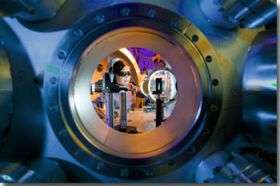
Physicist Hui Chen sets up targets for the anti-matter experiment at the Jupiter laser facility.

(PhysOrg.com) -- Take a gold sample the size of the head of a push pin, shoot a laser through it, and suddenly more than 100 billion particles of anti-matter appear.

The anti-matter, also known as positrons, shoots out of the target in a cone-shaped plasma "jet."

This new ability to create a large number of positrons in a small laboratory opens the door to several fresh avenues of anti-matter research, including an understanding of the physics underlying various astrophysical phenomena such as black holes and gamma ray bursts.

Anti-matter research also could reveal why more matter than anti-matter survived the Big Bang at the start of the universe.

"We've detected far more anti-matter than anyone else has ever measured in a laser experiment," said Hui Chen, a Livermore researcher who led the experiment. "We've demonstrated the creation of a significant number of positrons using a short-pulse laser." Chen and her colleagues used a short, ultra-intense laser to irradiate a millimeter-thick gold target. "Previously, we concentrated on making positrons using paper-thin targets," said Scott Wilks, who designed and modeled the experiment using computer codes. "But recent simulations showed that millimeter-thick gold would produce far more positrons. We were very excited to see so many of them."

In the experiment, the laser ionizes and accelerates electrons, which are driven right through the gold target. On their way, the electrons interact with the gold nuclei, which serve as a catalyst to create positrons. The electrons give off packets of pure energy, which decays into matter and anti-matter, following the predictions by Einstein's famous equation that relates matter and energy. By concentrating the energy in space and time, the laser produces positrons more rapidly and in greater density than ever before in the laboratory.

"By creating this much anti-matter, we can study in more detail whether anti-matter really is just like matter, and perhaps gain more clues as to why the universe we see has more matter than anti-matter," said Peter Beiersdorfer, a lead Livermore physicist working with Chen.

Particles of anti-matter are almost immediately annihilated by contact with normal matter, and converted to pure energy (gamma rays). There is considerable speculation as to why the observable universe is apparently almost entirely matter, whether other places are almost entirely anti-matter, and what might be possible if anti-matter could be harnessed. Normal matter and anti-matter are thought to have been in balance in the very early universe, but due to an "asymmetry" the anti-matter decayed or was annihilated, and today very little anti-matter is seen.

Over the years, physicists have theorized about anti-matter, but it wasn't confirmed to exist experimentally until 1932. High-energy cosmic rays impacting Earth's atmosphere produce minute quantities of anti-matter in the resulting jets, and physicists have learned to produce modest amounts of anti-matter using traditional particle accelerators. Anti-matter similarly may be produced in regions like the center of the Milky Way and other galaxies, where very energetic celestial events occur. The presence of the resulting anti-matter is detectable by the gamma rays produced when positrons are destroyed when they come into contact with nearby matter.

Laser production of anti-matter isn't entirely new either. Livermore researchers detected anti-matter about 10 years ago in experiments on the since-decommissioned Nova "petawatt" laser - about 100 particles. But with a better target and a more sensitive detector, this year's experiments directly detected more than 1 million particles. From that sample, the scientists infer that around 100 billion positron particles were produced in total.

Until they annihilate, positrons (anti-electrons) behave much like electrons (just with an opposite charge), and that's how Chen and her colleagues detected them. They took a normal electron detector (a spectrometer) and equipped it to detect particles with opposite polarity as well.

"We've entered a new era," Beiersdorfer said. "Now, that we've looked for it, it's almost like it hit us right on the head. We envision a center for antimatter research, using lasers as cheaper anti-matter factories."

Chen will present her work at the American Physical Society's Division of Plasma Physics meeting Nov. 17-21 at the Hyatt Regency Reunion in Dallas. S.C. Wilks, E. Liang, J. Myatt, K. Cone ,L. Elberson, D.D. Meyerhofer, M. Schneider, R. Shepherd, D. Stafford, R. Tommasini, P. Beiersdorfer are the collaborators on this project.

Provided by Lawrence Livermore National Laboratory


print this article email this article download pdf blog this article bookmark this article     Digg this Stumble it share on Facebook share on Reddit add to delicious save to Yahoo! bookmarks
4.9/5 after 128 votes

Rank Filter

Move the slider to adjust rank threshold, so that you can hide some of the comments.


Display comments: newest first

  • Star_Gazer - Nov 17, 2008
    • Rank: 4.6 / 5 (11)
    Finally!!! I am waiting on my antimatter rocket now! 10mg (0.01 grams) of this stuff equals in power to 23 space shuttle external tanks.
  • OregonWind - Nov 17, 2008
    • Rank: 4.8 / 5 (6)
    "Finally!!! I am waiting on my antimatter rocket now! 10mg (0.01 grams) of this stuff equals in power to 23 space shuttle external tanks"

    I would like to share your enthusiasm but the technology has a long way to go...unfortunately
  • NeilFarbstein - Nov 17, 2008
    • Rank: 3.2 / 5 (6)
    why gold?
  • axemaster - Nov 17, 2008
    • Rank: 4 / 5 (6)
    I share your enthusiasm for an AM powered rocket, but unfortunately it's unlikely that such a thing would be built, even with the available technology.

    After all, we have nuclear power right now, which has an energy density ~1 million times greater than conventional rocket fuel, and we aren't using that either. NASA is utterly fixated on chemical fuel, and until that changes there will be little real progress in the field of human spaceflight.
  • Rawley - Nov 17, 2008
    • Rank: 4.7 / 5 (6)
    Hrmm, gold is pretty easy to work with. It's readily available in high purity. Has great conduction ability. Doesn't oxidize quickly. Is rather dense which gives more opportunity for particle interactions....
  • brant - Nov 17, 2008
    • Rank: 2.5 / 5 (6)
    Warp 9 Scotty....
  • Eco_R1 - Nov 17, 2008
    • Rank: 1.5 / 5 (8)
    forget the B.F.G....A.M.H.G's (anti-matter-hand-gun)the new terrorist/zombie slaying machine. Laser, add some tiny gold pellets(ammo), you'll be turning the scariest zombies and monsters into gamma rays in no time!
  • zbarlici - Nov 17, 2008
    • Rank: 2.4 / 5 (8)
    ..so, wait a minute there. Are you sh---ing me? You`re telling me the guys that wrote star trek were actually onto something? Quick! Maybe the Bussard Collector will work too!

    Oh wait a minute i almost forgot, one thing at a time... Bussard has possibly just given humanity a fighting chance at life beyond this planet...

    His Polywell IEC fusion prototype presumably generated extremely high neutron counts, readings which will hopefully be deemed correct and accurate by the review panel currently investigating Bussard`s claim that he has FOUND A WAY TO FUSION!

    http://en.wikiped...Polywell
    http://www.talk-polywell.org
  • zbarlici - Nov 17, 2008
    • Rank: 3 / 5 (4)
    don`t nobody get your hopes up about utilising antimatter engines.... perhaps this finding has reduced the amount of time needed to generate enough antimatter to get a ship to mars and back by 50 years, and perhaps the funds requires to do so will only half-bankrupt the US... and then theres the containment matter... we have to take baby steps, and until this technology is develpoed, and refined, we will just have to rely on Bussard``s polywell QED drive. Cheers!
  • Mynameisalex - Nov 18, 2008
    • Rank: 4 / 5 (8)
    Human space exploration will continue to remain at a standstill until there is a concise way to unite the world in mutual efforts. Especially with the current economical problems, which show no end in near future its just too damn expensive. How about more money on space exploration and less money on killing people. We could use that 2 billion plus on every F-22 to fund more research such as anti matter engines or plasma applications. But thats just not how we roll.
  • earls - Nov 18, 2008
    • Rank: 4.3 / 5 (3)
    What about people who don't think like you Mynameisalex? Allow them to live? That's fine, but what about when they're sabotaging your efforts? People need to be evolved by example. That example being high power munitions by next-gen VTOL aircraft.

    Don't get me wrong, I'm with you 100%, unfortunately... Reality is a bigger challenge.

    Forget flying off into the next frontier, we need to meet the basic human necessities here on Earth for every person alive today: food, water, shelter and power.
  • Soylent - Nov 18, 2008
    • Rank: 5 / 5 (2)
    His Polywell IEC fusion prototype presumably generated extremely high neutron counts


    He was several orders of magnitude farther from break-even than either the ICF or tokamak approach. He believed that the scaling laws he derived from small scale experiment would extend to power levels millions of times higher; unlikely but not impossible. He believed he had solved the problems of brehmsstralung losses and losses from operating in a non-equilibrium state; that too is rather unlikely.
  • lengould100 - Nov 18, 2008
    • Rank: 5 / 5 (1)
    Ok. 10% of the ships mass is antimatter in a storage ring, or some futuristic equivalent. The ship has a large parabolic reflector at the back made of sodium chloride crystal, with two holes near the focus where electrons and positrons are fed in by accelerators.

    A gamma-ray power interstellar rocket, can accelerate at 1 G for 4 years, turn around, decelerate at 1 G for 4 years, and arrive at the nearest star in 8 years with enough fuel to get back.
  • Yes - Nov 18, 2008
    • Rank: not rated yet
    According to Feynman diagram, the opposite particles will annihilate smoothly and convert into gamma radiation and exit the system at light speed with a relativistic impulse of hv/c^2 and an energy of hv that was before 1/2mc^2 about 512KeV
    The real mass of the electrons and positrons will just disappear and cause a minuscule gravity wave at their disappearance at most.
    Any motor working through and according to action is -reaction will just not work on relativistic impulse.
    I don't see how such a motor would work on electron-positron annihilation.
    Maybe anti proton annihilation might work, but where are the billions of anti protons?
  • zbarlici - Nov 18, 2008
    • Rank: not rated yet
    Soylent - lets just wait for the review panel`s verdict. As silly as you might think the polywell idea is, The US Navy extended the company`s contract by one year, with something like $2M to rebuild a vaporised prototype. That was over a year ago now. The new prototype is rebuilt, and the peer review was already done. I assume the company is most likely under an embargo(as they have been for the last 12 years...). If the thing did NOT work, we would have heard about it. If we do not hear anything of it in the next couple of months most likely it is successful but dont want to share the info with the world, makes sense, until they fully design a netpower device and build it.
  • robbycoats - Nov 18, 2008
    • Rank: 5 / 5 (1)
    I think just a year ago creating this much antimatter in a lab would have been laughed at. Technology advances far faster than most people would expect; exponentially. Barriers that we create for ourselves, like heat dissipation on tiny scales and the generation of useful amounts of antimatter, are just that; barriers that we create for ourselves. All these problems have answers, we just have to discover them, and I bet we discover them far faster than would most. As long as everybody is working on something, and information is easily accessible, things will mesh and epiphanies and 'eureka!' moments will happen.
  • ShadowRam - Nov 18, 2008
    • Rank: 5 / 5 (1)
    This is awesome news
  • EdWood - Nov 18, 2008
    • Rank: 5 / 5 (1)
    Would a coloidal gold aerogel as a target work to produce a cascade reaction?

    The stuff that pops into my mind.

    What direction relative to the laser do the anti electrons travel?

    What is the power of the laser?

    Can the cone be focused?

    Questions inquiring minds would like to know.
  • holmstar - Nov 18, 2008
    • Rank: 5 / 5 (2)
    Finally!!! I am waiting on my antimatter rocket now! 10mg (0.01 grams) of this stuff equals in power to 23 space shuttle external tanks.


    great! so you would only need to repeat this
    1.10*10^17 times in order to get your 10mg of antimatter.
  • holmstar - Nov 18, 2008
    • Rank: not rated yet
    if you don't like exponents, thats 110000000000000000 times.

    (positrons, like electrons, have very little mass)
  • jonnyboy - Nov 18, 2008
    • Rank: 2.3 / 5 (3)
    Mynameisalex "...How about more money on space exploration and less money on killing people. We could use that 2 billion plus on every F-22 to fund more research such as anti matter engines or plasma applications....."

    I could more readily agree with you if you could just show me where in the US constitution it says that the federal government has the right or obligation to provide for the national space travel program. Fortunately what is says instead it that the federal government is responsible for the NATIONAL DEFENSE.

    Go whine on one of your liberal sites, let's keep this one related to science, not politics.
  • Alizee - Nov 18, 2008
    • Rank: not rated yet
    This is a good one... We should check the formation of antimatter by peeling of Scotch tape after all...
  • Flakk - Nov 18, 2008
    • Rank: not rated yet
    "We could use that 2 billion plus on every F-22 to fund more research such as anti matter engines or plasma applications"

    Raptors don't cost 2 billion. Each aircraft is only $361 mil. A drop in the bucket of the anual defence budget.

    Your thinking of the B-2 Spirit.

    I'm not even a scientist and I know to do my research.
  • danielt998 - Nov 19, 2008
    • Rank: not rated yet
    how much grams of antimatter did they create?
  • General_Haberdashery - Nov 19, 2008
    • Rank: not rated yet
    "if you don't like exponents, thats 110000000000000000 times.

    (positrons, like electrons, have very little mass)"

    That might be reasonable with 10-1,000,000 lasers firing constantly over the course of the acceleration periods. It would be less dangerous that way as well. No containment, just produce and annihilate.

    Is this the sort of process where enough excess energy is produced for them to make a g of acceleration while powering lasers that continue firing?

    If so, yay space travel! Though you'd have to be pretty dumb to travel through space, what with the black holes and immense amounts of radiation and all.
  • Soylent - Nov 22, 2008
    • Rank: not rated yet
    Soylent - lets just wait for the review panel`s verdict. As silly as you might think the polywell idea is[...]


    I don't think it's silly. I just don't like people hyping the hell out of what is very much a long-shot(one of many I might add).

    [...]The US Navy extended the company`s contract by one year, with something like $2M to rebuild a vaporised prototype.


    Military money is notoriously stupid so that's not saying much.
  • Soylent - Nov 22, 2008
    • Rank: 5 / 5 (1)
    Ok. 10% of the ships mass is antimatter in a storage ring, or some futuristic equivalent.


    Like charges repell. It would be exceedingly difficult to have more than a miniscule amount of positrons stored that way. If you had access to anti-protons you could make electrically neutral anti-hydrogen; easier to achieve high density but I know of no mechanism that would contain it.

    A more realistic alternative in the short term is the Nuclear Salt Water Rocket. If you're not opposed to wasting perfectly good Highly Enriched Uranium or weapons grade plutonium left over from decommissioning of nuclear weapons you could make a NSWR that in prinicple could reach a few percent of lightspeed, accelerated by a continuous nuclear explosion(the waste products would have escape velocity from our solar system unless something goes spectacularly wrong).
  • AtlasGemini - Nov 24, 2008
    • Rank: not rated yet
    Mynameisalex, not to burst your bubble, but even if that money was spent on A-M research, it would still be "spending money on weapons." A-M devices would be very effective weapons. Enough that would power a space rocket could also power a low-yield tactical nuclear warhead. Instead of the annihilation of the fuel little by little to power a rocket, it would be annihilated all at once. Larger amounts of A-M would be able to produce weapons with larger yields.
  • denijane - Nov 25, 2008
    • Rank: 2.3 / 5 (3)
    Erm, I also don't share the enthusiasm. It's nice from technological point of view, but it's not so break-trough. It's not like we couldn't make antiparticles already...

    As for its use in weapons?! What is wrong with you people!!! Instead of considering the social value of a discovery, you immediately start wondering what kind of killing device you can create with it. This is sick!

    http://denijane.blogspot.com
  • visual - Nov 26, 2008
    • Rank: not rated yet
    General_Haberdashery, and anyone else imagining generating the antimatter on-board a space ship to then use for propulsion, wake up...
    Generating that antimatter would naturally require energy, and if we were able to get enough energy on the ship we could use that for propulsion directly.
    There is absolutely no point in producing antimatter on the ship.

    If antimatter is ever used for propulsion, it will be generated beforehand and used as a fuel.
    Antimatter is the perfect energy storage - with the highest possible density.
    That is, if we were able to store it :p

November 17th, 2008 all stories
Physics / General Physics

Comments: 30
Rank: 4.9/5 after 128 votes

  • Stumble this up

  • Digg this

  • Share it:
  • share on Facebook
  • share on MySpace
  • share on Slashdot
  • rss-newsfeed
  • share on Google
  • share on Reddit
  • add to delicious
  • save to Yahoo! bookmarks
  • share on Windows Live
  • Add to Mixx!
Rating: 4.9/5 after 128 votes

  • Related Stories

  • High-energy Electrons Could Come from Pulsars -- or Dark Matter
    created May 05, 2009 | popularity not rated yet | comments 0
  • Fermi telescope explores high-energy 'space invaders'
    created May 04, 2009 | popularity not rated yet | comments 0
  • Clemson astronomers to study mysterious antimatter in the Milky Way
    created Feb 16, 2009 | popularity not rated yet | comments 0
  • Fingers, Loops and Bays in the Crab Nebula
    created Nov 06, 2008 | popularity not rated yet | comments 0
  • Advancing the study of antimatter
    created Mar 26, 2008 | popularity not rated yet | comments 0


  • Physicists Demonstrate Quantum Memory with Matter Qubits
    Physicists Demonstrate Quantum Memory with Matter Qubits
    Physics / General Physics
    created Jul 03, 2009 | popularity 4.4 / 5 (16) | comments 1
  • 'Holey' Nanosheets for Wastewater Dye Removal
    Nanotechnology / Nanomaterials
    created Jul 01, 2009 | popularity 5 / 5 (5) | comments 1
  • Jellyfish Robot Swims Like its Biological Counterpart
    Jellyfish Robot Swims Like its Biological Counterpart
    Electronics / Robotics
    created Jun 26, 2009 | popularity 4.4 / 5 (8) | comments 1
  • Could Maxwell's Demon Exist in Nanoscale Systems?
    Could Maxwell's Demon Exist in Nanoscale Systems?
    Physics / General Physics
    created Jun 24, 2009 | popularity 4.4 / 5 (18) | comments 29
  • Living Safely with Robots, Beyond Asimov's Laws
    Living Safely with Robots, Beyond Asimov's Laws
    Electronics / Robotics
    created Jun 22, 2009 | popularity 4.6 / 5 (52) | comments 40
  • Other News

    Science journals

    How to Spot an Influential Paper Based on its Citations

    Physics / General Physics

    created 19 hours ago | popularity 4.1 / 5 (8) | comments 5

    (PhysOrg.com) -- At first it may seem that the number of citations received by a published scientific paper is directly related to that paper's quality of content. The higher the quality, the more people read ...


    Scientists create first electronic quantum processor

    Scientists create first electronic quantum processor

    Physics / General Physics

    created Jun 28, 2009 | popularity 4.8 / 5 (51) | comments 39

    A team led by Yale University researchers has created the first rudimentary solid-state quantum processor, taking another step toward the ultimate dream of building a quantum computer.


    Fermilab's CDF observes Omega-sub-b baryon

    Fermilab's CDF observes Omega-sub-b baryon

    Physics / General Physics

    created Jun 29, 2009 | popularity 4.7 / 5 (16) | comments 7

    (PhysOrg.com) -- At a recent physics seminar at the Department of Energy’s Fermi National Accelerator Laboratory, Fermilab physicist Pat Lukens of the CDF experiment announced the observation of a new particle, ...


    New insights, and a new angle, on high-temperature superconductivity

    New insights, and a new angle, on high-temperature superconductivity

    Physics / Superconductivity

    created Jun 29, 2009 | popularity 4.8 / 5 (13) | comments 6

    (PhysOrg.com) -- A Princeton-led research team has revealed surprising information about how electron behavior influences the conduction of electricity in a class of high-temperature superconductors. An increased ...


    The art of invisibility and the perfect cat's eye

    The art of invisibility and the perfect cat's eye

    Physics / Optics & Photonics

    created Jun 30, 2009 | popularity 4 / 5 (8) | comments 6

    (PhysOrg.com) -- In recent years scientists have explored the impossible by developing invisibility or 'cloaking' devices, but can the same technology also help make things more visible?