Technology Gives 3-D View of Human Coronary Arteries
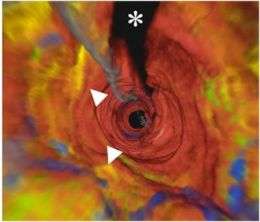
For the first time researchers are getting a detailed look at the interior of human coronary arteries, using an optical imaging technique developed at the Wellman Center for Photomedicine at Massachusetts General Hospital (MGH). In their report in the journal JACC: Cardiovascular Imaging, the research team describes how optical frequency-domain imaging (OFDI) gives three-dimensional, microscopic views of significant segments of patients' coronary arteries, visualizing areas of inflammation and plaque deposits.
"This is the first human demonstration of a technique that has the potential to change how cardiologists look at coronary arteries," says Gary Tearney, MD, PhD, of the MGH Pathology Department and the Wellman Center for Photomedicine at MGH, the study's lead author. "The wealth of information that we can now obtain will undoubtedly improve our ability to understand coronary artery disease and may allow cardiologists to diagnose and treat plaque before it leads to serious problems."
OFDI is an advance over optical coherence tomography (OCT), another imaging technology developed by the MGH investigators. While OCT examines tissues one point at a time, OFDI can look at over 1,000 points simultaneously using a device developed at MGH-Wellman. Inside a fiberoptic probe, a constantly rotating laser tip emits a light beam with an ever-changing wavelength. As the probe moves through the structure to be imaged, measuring how each wavelength is reflected back allows rapid acquisition of the data required to create the detailed microscopic images. Besides providing three-dimensional images of an artery's microstructure in seconds, the increased speed also reduces signal interference from blood, which had plagued the first-generation technology. In 2006 members of the MGH-Wellman team reported the successful use of OFDI to image the esophagus and coronary arteries of pigs.
The current study enrolled three patients scheduled to have stents placed in their coronary arteries at the Lahey Clinic in Burlington, Mass. After the completion of stent placement, OFDI was used to image 3- to 7-centimeter-long segments of the patients' coronary arteries including the stented areas. OFDI provided detailed images along the length of the arteries – visualizing lipid or calcium deposits, immune cells that could indicate inflammation, and the stents – and dramatic "fly-through" views looking down the artery's interior. More detailed, cross-sectional images of narrowed vascular segments revealed features associated with the type of atherosclerotic plaques that are likely to rupture and cause a heart attack.
Tearney and his colleagues note that these findings need to be duplicated in a larger group of patients, and the time required to process the "fly-through" images – currently several hours – needs to be reduced to provide the real-time information most useful for clinical applications. Combining OFDI with intravascular ultrasound might help with another of the technique's limitations, the inability to penetrate deep into tissues.
"While more work remains, the technology is advancing at a rapid pace. We expect to see commercial devices available in a one- to two-year time frame," says Brett Bouma, PhD, of the Wellman Center, senior author of the report. "Our goal now is to help put the pieces in place to ensure that this technique will be widely available to interventional cardiologists." Bouma is an associate professor of Dermatology, and Tearney an associate professor of Pathology at Harvard Medical School.
Source: Massachusetts General Hospital


