World's earliest nuclear family found
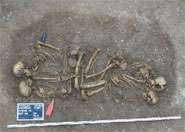
The researchers dated remains from four multiple burials discovered in Germany in 2005. The 4,600-year-old graves contained groups of adults and children buried facing each other – an unusual practice in Neolithic culture.
One of the graves was found to contain a female, a male and two children. Using DNA analysis, the researchers established that the group consisted of a mother, father and their two sons aged 8-9 and 4-5 years: the oldest molecular genetic evidence of a nuclear family in the world (so far).
The burials, discovered and excavated at Eulau, Saxony-Anhalt, were also unusual for the great care taken in the treatment of the dead. The remains of thirteen individuals were found in total, all of whom had been interned simultaneously.
Intriguingly, the arrangement of the dead seemed to mirror their relations in life. Several pairs of individuals were buried face-to-face with arms and hands interlinked in many cases. All the burials contained children ranging from newborns up to 10 years of age and adults of around 30 years or older. Interestingly, there were no adolescents or young adults.
Many showed injuries that indicated they were the victims of a violent raid. One female was found to have a stone projectile point embedded in one of her vertebra and another had skull fractures. Several bodies also had defence injuries to the forearms and hands.
In an article published this week in Proceedings of the National Academy of Sciences (PNAS), the researchers reconstruct this Stone Age tragedy using state-of-the-art genetics and isotope techniques, physical anthropology and archaeology.
Lead author Dr Wolfgang Haak of the University of Adelaide said: "By establishing the genetic links between the two adults and two children buried together in one grave, we have established the presence of the classic nuclear family in a prehistoric context in Central Europe – to our knowledge the oldest authentic molecular genetic evidence so far. Their unity in death suggests a unity in life. However, this does not establish the elemental family to be a universal model or the most ancient institution of human communities."
As well as establishing the biological relationships of the people buried at Eulau, the researchers were also able to shed light on their social organisation using strontium isotope analysis.
Hylke de Jong, a PhD student working on the Eulau graves at the University of Bristol said: "We measured strontium isotopes in their teeth to give us an indication of where these people spent their childhood. Strontium from the food you eat is incorporated into your teeth as they grow. We can relate the proportion of different strontium isotopes back to regions with different geology and identify the area where a person grew up."
Dr Alistair Pike, Head of Archaeology at the University of Bristol and co-Director of the project, continued: "The strontium analysis showed that the females spent their childhood in a different region from the males and children. This is an indication of exogamy (marrying out) and patrilocality (the females moving to the location of the males). Such traditions would have been important to avoid inbreeding and to forge kinship networks with other communities."
The burials described in detail in the article are now on permanent display in the newly renovated Landesmuseum Sachsen-Anhalt in Germany.
Source: University of Bristol


