Gamma-Ray Evidence Suggests Ancient Mars Had Oceans
November 17th, 2008 Gamma-Ray Evidence Suggests Ancient Mars Had Oceans

Enlarge

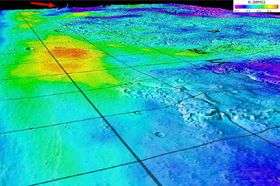
This 3D map superimposes gamma-ray data from Mars Odyssey's Gamma-Ray Spectrometer onto topographic data from the laser altimeter onboard the Mars Global Surveyor. The red arrow indicates the shield volcanoes of Elysium rise in northern Mars, seen obliquely to the southeast. Blue-to-violet colors at the Elysium rise and highlands stretching to the foreground of the map mark areas poor in potassium. Red-to-yellow colors mark potassium-rich sedimentary deposits in lowlands below the Mars Pathfinder landing site (PF) and Viking 1 landing site (V1).

(PhysOrg.com) -- An international team of scientists who analyzed data from the Gamma Ray Spectrometer onboard NASA's Mars Odyssey reports new evidence for the controversial idea that oceans once covered about a third of ancient Mars.

"We compared Gamma Ray Spectrometer data on potassium, thorium and iron above and below a shoreline believed to mark an ancient ocean that covered a third of Mars' surface, and an inner shoreline believed to mark a younger, smaller ocean," said University of Arizona planetary geologist James M. Dohm, who led the international investigation.

"Our investigation posed the question, Might we see a greater concentration of these elements within the ancient shorelines because water and rock containing the elements moved from the highlands to the lowlands, where they eventually ponded as large water bodies?" Dohm said.

Mars Odyssey's GRS, or Gamma Ray Spectrometer, led by William Boynton of UA's Lunar and Planetary Laboratory, has the unique ability to detect elements buried as much as 1/3 meter, or 13 inches, below the surface by the gamma rays they emit. That capability led to GRS' dramatic 2002 discovery of water-ice near the surface throughout much of high-latitude Mars.

Results from Mars Odyssey and other spacecraft suggest that past watery conditions likely leached, transported and concentrated such elements as potassium, thorium and iron, Dohm said. "The regions below and above the two shoreline boundaries are like cookie cutouts that can be compared to the regions above the boundaries, as well as the total region."

The younger, inner shoreline is evidence that an ocean about 10 times the size of the Mediterranean Sea, or about the size of North America, existed on the northern plains of Mars a few billion years ago. The larger, more ancient shoreline that covered a third of Mars held an ocean about 20 times the size of the Mediterranean, the researchers estimate.

The potassium-thorium-iron enriched areas occur below the older and younger paleo-ocean boundaries with respect to the entire region, they said. The scientists used data from Mars Global Surveyor's laser altimeter for topographic maps of the regions in their study.

They are reporting their findings in the article, "GRS Evidence and the Possibility of Paleo-oceans on Mars." The article will be published in a special edition of Planetary and Space Science, which stems from a June 2007 workshop on Mars and its Earth analogs held in Trento, Italy. UA Regents' Professor Victor Baker and Boynton, and other scientists from the United States, Italy, Spain, South Korea and Canada are co-authors.

Scientific debate on the possible existence of ancient Martian oceans marked by shorelines was sparked by several studies almost 20 years ago. One such study, by Baker and colleagues at the UA Lunar and Planetary Laboratory, proposed that a few billion years ago, erupting magma unleashed floods far greater than Brazil's Amazon River. The floods ponded in the northern lowlands of Mars, forming seas and lakes that triggered relatively warmer and wetter conditions that lasted tens of thousands of years.

Scientists are driven to understand how and when water existed on Mars because water is critical to life.

Spacecraft images going back to Mariner 9 in the early 1970s and the Viking orbiters and landers later in the 1970s showed widespread evidence for a watery past for Mars. Images and other information from a flotilla of U.S. and European Mars orbiters have sharpened the details in the past decade, they added. Results from Mars Global Surveyor, Mars Odyssey, Mars Express and Mars Reconnaissance Orbiter highlight a water-and-ice-sculpted Martian landscape.

Scientists studying spacecraft images have a hard time confirming "shoreline" landforms, the researchers said, because Mars shorelines would look different from Earth's shorelines. Earth's coastal shorelines are largely a direct result of powerful tides caused by gravitational interaction between Earth and the moon, but Mars lacks a sizable moon. Another difference is that lakes or seas on Mars could have formed largely from giant debris flows and liquefied sediments. Still another difference is that Mars oceans may have been ice-covered, which would prevent wave action.

"The GRS adds key information to the long-standing oceans-on-Mars controversy," Dohm said. "But the debate is likely to continue well into the future, perhaps even when scientists can finally walk the Martian surface with instruments in hand, with a network of smarter spaceborne, airborne and ground-based robotic systems in their midst."

Provided by University of Arizona


print this article email this article download pdf blog this article bookmark this article     Digg this Stumble it share on Facebook share on Reddit add to delicious save to Yahoo! bookmarks
4.5/5 after 22 votes


November 17th, 2008 all stories
Space & Earth / Space Exploration

Comments: 0
Rank: 4.5/5 after 22 votes

  • Stumble this up

  • Digg this

  • Share it:
  • share on Facebook
  • share on MySpace
  • share on Slashdot
  • rss-newsfeed
  • share on Google
  • share on Reddit
  • add to delicious
  • save to Yahoo! bookmarks
  • share on Windows Live
  • Add to Mixx!
Rating: 4.5/5 after 22 votes

  • Related Stories

  • Research team finds definitive evidence for ancient lake on Mars
    created Jun 18, 2009 | popularity not rated yet | comments 0
  • New Evidence Points to Oceans on Mars
    created Jun 13, 2007 | popularity not rated yet | comments 0
  • New instrument has potential to detect water deep underground on Mars (w/ Video)
    created Jun 24, 2009 | popularity not rated yet | comments 0
  • Magnetic Tornadoes Could Liberate Mercury's Tenuous Atmosphere
    created Jun 02, 2009 | popularity not rated yet | comments 0
  • Meteorite bombardment may have made Earth more habitable
    created Jun 01, 2009 | popularity not rated yet | comments 0

Tags

mars

  • Physicists Demonstrate Quantum Memory with Matter Qubits
    Physicists Demonstrate Quantum Memory with Matter Qubits
    Physics / General Physics
    created Jul 03, 2009 | popularity 4.4 / 5 (16) | comments 1
  • 'Holey' Nanosheets for Wastewater Dye Removal
    Nanotechnology / Nanomaterials
    created Jul 01, 2009 | popularity 5 / 5 (5) | comments 1
  • Jellyfish Robot Swims Like its Biological Counterpart
    Jellyfish Robot Swims Like its Biological Counterpart
    Electronics / Robotics
    created Jun 26, 2009 | popularity 4.4 / 5 (8) | comments 1
  • Could Maxwell's Demon Exist in Nanoscale Systems?
    Could Maxwell's Demon Exist in Nanoscale Systems?
    Physics / General Physics
    created Jun 24, 2009 | popularity 4.4 / 5 (18) | comments 29
  • Living Safely with Robots, Beyond Asimov's Laws
    Living Safely with Robots, Beyond Asimov's Laws
    Electronics / Robotics
    created Jun 22, 2009 | popularity 4.6 / 5 (52) | comments 40
  • Other News

    Forty years ago man first walked on the moon

    Space & Earth / Space Exploration

    created 4 hours ago | popularity 5 / 5 (2) | comments 0

    Forty years ago on July 20, 1969, American astronaut Neil Armstrong realized the oldest dream of human civilizations when he became the first man to walk on the moon.


    The least sea ice in 800 years

    The least sea ice in 800 years

    Space & Earth / Earth Sciences

    created Jul 01, 2009 | popularity 4.3 / 5 (59) | comments 52

    New research, which reconstructs the extent of ice in the sea between Greenland and Svalbard from the 13th century to the present indicates that there has never been so little sea ice as there is now. The ...


    Gas around young galaxy

    Intense heat killed the Universe's would-be galaxies, researchers say

    Space & Earth / Astronomy

    created Jul 01, 2009 | popularity 3.2 / 5 (19) | comments 25

    (PhysOrg.com) -- Our Milky Way galaxy only survived because it was already immersed in a large clump of dark matter which trapped gases inside it, scientists led by Durham University's Institute for Computational ...


    Scientists' Drill Hits Magma: Only Third Time on Record

    Scientists' Drill Hits Magma: Only Third Time on Record

    Space & Earth / Earth Sciences

    created Jun 29, 2009 | popularity 4.7 / 5 (20) | comments 19

    (PhysOrg.com) -- Scientists drilling a borehole deep into Iceland’s rocky crust to explore new methods of using geothermal energy hit a major roadblock on Thursday: Their drill ran into molten rock at a depth ...


    NASA manager pitches a cheaper return-to-moon plan

    Space & Earth / Space Exploration

    created Jun 30, 2009 | popularity 4 / 5 (7) | comments 18

    (AP) -- Like a car salesman pushing a luxury vehicle that the customer no longer can afford, NASA has pulled out of its back pocket a deal for a cheaper ride to the moon.