Can an ant be employee of the month?
November 18th, 2008 Rock Ant Colony in Efficiency Experiment

Enlarge

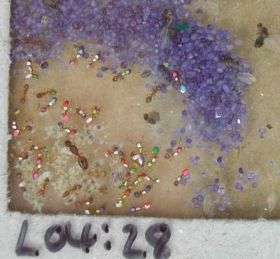
A colony of rock ants, Temnothorax albipennis, inside the artificial colony, a cutout in a piece of gray cardboard sandwiched between two glass slides. The number written on the upper slide is the colony's id number. The workers have been color-coded with model airplane glue. The large ant without paint on her is the queen. The white grains in the lower left-hand corner of the picture are the brood -- eggs and larvae. The purple grains of sand are the wall the ants build to protect the colony. The dead fruit fly in the upper right is probably going to become ant food. Credit: Anna Dornhaus

Ants specializing on one job such as snatching food from a picnic are no more efficient than "Jane-of-all-trade" ants, according to new research.

The finding casts doubt on the idea that the world-wide success of ants stems from job specialization within the colony. Ants are found on every continent besides Antarctica.

"The question is, why is job specialization a good thing?" said Anna Dornhaus of The University of Arizona in Tucson. "We thought that the fact that ants have specialists was one of the things that made them so successful and live all over the world in all habitats in great numbers.

"It turns out that the ones that are specialized on a particular job are not particularly good at doing that job."

Dornhaus studied the rock ant, known by scientists as Temnothorax albipennis, that lives in cracks in rocks in Europe. In ant colonies, all the workers are females.

She videotaped individual ants as they performed four typical ant tasks: brood transport, collecting sweets, foraging for animal protein and nest building. The videotape allowed her to compare how long it took each ant to do a particular task.

Dornhaus, a UA assistant professor of ecology and evolutionary biology, is publishing her paper, "Specialization Does Not Predict Individual Efficiency in an Ant," in the Nov. 18 issue of the online journal PLoS Biology. The German Science Foundation (DFG) funded some of the research.

Adam Smith, the father of modern economics, wrote in 1776 that specialized labor provided benefits to human industry.

Dornhaus, who studies social insects, wanted to see if this applied to ants because efficiency in ants had rarely been tested.

The workers of rock ants, like those of most ant species, all look the same and do not appear physically specialized for any particular task. Nevertheless, they do specialize.

She expected rock ants that specialized would work more efficiently, but that's not what she found.

To identify the individual workers, which are half the size of a grain of rice, Dornhaus color-coded them with model airplane paint in colors such as rally green and racing red using hair-thin wires as paintbrushes.

She crafted nests for the ants by sandwiching cardboard squares between two glass slides. A tiny tunnel in the cardboard let the ants leave the nest.

Dornhaus tested 1,142 workers from 11 colonies that ranged in size from 27 to 233 workers.

To watch ants in action, Dornhaus put individual colonies in a square arena that was 22 centimeters (about eight-and-half inches) on a side and recorded workers' job performance with two video cameras.

For example, in the brood transport test, she placed a colony and an empty nest 10 centimeters (4 inches) apart. Then she took the roof off the colony's nest by taking off the top slide. Once their nest was destroyed, Dornhaus recorded how long the ants took to find the empty nest and move the eggs and larvae to it.

She measured how often and how readily an individual ant performed each task and considered an ant more specialized the more it concentrated its work on one task.

Dornhaus said some go-getter ants eagerly worked in all of the tasks, but other ants seemed lazy. Although the specialists were not more efficient, they put in more hours of work.

It's not known why ants choose the jobs they do, or why some are slow to begin work.

She said it might be explained by how quickly an individual detects work to be done, like noticing dirty dishes in the sink.

A person with a lower threshold will notice and wash the dishes as soon as there are one or two in the sink. However, a person with a higher threshold doesn't notice the dishes until there are at least 10 piled up. The dishes will still be washed, just not as frequently.

"You get division of labor that way just because they have differences in their sensory systems or somehow in the way they interpret the world without consciously wanting to divide labor," Dornhaus said.

The ability to sense work also varies in ants, she suspects.

Dornhaus found that specialists and generalists work equally fast, but the question of employee of the month is still unanswered.

Even though putting in longer hours might seem like the way to success, it wastes colony resources.

"Speed does matter because every minute they spend outside is dangerous and energy costly," she said. "They burn fuel, and they risk dying."

Her next step is investigating "switching costs," such as the time it takes to walk from one side of the nest to the other or the break in concentration when switching between tasks. Dornhaus suggests specialization might minimize such costs.

"I do science because I think it's cool to find out how the world works, specifically how social insects works," Dornhaus said. "Isn't it cool to know that there are little societies underground everywhere you walk?"

Citation: Dornhaus A (2008) Specialization does not predict individual efficiency in an ant. PLoS Biol 6(11): e285. doi:10.1371/journal.pbio.0060285
http://biology.plosjournals.org/perlserv/?request=get-document&doi=10.1371/journal.pbio.0060285

Source: University of Arizona


print this article email this article download pdf blog this article bookmark this article     Digg this Stumble it share on Facebook share on Reddit add to delicious save to Yahoo! bookmarks
4.7/5 after 7 votes

Rank Filter

Move the slider to adjust rank threshold, so that you can hide some of the comments.


Display comments: newest first

  • Mercury_01 - Nov 18, 2008
    • Rank: 5 / 5 (1)
    I always wondered if I give an ant a huge cookie crumb, he'll get a promotion.
  • lengould100 - Nov 18, 2008
    • Rank: 5 / 5 (2)
    "a square arena that was 22 centimeters (about eight-and-half inches) on a side"

    The repeated asides to translate from metric to antique units are jarring and should be unnecessary for anyone willing to read any article with even minimal scientific content.
  • tigger - Nov 19, 2008
    • Rank: not rated yet
    "jarring".. fantastic choice of wording there lengould100

November 18th, 2008 all stories
Biology /

Comments: 3
Rank: 4.7/5 after 7 votes

  • Stumble this up

  • Digg this

  • Share it:
  • share on Facebook
  • share on MySpace
  • share on Slashdot
  • rss-newsfeed
  • share on Google
  • share on Reddit
  • add to delicious
  • save to Yahoo! bookmarks
  • share on Windows Live
  • Add to Mixx!
Rating: 4.7/5 after 7 votes

  • Related Stories

  • Sequencing effort to chart ants and their ecosystem
    created Jun 26, 2009 | popularity not rated yet | comments 0
  • Scientists publish the discoveries that saved the large blue butterfly
    created Jun 16, 2009 | popularity not rated yet | comments 0
  • Wildlife Conservation Society supports world's first study of egg-laying mammal
    created Jun 09, 2009 | popularity not rated yet | comments 0
  • Diuscovery in amber reveals ancient biology of termites
    created May 14, 2009 | popularity not rated yet | comments 0
  • How house-hunting ants choose the best home
    created Apr 22, 2009 | popularity not rated yet | comments 0

Tags

ants

  • Physicists Demonstrate Quantum Memory with Matter Qubits
    Physicists Demonstrate Quantum Memory with Matter Qubits
    Physics / General Physics
    created Jul 03, 2009 | popularity 4.4 / 5 (17) | comments 1
  • 'Holey' Nanosheets for Wastewater Dye Removal
    Nanotechnology / Nanomaterials
    created Jul 01, 2009 | popularity 5 / 5 (5) | comments 1
  • Jellyfish Robot Swims Like its Biological Counterpart
    Jellyfish Robot Swims Like its Biological Counterpart
    Electronics / Robotics
    created Jun 26, 2009 | popularity 4.4 / 5 (8) | comments 1
  • Could Maxwell's Demon Exist in Nanoscale Systems?
    Could Maxwell's Demon Exist in Nanoscale Systems?
    Physics / General Physics
    created Jun 24, 2009 | popularity 4.4 / 5 (18) | comments 29
  • Living Safely with Robots, Beyond Asimov's Laws
    Living Safely with Robots, Beyond Asimov's Laws
    Electronics / Robotics
    created Jun 22, 2009 | popularity 4.6 / 5 (55) | comments 40
  • Other News

    Songbirds reveal how practice improves performance

    Songbirds reveal how practice improves performance

    Biology / Plants & Animals

    created 4 hours ago | popularity not rated yet | comments 2

    (PhysOrg.com) -- Learning complex skills like playing an instrument requires a sequence of movements that can take years to master. Last year, MIT neuroscientists reported that by studying the chirps of tiny ...


    Study finds role for parasites in evolution of sex

    Biology / Plants & Animals

    created 4 hours ago | popularity 3 / 5 (1) | comments 1

    What's so great about sex? From an evolutionary perspective, the answer is not as obvious as one might think. An article published in the July issue of the American Naturalist suggests that sex may have evolved in part a ...


    Nitrogen research shows how some plants invade, take over others

    Biology / Plants & Animals

    created 3 hours ago | popularity not rated yet | comments 0

    Biologists know that when plants battle for space, often the actual battle is for getting the nitrogen.


    New research shows key player in mitosis not required for chromosome alignment

    New research shows key player in mitosis not required for chromosome alignment

    Biology / Microbiology

    created 5 hours ago | popularity 5 / 5 (1) | comments 0

    (PhysOrg.com) -- K-fibers, structures long thought to play a key role in the alignment of chromosomes prior to cell division, are not required after all, say Indiana University and New York State Department ...


    Scientists are learning more about big birds from feathers

    Scientists are learning more about big birds from feathers

    Biology / Plants & Animals

    created 5 hours ago | popularity not rated yet | comments 0

    (PhysOrg.com) -- Catching adult eagles for research purposes is no easy task, but a Purdue University researcher has found a way around the problem, and, in the process, gathered even more information about ...