Astronomers detect matter torn apart by black hole
November 18, 2008
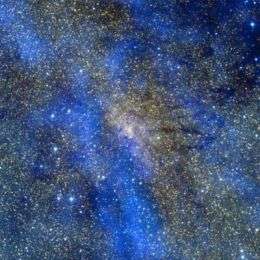
Submillimeter and Infrared View of the Galactic Center

Enlarge

This is a color composite image of the central region of our Milky Way galaxy, about 26 000 light years from Earth. Giant clouds of gas and dust are shown in blue, as detected by the LABOCA instrument on the Atacama Pathfinder Experiment (APEX) telescope at submillimeter wavelengths (870 micron). The image also contains near-infrared data from the 2MASS project at K-band (in red), H-band (in green), and J-band (in blue). The image shows a region approximately 100 light-years wide. Credit: ESO/APEX/2MASS/A. Eckart et al.

The team of European and US astronomers used ESO's Very Large Telescope (VLT) and the Atacama Pathfinder Experiment (APEX) telescope, both in Chile, to study light from Sagittarius A* at near-infrared wavelengths and the longer submillimetre wavelengths respectively. This is the first time that astronomers have caught a flare with these telescopes simultaneously. The telescopes' location in the southern hemisphere provides the best vantage point for studying the Galactic Centre.

"Observations like this, over a range of wavelengths, are really the only way to understand what's going on close to the black hole," says Andreas Eckart of the University of Cologne, who led the team.

Sagittarius A* is located at the centre of our own Milky Way Galaxy at a distance from Earth of about 26 000 light-years. It is a supermassive black hole with a mass of about four million times that of the Sun. Most, if not all, galaxies are thought to have a supermassive black hole in their centre.

"Sagittarius A* is unique, because it is the nearest of these monster black holes, lying within our own galaxy," explains team member Frederick K. Baganoff of the Massachusetts Institute of Technology (MIT) in Cambridge, USA. "Only for this one object can our current telescopes detect these relatively faint flares from material orbiting just outside the event horizon."

The emission from Sagittarius A* is thought to come from gas thrown off by stars, which then orbits and falls into the black hole.

Making the simultaneous observations required careful planning between teams at the two telescopes. After several nights waiting at the two observatory sites, they struck lucky.

"At the VLT, as soon as we pointed the telescope at Sagittarius A* we saw it was active, and getting brighter by the minute. We immediately picked up the phone and alerted our colleagues at the APEX telescope," says Gunther Witzel, a PhD student from the University of Cologne.

Macarena García-Marín, also from Cologne, was waiting at APEX, where the observatory team had made a special effort to keep the instrument on standby. "As soon as we got the call we were very excited and had to work really fast so as not to lose crucial data from Sagittarius A*. We took over from the regular observations, and were in time to catch the flares," she explains.

Over the next six hours, the team detected violently variable infrared emission, with four major flares from Sagittarius A* . The submillimetre-wavelength results also showed flares, but, crucially, this occurred about one and a half hours after the infrared flares.

The researchers explain that this time delay is probably caused by the rapid expansion, at speeds of about 5 million km/h, of the clouds of gas that are emitting the flares. This expansion causes changes in the character of the emission over time, and hence the time delay between the infrared and submillimetre flares.

Although speeds of 5 million km/h may seem fast, this is only 0.5% of the speed of light. To escape from the very strong gravity so close to the black hole, the gas would have to be travelling at half the speed of light – 100 times faster than detected – and so the researchers believe that the gas cannot be streaming out in a jet. Instead, they suspect that a blob of gas orbiting close to the black hole is being stretched out, like dough in a mixing bowl, and this is causing the expansion.

The simultaneous combination of the VLT and APEX telescopes has proved to be a powerful way to study the flares at multiple wavelengths. The team hope that future observations will let them prove their proposed model, and discover more about this mysterious region at the centre of our Galaxy.

Source: ESO

4.6 /5 (33 votes)  

Filter


Move the slider to adjust rank threshold, so that you can hide some of the comments.


Display comments: newest first

Ivan2
Nov 18, 2008

Rank: 1 / 5 (5)
"detected by the LABOCA instrument on the Atacama Pathfinder Experiment (APEX) telescope at submillimeter wavelengths (870 micron)": 870 microns? Isn't that almost 9 millimeters? The zero is probably a typo, since it can't simultaneously be sub-millimeter and above it. Would someone explain, please? Maybe my own measures are differently-named, since as far as I know a millimeter has 100 microns.
barakn
Nov 18, 2008

Rank: 4 / 5 (4)
No, a millimeter has 1000 microns. 870 microns is 0.870 millimeters.
Ivan2
Nov 18, 2008

Rank: 1 / 5 (4)
No, a millimeter has 1000 microns. 870 microns is 0.870 millimeters.


It just sounds wrong. I worked with jewelry when I was a little kid and sometimes I had to make a gold or silver slice of something or another that had to be under the millimeter range for specific uses. I never used the extra zero in jewelry, nor do I know anyone who does!!
Ivan2
Nov 18, 2008

Rank: 1 / 5 (4)
(It just occurred to me: we are talking about different usages, after all, and not at all about measurements per se!)
NeilFarbstein
Nov 18, 2008

Rank: 1.7 / 5 (7)
There's somthing wronmg with them. Its stupid to call the black hole at the center of our galaxy unique. There are billions of them that are the same.
yyz
Nov 23, 2008

Rank: 2.5 / 5 (2)
A great article on the value of multiwavelength observations of astronomical objects & phenomenon. This is similar to multiwavelength studies of gamma-ray bursters(GRBs) in that multiple phenomena can be correlated and must be explained by theorists studying these objects. @NeilFarbstein, I believe the SMBH at the center of the Milky Way is unique in the sense that it's the closest object of its type to the Earth and can be studied in the greatest detail by Earth-bound astronomers (at least until our galaxy's collision with the Andromeda Galaxy several billion years from now!).
Rank 4.6 /5 (33 votes)
Tags

Related Stories
Relevant PhysicsForums posts
  • Never ending outer space.....
    created15 hours ago
  • Neutron Star fragments?
    created17 hours ago
  • stationary or not?
    created21 hours ago
  • Scale of the Universe
    createdFeb 10, 2012
  • Titan's lack of impact craters
    createdFeb 09, 2012
  • Real pictures of black hole eating a star?
    createdFeb 08, 2012
  • More from Physics Forums - General Astronomy

More news stories

Salvage workers begin pumping fuel from Italian shipwreck

Salvage workers Sunday began pumping fuel from the shipwrecked Italian cruise liner Costa Concordia, a day ahead of schedule, officials said.

Space & Earth / Environment

created 32 minutes ago | popularity not rated yet | comments 0

Latin America mining boom clashes with conservation

Latin America is experiencing a mining boom as prices rise fuelled by a hike in global demand, but the region is also being hit by a wave of violent protests, strikes and rallies by environmentalists.

Space & Earth / Environment

created 8 hours ago | popularity 5 / 5 (1) | comments 0

Political leaders play key role in how worried Americans are by climate change: study

More than extreme weather events and the work of scientists, it is national political leaders who influence how much Americans worry about the threat of climate change, new research finds.

Space & Earth / Environment

created Feb 06, 2012 | popularity 5 / 5 (6) | comments 73

NASA budget will axe Mars deal with Europe: scientists

US President Barack Obama's budget proposal to be submitted next week for 2013 will cut NASA's budget by 20 percent and eliminate a major partnership with Europe on Mars exploration, scientists said Thursday.

Space & Earth / Space Exploration

created Feb 10, 2012 | popularity 5 / 5 (3) | comments 55

Humans may have helped the decline of African rainforests 3000 years ago

(PhysOrg.com) -- Large areas of rainforests in Central Africa mysteriously disappeared over three thousand years ago, to be replaced by savannas. The prevailing theory has been that the cause was a change ...

Space & Earth / Environment

created Feb 10, 2012 | popularity 4.1 / 5 (14) | comments 20 | with audio podcast report


Scientists discover molecular secrets of 2,000-year-old Chinese herbal remedy

For roughly two thousand years, Chinese herbalists have treated Malaria using a root extract, commonly known as Chang Shan, from a type of hydrangea that grows in Tibet and Nepal. More recent studies suggest that halofuginone, ...

New method to examine batteries -- MRI from the inside

There is an ever-increasing need for advanced batteries for portable electronics, such as phones, cameras, and music players, but also to power electric vehicles and to facilitate the distribution and storage of energy derived ...

A mitosis mystery solved: How chromosomes align perfectly in a dividing cell

Although the process of mitotic cell division has been studied intensely for more than 50 years, Whitehead Institute researchers have only now solved the mystery of how cells correctly align their chromosomes during symmetric ...

Starve a virus, feed a cure? Findings show how some cells protect themselves against HIV

A protein that protects some of our immune cells from the most common and virulent form of HIV works by starving the virus of the molecular building blocks that it needs to replicate, according to research published online ...

Researchers find extensive RNA editing in human transcriptome

In a new study published online in Nature Biotechnology, researchers from BGI, the world's largest genomics organization, reported the evidence of extensive RNA editing in a human cell line by analysis of RNA-seq data, demons ...

The proteins ensuring genome protection

Researchers from the University of Geneva (UNIGE), Switzerland, have discovered the crucial role of two proteins in developing a cell 'anti-enzyme shield'. This protection system, which operates at the level of molecular ...