New filtering technology has environmental, industrial applications
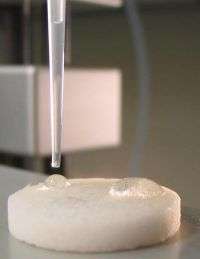
Materials engineers have created a new type of membrane that separates oil from water and, if perfected, might be used for environmental cleanup, water purification and industrial applications.
The new technology would last longer than conventional filters for separating oil from water and works by attracting water while beading oil, traits that are usually mutually exclusive. Researchers attached the material to a glass filter commonly used in laboratory research.
"We take mixtures of oil dispersed in water and run them through these filters, and we are getting 98 percent separation," said Jeffrey Youngblood, an assistant professor of materials engineering at Purdue University. "This is pretty good because if you don't modify the glass filters with our material essentially all the oil goes through. If you modify it with our material, then almost none of the oil goes through."
Findings were detailed in a paper that appeared online in October in the Journal of Colloid and Interface Science. The paper, which was written by Youngblood and materials engineering doctoral student John A. Howarter, also will appear in an upcoming print edition of the journal.
The findings demonstrate how an oily substance called hexadecane beads up on the membrane while water passes through.
The membrane consists of a layer of material called polyethylene glycol, and each molecule is tipped with a Teflon-like "functional group" made with fluorine. Water molecules are attracted to the polyethylene glycol, yet pass through the Teflon-like layer, which acts as a barrier to the oil molecules.
The researchers have tested the material with solutions containing oil suspended in water, similar to concentrations existing in oil spills and other environmental cleanup circumstances.
"To clean up an oil spill, for example, you could run contaminated water through a bunch of these filters to remove the oil," Youngblood said.
Such filters also might be used in other cleanup applications, such as removing oil from a ship's bilge water or cleaning wastewater contaminated with oil.
The technology might be used in a water-purification technology called reverse osmosis, which now requires a "pre-filter" to remove oil. This "oil coalescence filter" is needed to prevent oil from reaching the reverse osmosis membrane, which is ruined by oil. These conventional oil coalescence filters, however, must be replaced regularly. As water flows through the system, oil sticks to the filters, eventually rendering them ineffective.
The new technology, however, would not need to be replaced as frequently because oil does not stick to the filtration material. Instead, the oil droplets could be skimmed off through a commonly used industry technique called cross-flow filtration.
"When the oil-in-water dispersion contacts the filter surface, the oil coalesces to form big droplets. If the mixture is poured onto the filter, the oil forms on top of the material like a layer of cream," Youngblood said.
When a fluid lands on the surface of the material, it forms beads having a distinctive curvature determined by the "contact angle" of the substance. The higher the contact angle, the more a material is likely to form beads. Lowering the contact angle enough prevents substances from beading.
"This material maximizes oil's contact angle while minimizing water's contact angle, allowing water to flow through a filter while holding back the beaded oil," Youngblood said.
A key advantage of the new approach over some conventional methods is that it separates oil from water without using "nanoporous" filters. Filters containing extremely small pores require the water to be pushed through at high pressure, which consumes energy.
"One big problem is that if you are forcing stuff through very small pores it takes a lot of pressure," Youngblood said. "As the pores go down in size, the pressure goes way up. So, ideally you would want to use microfiltration instead of nanofiltration."
The new material contains pores between 10 and 174 microns, or millionths of a meter. Because the pores are relatively large, oil-contaminated water would not have to be pumped through.
"Microfiltration ordinarily works well to remove particles but really for nothing else, meaning it will not remove oil from water," Youngblood said. "The pores are just too large, and the oil passes right through."
The new material, however, efficiently separates oil from water even though the pores are large, he said.
The membranes are said to be amphiphilic, meaning they are made of molecules with two ends - one end attracts water while the other end attracts oils and grease.
Future work may explore whether the filter works for solutions containing mostly oil and small amounts of water. Because crude oil extracted in commercial drilling operations initially contains some water, such a filter might have applications in the oil industry. Future research also will involve finding a substitute for the glass filters, which are not practical for commercial membranes.
"You would probably use fiberglass, but we are also looking at other technologies, such as a new nylon that has the right properties," Youngblood said.
A patent is pending on the technology.
The same technology also might be used to create antifogging goggles and self-cleaning eyeglasses by not allowing water to form beads on surfaces. In previous work by the same researchers, self-cleaning and antifogging behavior has been demonstrated in experiments using glass surfaces coated with the material. Eyeglasses and goggles used by skiers are two obvious potential applications, along with automotive windshields.
Source: Purdue University


