Missing Radioactivity in Ice Cores Bodes Ill for Part of Asia
November 18th, 2008 Missing Radioactivity in Ice Cores Bodes Ill for Part of Asia

Enlarge

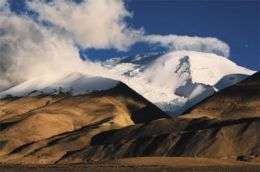
Naimona'nyi's frozen ice cap lacks critical radioactive signal, based on the latest study by Ohio State University researchers. This could foretell drastic water shortages for people living in the Indian sub-continent. Photo courtesy ©Thomas Nash 2007

When Ohio State glaciologists failed to find the expected radioactive signals in the latest core they drilled from a Himalayan ice field, they knew it meant trouble for their research.

But those missing markers of radiation, remnants from atomic bomb tests a half-century ago, foretell much greater threat to the half-billion or more people living downstream of that vast mountain range.

It may mean that future water supplies could fall far short of what's needed to keep that population alive.

In a paper just published in Geophysical Research Letters, researchers from the Byrd Polar Research Center explain that levels of tritium, beta radioactivity emitters like strontium and cesium, and an isotope of chlorine are absent in all three cores taken from the Naimona'nyi glacier 19,849 feet (6,050 meters) high on the southern margin of the Tibetan Plateau.

"We've drilled 13 cores over the years from these high-mountain regions and found these signals in all but one – this one," explained Lonnie Thompson, University Distinguished Professor of Earth Sciences at Ohio State.

The absence of radioactive signals in the top portion of these cores is a critical problem for determining the age of the ice in the cores. The signals, remnants of the 1962-63 Soviet Arctic nuclear blasts and the 1952-58 nuclear tests in the South Pacific, provide well-dated benchmarks to calibrate the core time scales.

"We rely on these time markers to date the upper part of the ice cores and without them, extracting the climate history they preserve becomes more challenging," Thompson said.

"We drilled three cores through the ice to bedrock at Naimona'nyi in 2006," said Natalie Kehrwald, a doctoral student at Ohio State and lead author on the paper. "When we analyzed the top 50 feet (15 meters) of each core, we found that the beta radioactivity signal was barely above normal background levels."

Tritium, an isotope of hydrogen, and chlorine-36 were also both absent from the Naimona'nyi cores, she said. They were able, however, to find a small amount of a lead isotope, lead-210, which allowed them to date the top of the core.

"We were able to get a date of approximately 1944 A.D.," Kehrwald said, "and that, coupled with the other missing signals, means that no new ice has accumulated on the surface of the glacier since 1944," nearly a decade before the atomic tests.

While the loss of the radioactive horizons to calibrate the cores poses a challenge for Thompson's research, he worries more about the possibility that other high-altitude glaciers in the region, like Naimona'nyi, are no longer accumulating ice and the impact that could have on water resources for the people living in these regions.

"When you think about the millions of people over there who depend on the water locked in that ice, if they don't have it available in the future, that will be a serious problem," he said.

Seasonal runoff from glaciers like Naimona'nyi feeds the Indus, the Ganges and the Brahmaputra rivers in that part of the Asian subcontinent. In some places, for some months each year, those rivers are severely depleted now, the researchers said. The absence of new ice accumulating on the glaciers will only worsen that problem.

"The current models that predict river flow in the region have taken recent glacial 'retreat' into account," said Kehrwald, "but they haven't considered that some of these glaciers are actually thinning until now.

"If the thinning isn't included, then whatever strategies people adopt in their efforts to adapt to reductions in river flow simply won't work."

Thompson fears that what's happening to the Naimona'nyi glacier may be happening to many other high-altitude glaciers around the world. "I think that this has tremendous implications for future water supplies in the Andes, as well as the Himalayas, and for people living in those regions."

The absence of the radioactive signals in the 2006 Naimona'nyi core also suggests that Thompson and his colleagues have been lucky with their previous expeditions to other ice fields.

"We have to wonder -- if we were to go back to previous drill sites, some drilled in the 1980s, and retrieved new cores -- would these radioactive signals be present today?" he asked.

"My guess is that they would be missing." The researchers' recent work has shown similar thinning on glaciers in Africa, South America and in Asia in the past few years.

Source: Ohio State University


print this article email this article download pdf blog this article bookmark this article     Digg this Stumble it share on Facebook share on Reddit add to delicious save to Yahoo! bookmarks
4.1/5 after 32 votes

Rank Filter

Move the slider to adjust rank threshold, so that you can hide some of the comments.


Display comments: newest first

  • GrayMouser - Nov 18, 2008
    • Rank: 3.8 / 5 (11)
    Or it means something else. They should not jump directly to the spectacular conclusions.
  • CWFlink - Nov 18, 2008
    • Rank: 3.7 / 5 (6)
    Indeed...
    '
    "We have to wonder -- if we were to go back to previous drill sites, some drilled in the 1980s, and retrieved new cores -- would these radioactive signals be present today?" he asked.
    '
    How could they NOT go back and check?
    As we well know, wind blows drifts of snow causing great variation in the thickness of snow layers based upon variations in the terrain and wind patterns. As this snow compresses into ice, it is clear that there will be considerable variation based on topology, terrain and wind fields around the mountain. I'm really surprised that cores have NOT be taken at regular intervals AT THE SAME LOCATION in order to determine the growth (shrinkage) and migration of the ice.
  • jeffsaunders - Nov 18, 2008
    • Rank: 4 / 5 (4)
    CWFlink - I agree the comment does seem pretty stupid coming from a scientist. What knowledge can be gained from a one off snap shot is nothing like the picture gained from multiple samples over time.

    If we take out the time link, we would have a pretty hard time building models that are supposed to reflect the real world over time.
  • Velanarris - Nov 18, 2008
    • Rank: 3.4 / 5 (5)
    "We were able to get a date of approximately 1944 A.D.," Kehrwald said, "and that, coupled with the other missing signals, means that no new ice has accumulated on the surface of the glacier since 1944," nearly a decade before the atomic tests.


    Or that region has had an abnormally low amount of precipitation due to the fact it's on the opposite side of the mountain.
  • QubitTamer - Nov 19, 2008
    • Rank: 3.7 / 5 (6)
    No no you don't understand... the consensus is in... global warming is causing massive amounts of water vapor to accelerate to orbital escape velocity and fly off into deep space.

    I was there when it happened on Mars and humans were to blame there as well.

    The science is OBVIOUS if you just close your eyes and believe.
  • out7x - Nov 20, 2008
    • Rank: 2 / 5 (4)
    Where's the dust, isotopes, and air bubble CO2, data? This is how ice cores are dated.
  • Velanarris - Nov 20, 2008
    • Rank: 5 / 5 (1)
    Where's the dust, isotopes, and air bubble CO2, data? This is how ice cores are dated.


    Ice cores are dated based on relative data, such as tree rings, geological formations, radiological data, etc.

    All of which are subject to large standards of deviation. In this case they have a known entity, radiation from weapons testing. They have hard dates that the testing was done and known amounts and concentrations. Only issue here is penetration and survey radius. How large an area of cores is the radiation missing from? A square mile, 10 square miles? That would determine if this measurement is even somewhat valid. Similar to that "anomalous area" in the Artic that threw off the results of some other studies.

November 18th, 2008 all stories
Space & Earth / Earth Sciences

Comments: 7
Rank: 4.1/5 after 32 votes

  • Stumble this up

  • Digg this

  • Share it:
  • share on Facebook
  • share on MySpace
  • share on Slashdot
  • rss-newsfeed
  • share on Google
  • share on Reddit
  • add to delicious
  • save to Yahoo! bookmarks
  • share on Windows Live
  • Add to Mixx!
Rating: 4.1/5 after 32 votes

  • Related Stories

  • Steppe change: Mammoths roamed southern Spain
    created 5 hours ago | popularity not rated yet | comments 0
  • Arctic climate under greenhouse conditions in the Late Cretaceous
    created 10 hours ago | popularity not rated yet | comments 0
  • Earth's most prominent rainfall feature creeping northward
    created Jul 01, 2009 | popularity not rated yet | comments 0
  • The least sea ice in 800 years
    created Jul 01, 2009 | popularity not rated yet | comments 0
  • Researchers find quicker, cheaper way to sort isotopes
    created Jun 29, 2009 | popularity not rated yet | comments 0


  • Transform a ball into a rock -- or make it invisible -- using transformation optics
    Transform a ball into a rock -- or make it invisible -- using transformation optics
    Physics / General Physics
    created 11 hours ago | popularity 3.8 / 5 (4) | comments 0
  • Could a quantum motor do work?
    Physics / General Physics
    created Jul 07, 2009 | popularity 4 / 5 (12) | comments 0
  • Physicists Demonstrate Quantum Memory with Matter Qubits
    Physicists Demonstrate Quantum Memory with Matter Qubits
    Physics / General Physics
    created Jul 03, 2009 | popularity 4.3 / 5 (21) | comments 1
  • 'Holey' Nanosheets for Wastewater Dye Removal
    Nanotechnology / Nanomaterials
    created Jul 01, 2009 | popularity 5 / 5 (5) | comments 1
  • Jellyfish Robot Swims Like its Biological Counterpart
    Jellyfish Robot Swims Like its Biological Counterpart
    Electronics / Robotics
    created Jun 26, 2009 | popularity 4.4 / 5 (9) | comments 1
  • Other News

    Living fossils hold record of 'supermassive' kick

    Living fossils hold record of 'supermassive' kick

    Space & Earth / Astronomy

    created 4 hours ago | popularity 4.7 / 5 (3) | comments 1

    The tight cluster of stars surrounding a supermassive black hole after it has been violently kicked out of a galaxy represents a new kind of astronomical object and a fossil record of the kick.


    Methane-eating microbes can use iron and manganese oxides to 'breathe'

    Methane-eating microbes can use iron and manganese oxides to 'breathe'

    Space & Earth / Earth Sciences

    created 7 hours ago | popularity 4.7 / 5 (3) | comments 0

    Iron and manganese compounds, in addition to sulfate, may play an important role in converting methane to carbon dioxide and eventually carbonates in the Earth's oceans, according to a team of researchers ...


    Tremors on southern San Andreas Fault may mean increased quake risk

    Tremors on southern San Andreas Fault may mean increased quake risk

    Space & Earth / Earth Sciences

    created 5 hours ago | popularity 5 / 5 (1) | comments 0

    (PhysOrg.com) -- Increases in mysterious underground tremors observed in several active earthquake fault zones around the world could signal a build-up of stress at locked segments of the faults and presumably ...


    A Galaxy Collision in Action

    A Galaxy Collision in Action

    Space & Earth / Astronomy

    created 6 hours ago | popularity 4.8 / 5 (5) | comments 1

    This beautiful image gives a new look at Stephan's Quintet, a compact group of galaxies discovered about 130 years ago and located about 280 million light years from Earth. The curved, light blue ridge running ...


    Aerial view of a flooded area in Bolivia in 2007

    'El Nino' arrives in Pacific for a months-long stay

    Space & Earth / Earth Sciences

    created 7 hours ago | popularity 3 / 5 (1) | comments 0

    US scientists on Thursday said that the El Nino warming trend of the Pacific Ocean waters has returned, bringing with it almost certain changes in weather patterns around the world.