New Virtual Tool Can Train Athlete Brains to React 53 Percent Faster, Improve Their Game
November 18, 2008 New Virtual Tool Can Train Athlete Brains to React 53 Percent Faster, Improve Their Game

Enlarge

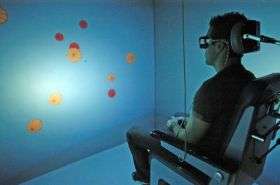
Boxing champion Antonin Décarie in automatic virtual environment cave developed at Universite de Montreal. Credit: Claude Lacasse

All great athletes know that in order to perform well, they can't just depend on their physical capabilities. Speed and efficiency in decision-making are just as essential. Two researchers from the School of Optometry of the Université de Montréal have discovered how to train the brain of athletes to improve their overall athletic performance.

Professor Jocelyn Faubert and postdoctoral student David Tinjust, put a dozen soccer, tennis and hockey players through multiple object-tracking exercises. The athletes' capacity to absorb a lot of information simultaneously and manage it efficiently increased on average by 53 percent.

In one of these exercises, subjects in the automatic virtual environment cave were asked to follow the increasingly rapid movements of a series of balls and identify those that quickly changed colour. After each training session, which lasted about an hour, results were recorded and athletes could note their progress. "It's like physical training, but for the brain," says Faubert.

The approach has already gained great popularity among athletes, from star goalie Kim St-Pierre to North American boxing champion Anthonin Décarie.

"In their normal workouts, athletes regularly evaluate their physical performance, but until now there has been no tool that could rate their cognitive performance," says Faubert. "If an athlete feels both physically and mentally ready, that can only have a positive influence on his or her performance."

Originally, the tool was used to see how elderly people or those with vision problems would behave in a virtual environment. For example, how could subjects work their way through a crowd, traffic or get on an escalator? The researchers then decided to adapt the process to top athletes and transfer the scientific knowledge to virtual training tools.

Athletes could wear a virtual helmet that would allow them to train anywhere. They could also wear cybernetic gloves and glasses and, while viewing superimposed images, they could practise complex movements with a fictitious opponent. Every movement of the hand, foot and head would be recorded with sensors.

Source: University of Montreal


print this article email this article download pdf blog this article bookmark this article     Stumble it Digg this share on Facebook retweet share on Reddit add to delicious
Rate this story - 3.8 /5 (15 votes)

Rank Filter

Move the slider to adjust rank threshold, so that you can hide some of the comments.


Display comments: newest first

  • h1ghj3sus - Nov 18, 2008
    • Rank: 4 / 5 (1)
    Simulations are great for training and testing.
  • bredmond - Nov 18, 2008
    • Rank: 5 / 5 (2)
    "They could also wear cybernetic gloves and glasses and, while viewing superimposed images, they could practise complex movements with a fictitious opponent. Every movement of the hand, foot and head would be recorded with sensors."

    I wanna use it to play Tekken.

November 18, 2008 all stories

Comments: 2

3.8 /5 (15 votes)
  • Stumble this up

  • Digg this

  • share this

  • hide
  • Related Stories

  • Exercising judgment: The psychology of fitness
    created Jan 09, 2008 | popularity not rated yet | comments 0
  • CyberWalk - Unconstrained Walking in Virtual Worlds
    created Apr 27, 2005 | popularity not rated yet | comments 0
  • Virtual Reality May Help Arm Minds for Combat
    created Nov 13, 2009 | popularity not rated yet | comments 0
  • Twitter testing tool to organize tweets
    created Oct 01, 2009 | popularity not rated yet | comments 0
  • Knee injuries may start with strain on the brain, not the muscles (w/ Podcast)
    created Jul 24, 2009 | popularity not rated yet | comments 0


  • hide
  • Relevant PhysicsForums posts

  • Chest x-ray???
    created 1hour ago
  • Multiple Sclerosis & CCSVI
    created 21 hours ago
  • 23 Years in a Vegetative State....or not?
    created Nov 25, 2009
  • Has the H1N1 vaccine been scientifically proven to work?
    created Nov 24, 2009
  • More from Physics Forums - Medical Sciences

Other News

Overeating can set stage for obesity, researchers say

Medicine & Health / Health

created 7 hours ago | popularity not rated yet | comments 1

It doesn't seem like a fair fight. In one corner loomed the Thanksgiving table, groaning with poultry, pie and mashed potatoes.


What a grind: Bruxism at night likely a sign of stress by day

Medicine & Health / Health

created 1hour ago | popularity not rated yet | comments 0

You can practically track Steve Barkley's stress by the level of activity in his temporomandibular joint, or TMJ, the hinge joint that connects the lower jaw to the temporal bone of the skull and helps one chew, talk and ...


eye

Over-the-counter eye drops raise concern over antibiotic resistance

Medicine & Health / Medications

created 13 hours ago | popularity 3.5 / 5 (2) | comments 1

(PhysOrg.com) -- The use of antibiotic eye drops for conjunctivitis has increased by almost half since they became available over the counter at chemists in 2005, data obtained by Oxford University researchers ...


New tools for prediction of disease progression in acute childhood leukemia

Medicine & Health / Cancer

created 8 hours ago | popularity not rated yet | comments 0

(PhysOrg.com) -- Researchers at Uppsala University and University Children’s Hospital in Uppsala have devised powerful new tools for typing cells from children with acute lymphatic leukemia and for prediction of how children ...


Nuclear science to fight sleeping sickness

Medicine & Health / Diseases

created 10 hours ago | popularity not rated yet | comments 0

The International Atomic Energy Agency on Friday announced an agreement to help African nations battle the tsetse fly, the main carrier of parasites that causes sleeping sickness with its bites.