New dreams rise from Phoenix's ashes
November 18, 2008 By Brian Murphy New dreams rise from Phoenix's ashes

Enlarge

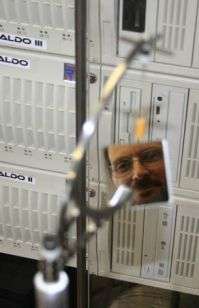
Carlos Lang, an associate professor of mechanical engineering, helped design a wind-speed indicator on the recently terminated Phoenix mission.

(PhysOrg.com) -- Carlos Lange has some sentimental thoughts about the shut down of the Phoenix Mars Lander, but science never sleeps and he's set his sights on a new mission to the Red Planet.

Lange, an associate professor of mechanical engineering at the University of Alberta, helped design a wind-speed indicator on the recently terminated Phoenix mission.

The Phoenix lander has been on Mars for more than five months. NASA pulled the plug Nov.10, about a week earlier than scheduled. With Martian winter setting in, less sunlight was reaching the lander's solar panels, causing power and communications problems. At the landing site near the north pole of Mars, winter temperatures will plunge to -150 C.

"It's sad to think Phoenix will soon be frozen in ice for several months," said Lange.

But he adds that in its short operational life the lander developed a lot of fans. In an online contest, Wired magazine asked readers to write an epitaph for Phoenix. The most popular epitaph was written in Latin. "'Veni, vidi, fodi,' which Lange translates as, "'I came I saw, I dug.'"

And the lander did a lot of important digging, says Lange. "It found the ground frozen below the surface." But more importantly he says, "life, at least under the surface layer of Mars, seems possible; the lander did not find anything toxic to microbial life."

The efforts of Lange and other Canadians on the Phoenix lander were focused on weather-monitoring technology. Lange says their success speaks well for future assignments. "Canadian equipment detected snow falling above the planet and confirmed the presence of frost."

That kind of performance sparked the interest of the European Space Agency. The agency plans to send a rover mission to Mars in 2016. They call it ExoMars and Lange's name came up as a possible collaborator on technology to measure humidity. Lange is intrigued by the ultimate goal ESA has set for ExoMars: "This lander will be one of the few that is planning to test for life."

Lange definitely wants to be part of the team trying to solve the Red Planet's ultimate riddle. He's currently negotiating with the ESA his role on the ExoMars project. But whether or not he signs on, Lange knows the new mission will benefit from the work he and his team have already done.

"When the question of life on Mars is answered the Phoenix Lander sitting silent like a monument; it will be a constant reminder of our contribution."

Provided by University of Alberta


print this article email this article download pdf blog this article bookmark this article     Stumble it Digg this share on Facebook retweet share on Reddit add to delicious
Rate this story - 3.8 /5 (4 votes)


November 18, 2008 all stories

Comments: 0

3.8 /5 (4 votes)
  • Stumble this up

  • Digg this

  • share this

  • hide
  • Related Stories

  • U of A device to measure wind on Mars
    created May 27, 2008 | popularity not rated yet | comments 0
  • U of A device to measure wind on Mars will soon be landing
    created May 22, 2008 | popularity not rated yet | comments 0
  • Taking a Bite of Antarctic Ice
    created Nov 16, 2009 | popularity not rated yet | comments 0
  • Frost-Covered Phoenix Lander Seen in Winter Images
    created Nov 05, 2009 | popularity not rated yet | comments 0
  • Scientists see water ice in fresh meteorite craters on Mars
    created Sep 24, 2009 | popularity not rated yet | comments 0


  • hide
  • Relevant PhysicsForums posts

  • Question about 2-body gravity
    created Nov 24, 2009
  • life on Mars
    created Nov 24, 2009
  • Semi-major axis from cartesian co-ordinates
    created Nov 23, 2009
  • Primary Mirror grinding
    created Nov 23, 2009
  • More from Physics Forums - General Astronomy

Other News

Cutting greenhouse pollutants could directly save millions of lives worldwide

Space & Earth / Environment

created 35 minutes ago | popularity 1 / 5 (1) | comments 0

Tackling climate change by reducing carbon dioxide and other greenhouse emissions will have major direct health benefits in addition to reducing the risk of climate change, especially in low-income countries, according to ...


It's not just dirt!

Space & Earth / Environment

created 32 minutes ago | popularity not rated yet | comments 0

Soil is the linchpin of the environment, where atmosphere, biosphere, and hydrosphere meet. Despite that, many students see soil as "just dirt" - a place to grow plants, but nothing more. Soil science educators are challenged ...


Small faults in Southeast Spain reduce earthquake risk of larger ones

Small faults in Southeast Spain reduce earthquake risk of larger ones

Space & Earth / Earth Sciences

created 1hour ago | popularity not rated yet | comments 0

A team of Spanish scientists, studying recent, active deformations in the Baetic mountain range, have shown that the activity of smaller tectonic structures close to larger faults in the south east of the ...


First black holes may have incubated in giant, starlike cocoons, says CU-Boulder study

First black holes may have incubated in giant, starlike cocoons

Space & Earth / Astronomy

created 22 hours ago | popularity 4.5 / 5 (11) | comments 15

(PhysOrg.com) -- The first large black holes in the universe likely formed and grew deep inside gigantic, starlike cocoons that smothered their powerful x-ray radiation and prevented surrounding gases from ...


Mars Reconnaissance Orbite

Mars Reconnaissance Orbite Team Plans Uplink of Protective Files

Space & Earth / Space Exploration

created 3 hours ago | popularity 5 / 5 (1) | comments 0

(PhysOrg.com) -- The team operating NASA's Mars Reconnaissance Orbiter plans to uplink protective files to the spacecraft next week as one step toward resuming the orbiter's research and relay activities.