November 18, 2008 weblog
SuperSpeed USB 3.0 Finalized By Major Players in USB Promoter Group
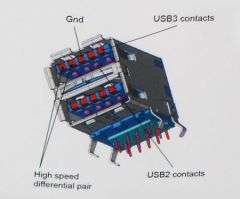
(PhysOrg.com) -- The final specifications for the SuperSpeed USB 3.0 is available and a discussion of the technology is underway at the SuperSpeed USB Conference in San Jose, California. Major players in the development of the SuperSpeed USB 3.0 include, Hewlett-Packard, ST-NXP Wireless, Intel, Microsoft, Texas Instruments and NEC.
The USB Promoter Group´s three-year effort to create a universal USB 3.0 culminated in the release of the specifications which is the technical road map for all developers to bring SuperSpeed USB technology to the marketplace. The Group invites developers to read the specifications and apply to become "Adopters" of the new technology.
According to the USB Promoter Group, the new SuperSpeed USB 3.0 will deliver speed 10-times faster than current USB 2.0. In practice, the Group claims the USB 3.0 is backward compatible with existing USB 2.0 and will be capable of transferring a 25-GB HD movie in approximately 70-seconds. Current, USB 2.0 transfer rates for the same content will take nearly 14-minutes. Recognizing the public demand for high definition content, the SuperSpeed USB 3.0 discrete controller will be seen in the second half of 2009 and for other consumer products like external hard drives, flash drives and consumer products by 2010.
Microsoft has been somewhat reluctant to say whether the new SuperSpeed USB will be incorporated into the new Windows 7 OS. It is considering adding it to its existing Windows Vista OS. Various tech experts caution that the newly released specifications and speed ratings are based on a maximum throughput in lab conditions. The actual performance for consumers will be significantly impacted by Internet infrastructure in their region.
Symwave a global fabless semiconductor company provided a live demonstration of a USB 3.0 PHY device at the SuperSpeed USB Conference in San Jose. According to Yossi Cohen, President of Symwave, " This is an amazing achievement for our engineering team and underscores our mixed-signal core competency. Symwave´s Quasar PHY is targeted at the fast-growing "sync- and- go" applications like mobile phones, media players, HD camcorders and external hard drives.
The exceptional hurdle made in the final form of the SuperSpeed USB 3.0 is its apparent ability to utilize optical lines and wireless with some room for future and yet to be developed technology. The Adopters Agreement with a reciprocal royalty-free licensing arrangement for developer´s compliant products has a good chance of igniting a firestorm of new products.
© 2008 PhysOrg.com


