Scientists discover new planet orbiting dangerously close to giant star
November 18, 2008 Scientists discover new planet orbiting dangerously close to giant star

Enlarge

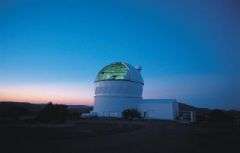
The scientists used the Hobby-Eberly Telescope, one of the largest and most powerful telescopes in the world, to make its discovery of the extrasoslar planet. Credit: Thomas Sebring, Hobby-Eberly Telescope

A team of astronomers from Penn State and Nicolaus Copernicus University in Poland has discovered a new planet that is closely orbiting a red-giant star, HD 102272, which is much older than our own Sun. The planet has a mass that is nearly six times that of Jupiter, the largest planet in our solar system.

The team includes Alexander Wolszczan, the discoverer of the first planets ever found outside our solar system, who is an Evan Pugh Professor of Astronomy and Astrophysics and the director of the Center for Exoplanets and Habitable Worlds at Penn State; and Andrzej Niedzielski, who leads his collaborators in Poland. The team suspects that a second planet may be orbiting HD 102272, as well. The findings, which will be published in a future issue of The Astrophysical Journal, shed light on the ways in which aging stars can influence nearby planets.

Scientists already know that stars expand as they age and that they eventually may gobble up adjacent planets. In fact, scientists expect our own planet to be swallowed up by the Sun in about a billion years. But what scientists don't yet understand fully is how aging stars influence nearby planets before they are destroyed. The team's newly discovered planet is interesting because it is located closer to a red-giant star than any other known planet.

"When red-giant stars expand, they tend to eat up the nearby planets," said Wolszczan. "Although the planet we discovered conceivably could be closer to the star without being harmed by it, there appears to be a zone of avoidance around such stars. Our discovery pushes it back to about 0.6 astronomical units, which is the size of the new planet's orbit. It is important to find out why planets don't want to get any closer to stars, so one of our next steps is to try to figure out why this zone of avoidance exists and whether it occurs around all red-giant stars."

The team used the Hobby-Eberly Telescope of McDonald Observatory in south-western Texas to make its discovery. Through the telescope, which is equipped with a precise spectrograph, the scientists observed a pattern of alternating shifts of spectral lines in the light coming from the star, which is located 1,200 light-years from the Earth in the constellation Leo. These tiny, alternating shifts represent the fingerprint of a star that is moving alternately toward and away from Earth as it wobbles in space responding to the gravitational pull of an orbiting planet. Because of the Doppler effect, the light from the star becomes bluer as it moves toward the Earth and then redder as it recedes from it, which is reflected by the measured shifts of the spectral lines. The specific pattern of these shifts, which the research team observed, allowed the scientists to determine that one planet -- and possibly two planets -- orbit the star. If the second planet exists, the system would become the first multiplanet system discovered around a red-giant star.

Wolszczan said that he is particularly interested in applying to our own solar system the knowledge he gains about the effects of aging stars on planets orbiting other stars. "Our own Sun one day will become a red giant and it is interesting to think about what will happen to the outer planets of our solar system as the Sun expands," he said. "For example, Europa, one of Jupiter's moons, is covered by ice, but if it were to exist closer to the Sun, it might become a warm ocean world that could possibly support life."

Source: Penn State


print this article email this article download pdf blog this article bookmark this article     Stumble it Digg this share on Facebook retweet share on Reddit add to delicious
Rate this story - 4.3 /5 (19 votes)

Rank Filter

Move the slider to adjust rank threshold, so that you can hide some of the comments.


Display comments: newest first

  • jeffsaunders - Nov 18, 2008
    • Rank: 5 / 5 (4)
    Scientists discover new planet orbiting dangerously close to giant star


    I had better read this article again. I cannot see anywhere where it says how lose the planet orbits the sun.

    The team's newly discovered planet is interesting because it is located closer to a red-giant star than any other known planet.


    ok we don't have an estimated distance just a relative distance of closer than any other one found so far. Just how close is that?
  • jonnyboy - Nov 18, 2008
    • Rank: 4.6 / 5 (5)
    More importanyly, exactly how is this dangerous?

    to who?

    when?

    another BS title
  • ofidiofile - Nov 19, 2008
    • Rank: not rated yet
    perhaps this is the distance?

    "Although the planet we discovered conceivably could be closer to the star without being harmed by it, there appears to be a zone of avoidance around such stars of about 0.6 astronomical units".

    though it's nothing more than implied here.

    and "dangerously close"-- it made you read the article, didn't it? :)
  • Trippy - Nov 19, 2008
    • Rank: 5 / 5 (1)
    DYOR - the original article isn't hard to find.

    http://arxiv.org/abs/0810.1710
  • ofidiofile - Nov 19, 2008
    • Rank: not rated yet
    ah, cool. thanks!
  • axemaster - Nov 19, 2008
    • Rank: 4 / 5 (1)
    So, the planet is at a semimajor axis of .62AU - wow that's actually insanely close for a red giant.
  • zevkirsh - Nov 19, 2008
    • Rank: 5 / 5 (1)
    what if this planet is actually dangerously far away from the star becasue there are sentient pain feeling beings living on that planet that need a much warmer climate and they are actually far too cold right now?

    the article might be titled ...dangerously far away.

  • Modernmystic - Nov 26, 2008
    • Rank: not rated yet
    I would think if it's a red giant and the planet is orbiting that close it could be getting some huge drag on the matter being sluffed off by the star in this phase...that's REALLY close.

    I wouldn't be surprised if it's orbit doesn't degrade to the point where it spirals in within a few million years.
  • Quantum_Conundrum - Dec 04, 2008
    • Rank: not rated yet
    Modernmystic:

    Of course you won't be surprised. You won't be here to witness it!
  • Modernmystic - Dec 04, 2008
    • Rank: not rated yet
    Modernmystic:

    Of course you won't be surprised. You won't be here to witness it!


    Mmmmmkay...your right. Very clever.

    *pats QC on the head and gives him a lollypop*

November 18, 2008 all stories

Comments: 10

4.3 /5 (19 votes)
  • Stumble this up

  • Digg this

  • share this

  • hide
  • Related Stories

  • Kepler Mission Update
    created Nov 06, 2009 | popularity not rated yet | comments 0
  • Starring Intelligent Aliens
    created Nov 05, 2009 | popularity not rated yet | comments 0
  • Unsettled Youth: Spitzer Observes a Chaotic Planetary System
    created Nov 04, 2009 | popularity not rated yet | comments 0
  • 'Ultra-primitive' particles found in comet dust
    created Nov 02, 2009 | popularity not rated yet | comments 0
  • Detecting Life-Friendly Moons
    created Oct 26, 2009 | popularity not rated yet | comments 0


  • hide
  • Relevant PhysicsForums posts

  • The shape of our solar system's orbits.
    created Nov 07, 2009
  • Above or Below the Line of Nodes
    created Nov 07, 2009
  • Supernova vs. Nova?
    created Nov 07, 2009
  • Supernova's Gamma Rays and Comets
    created Nov 06, 2009
  • More from Physics Forums - General Astronomy

Other News

Deep creep means milder, more frequent earthquakes along Southern California's San Jacinto fault

Deep creep means milder, more frequent earthquakes along Southern California's San Jacinto fault

Space & Earth / Earth Sciences

created 15 hours ago | popularity 4.5 / 5 (4) | comments 0

With an average of four mini-earthquakes per day, Southern California's San Jacinto fault constantly adjusts to make it a less likely candidate for a major earthquake than its quiet neighbor to the east, the ...


Success in 'space elevator' competition (AP)

Success in 'space elevator' competition (Update 3)

Space & Earth / Space Exploration

created Nov 05, 2009 | popularity 4.3 / 5 (33) | comments 50

(AP) -- A robot powered by a ground-based laser beam climbed a long cable dangling from a helicopter on Wednesday to qualify for prize money in a $2 million competition to test the potential reality of the ...


In a Galaxy Far, Far Away...

In a Galaxy Far, Far Away...

Space & Earth / Astronomy

created Nov 06, 2009 | popularity 4.8 / 5 (5) | comments 17

(PhysOrg.com) -- Astronomers have published the discovery of the farthest known object in the cosmos: a star that exploded when the universe was only 630 million years old -- only 4.6% of its current age. ...


'Dropouts' pinpoint earliest galaxies

'Dropouts' pinpoint earliest galaxies

Space & Earth / Astronomy

created Nov 06, 2009 | popularity 4.2 / 5 (10) | comments 13

Astronomers, conducting the broadest survey to date of galaxies from about 800 million years after the Big Bang, have found 22 early galaxies and confirmed the age of one by its characteristic hydrogen signature ...


Space hotel taking bookings for 2012 opening

Space hotel taking bookings for 2012 opening

Space & Earth / Space Exploration

created Nov 05, 2009 | popularity 4.4 / 5 (21) | comments 11

(PhysOrg.com) -- The first orbiting space hotel is on track to open for its first customers in 2012, but hurry, as bookings are filling fast.