Precise measurement of phenomenon advances solar cell understanding
November 18, 2008 Precise measurement of phenomenon advances solar cell understanding

Enlarge

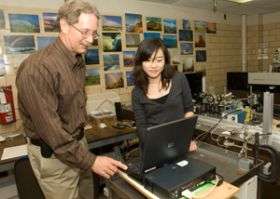
Dewey Holten, Ph.D., WUSTL professor of chemistry in Arts & Sciences (left) and WUSTL chemistry graduate student Hee-eun Song examine data in Holten's laboratory. The two have made a breakthrough in the electron transfer process that could have a significant impact on solar cell design.

(PhysOrg.com) -- "One type of solar cell design starts with a chain of chromophores strung between two electrodes," explained Dewey Holten, Ph.D., professor of chemistry in Arts & Sciences. "This chain absorbs the light energy and directs that energy towards one electrode, where it is deposited as an electron. The molecule which lost the electron now has a positive charge left behind called a hole. The hole migrates down the chain towards the opposite electrode. The electron and the hole recombine in the external circuit, creating the electrical current to do work."

Holten and graduate student Hee-eun Song have directly measured the rate of hole transfer between identical porphyrin compounds in their ground states. These results are key to understanding the fundamental processes underlying charge separation in this sort of structure and have applications for improving the efficiency of solar cells.

Their results represent the first time that ground-state hole transfer rates have been precisely measured. Previously, hole transfer in chains of porphyrin molecules was known to take from 20 picoseconds to 50 nanoseconds, a range that spans three orders of magnitude. These studies have defined the time as 0.5-1 nanoseconds.

The work has been published in the Journal of the American Chemical Society and is in press at the Journal of Physical Chemistry B and Photochemistry and Photobiology. The Department of Energy Solar Photochemistry Program provided funding.

Hopping downhill

Thermodynamic stability is often the driving force for the hole to move down the chain. However, this requires that the chain be made up of a variety of molecules so that each hop is downhill in energy.

"From a synthetic standpoint, it is easier to build a string of similar molecules with a minimum number of energy gradient steps built in. The challenge then becomes monitoring hole transfer between identical molecules," said Holten.

The multiporphyrinic arrays they studied were synthesized by a group at North Carolina State University under the direction of Jonathan Lindsey, Ph.D., Glaxo Distinguished University Professor of Chemistry.

Holten and his group placed the molecular arrays in a predefined starting form by electrochemically oxidizing one of the porphyrins to generate the hole and exciting another with light to make an electronic excited state. Then they used ultrafast femtosecond timescale transient absorption spectroscopy to monitor the hole transfer process between equivalent porphyrins.

"We compared the spectroscopic and kinetic results for the monomer, dyads, and triads," Holten said. "From this information, we could back out the rates of hole transfer between the equivalent sites."

David Bocian, Ph.D., professor of chemistry at the University of California, Riverside and his group performed additional spectroscopic studies.

"This work is an example of how an exciting collaboration between scientists can produce results that are fundamentally important, develop a general experimental method that can be adopted by other scientists, and also have real world applications," said Holten.

Provided by Washington University in St. Louis


print this article email this article download pdf blog this article bookmark this article     Stumble it Digg this share on Facebook retweet share on Reddit add to delicious
Rate this story - 4.3 /5 (12 votes)

Rank Filter

Move the slider to adjust rank threshold, so that you can hide some of the comments.


Display comments: newest first

  • holmstar - Nov 18, 2008
    • Rank: 5 / 5 (2)
    So is there anyone here that can explain how this will help solar cell design? I'm not criticizing the research... I'm genuinely interested.
  • ryuuguu - Nov 18, 2008
    • Rank: 5 / 5 (1)
    One of the design challenges in making solar cells is that
    -thicker makes it easier to hit by a photon and which frees and electron which travels towards one electron as mentioned in the article header.
    -thicker also means that the "hole" left by the electron has to travel back farther to get to the other electrode and if the hole meets an a new freed electron on the way they cancel each other out, meaning no current is produced by the new freed electron.

    So thicker means more electrons produced by light hitting the solor cell, but thicker also means there is less chance for the electron makes it to edge of the cell and generates power.
    So understanding the details of how the electrons and holes flow can help them model/build materials that have flows which do not have collisions between holes and electrons.
    how this could be done (this part is wild speculation by me because I don't really know)
    -faster movement of holes and electrons would mean less time in cell so less chance of colliding.

  • gmurphy - Nov 19, 2008
    • Rank: 5 / 5 (1)
    holmstar, as I understand it, solar cells have a similar process of using freed electrons for energy. The ability of the solar cell to sustain power generation is dependent on how quickly the positive hole left behind by the freed electron can be refilled. By configuring the energy topology of the material to easily allow the positive holes to "fall" towards to negative electrode, this potentially improves solar cell efficiency.

November 18, 2008 all stories

Comments: 3

4.3 /5 (12 votes)
  • Stumble this up

  • Digg this

  • share this

  • hide
  • Related Stories

  • Doing nature one better: Expanding the genetic code in living mammalian cells
    created Jul 01, 2007 | popularity not rated yet | comments 0
  • Scientists Uncover Critical Step in DNA Mutation
    created Aug 23, 2006 | popularity not rated yet | comments 0
  • 'Coinage' of plankton -- viruses
    created Mar 25, 2006 | popularity not rated yet | comments 0
  • Researchers create faster, more efficient laser for communications
    created Nov 08, 2005 | popularity not rated yet | comments 0
  • Hawaiian hot spot has deep roots
    created 14 hours ago | popularity not rated yet | comments 0


Other News

Stopping MRSA before it becomes dangerous is possible, researchers find

Stopping MRSA before it becomes dangerous is possible, researchers find

Chemistry / Biochemistry

created 15 hours ago | popularity 5 / 5 (1) | comments 0

Most scientists believe that staph infections are caused by many bacterial cells that signal each other to emit toxins. The signaling process is called quorum sensing because many bacteria must be present ...


Carbonic anhydrase

Blood Enzyme Could Help Realize Clean Coal

Chemistry / Biochemistry

created 16 hours ago | popularity 3.8 / 5 (4) | comments 0

(PhysOrg.com) -- An enzyme in our blood that enables our lungs to exhale carbon dioxide could be the key to isolating carbon dioxide emissions from coal plants in order to store them safely underground. A ...


Green tea chemical combined with another may hold promise for treatment of brain disorders

Chemistry / Biochemistry

created 18 hours ago | popularity 4.8 / 5 (4) | comments 1

Scientists at Boston Biomedical Research Institute (BBRI) and the University of Pennsylvania have found that combining two chemicals, one of which is the green tea component EGCG, can prevent and destroy a variety of protein ...


Smokeless tobacco called 'moist snuff' is contaminated with harmful substances

Smokeless tobacco called 'moist snuff' is contaminated with harmful substances

Chemistry / Biochemistry

created 20 hours ago | popularity 2 / 5 (1) | comments 0

A new study on the smokeless tobacco product called moist snuff — placed between lip and gum — has led scientists in Minnesota to urge the tobacco industry to change manufacturing practices to reduce snuff's ...


Innovation puts next-generation solar cells on the horizon

Chemistry / Materials Science

created Dec 01, 2009 | popularity 4.5 / 5 (23) | comments 9

In a world first, a Monash University-led international research team has developed an innovative way to boost the output of the next generation of solar cells.