Global warming predictions are overestimated, suggests study on black carbon
November 18, 2008 By Krishna Ramanujan
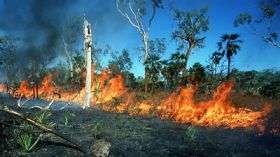
Savanna fires occur almost every year in northern Australia, leaving behind black carbon that remains in soil for thousands of years. Provided by Grant Stone, QCCCE
(PhysOrg.com) -- A detailed analysis of black carbon -- the residue of burned organic matter -- in computer climate models suggests that those models may be overestimating global warming predictions.
A new Cornell study, published online in Nature Geosciences, quantified the amount of black carbon in Australian soils and found that there was far more than expected, said Johannes Lehmann, the paper's lead author and a Cornell professor of biogeochemistry. The survey was the largest of black carbon ever published.
As a result of global warming, soils are expected to release more carbon dioxide, the major greenhouse gas, into the atmosphere, which, in turn, creates more warming. Climate models try to incorporate these increases of carbon dioxide from soils as the planet warms, but results vary greatly when realistic estimates of black carbon in soils are included in the predictions, the study found.
Soils include many forms of carbon, including organic carbon from leaf litter and vegetation and black carbon from the burning of organic matter. It takes a few years for organic carbon to decompose, as microbes eat it and convert it to carbon dioxide. But black carbon can take 1,000-2,000 years, on average, to convert to carbon dioxide.
By entering realistic estimates of stocks of black carbon in soil from two Australian savannas into a computer model that calculates carbon dioxide release from soil, the researchers found that carbon dioxide emissions from soils were reduced by about 20 percent over 100 years, as compared with simulations that did not take black carbon's long shelf life into account.
The findings are significant because soils are by far the world's largest source of carbon dioxide, producing 10 times more carbon dioxide each year than all the carbon dioxide emissions from human activities combined. Small changes in how carbon emissions from soils are estimated, therefore, can have a large impact.
"We know from measurements that climate change today is worse than people have predicted," said Lehmann. "But this particular aspect, black carbon's stability in soil, if incorporated in climate models, would actually decrease climate predictions."
The study quantified the amount of black carbon in 452 Australian soils across two savannas. Black carbon content varied widely, between zero and more than 80 percent, in soils across Australia.
"It's a mistake to look at soil as one blob of carbon," said Lehmann. "Rather, it has different chemical components with different characteristics. In this way, soil will interact differently to warming based on what's in it."
Provided by Cornell University
-
How Arctic microbes respond to a warming world
Nov 06, 2011 |
4.8 / 5 (6) |
1
-
Breaking down cellulose without blasting lignin
Jul 14, 2011 |
4.8 / 5 (4) |
0
-
Glory promises new view of perplexing particles
Feb 17, 2011 |
not rated yet |
0
-
Frequent, severe fires turn Alaskan forests into a carbon production line
Feb 10, 2011 |
4.6 / 5 (7) |
2
-
Reversing climate change: Is charcoal the answer?
Oct 08, 2010 |
4.3 / 5 (12) |
17
-
Engineers build first sub-10-nm carbon nanotube transistor
Feb 01, 2012 |
4.9 / 5 (31) |
30
-
Something old, something new: Evolution and the structural divergence of duplicate genes
Jan 31, 2012 |
4.6 / 5 (7) |
1
-
The hidden nanoworld of ice crystals: Revealing the dynamic behavior of quasi-liquid layers
Jan 30, 2012 |
5 / 5 (3) |
1
-
Stock market network reveals investor clustering
Jan 27, 2012 |
3.9 / 5 (23) |
8
-
Of microchemistry and molecules: Electronic microfluidic device synthesizes biocompatible probes
Jan 26, 2012 |
5 / 5 (1) |
0
-
Do some geologists actually act a lot like Randy Marsh?
18 hours ago
-
Discrepancy between oxygen and carbon-dioxide levels
Feb 09, 2012
-
where gems are found in the world
Feb 09, 2012
-
Wind Waves in Reservoir ~ Wind run-up and Wind set-up
Feb 08, 2012
-
Balance of oxygen in the atmosphere
Feb 01, 2012
-
The case for a methanol-based economy
Jan 30, 2012
- More from Physics Forums - Earth
More news stories
Europe stakes billion-dollar bet on new rocket
A pencil-slim rocket is scheduled to lift into space from South America on Monday, carrying a billion-dollar bet that Europe can grab a juicy slice of the market to place satellites in low orbit.
Space & Earth / Space Exploration
16 hours ago |
3.5 / 5 (2) |
0
Political leaders play key role in how worried Americans are by climate change: study
More than extreme weather events and the work of scientists, it is national political leaders who influence how much Americans worry about the threat of climate change, new research finds.
Feb 06, 2012 |
5 / 5 (6) |
72
NASA budget will axe Mars deal with Europe: scientists
US President Barack Obama's budget proposal to be submitted next week for 2013 will cut NASA's budget by 20 percent and eliminate a major partnership with Europe on Mars exploration, scientists said Thursday.
Space & Earth / Space Exploration
Feb 10, 2012 |
5 / 5 (3) |
48
Humans may have helped the decline of African rainforests 3000 years ago
(PhysOrg.com) -- Large areas of rainforests in Central Africa mysteriously disappeared over three thousand years ago, to be replaced by savannas. The prevailing theory has been that the cause was a change ...
High planetary tilt lowers odds for life?
Highly-tilted worlds would have extreme seasons, subjecting life to alternating periods of scorching and subzero temperatures. This could make the development of all but hardiest, simplest creatures a long ...
Space & Earth / Space Exploration
Feb 06, 2012 |
4.8 / 5 (12) |
14
|
Walney offshore wind farm is world's biggest (for now)
(PhysOrg.com) -- The Walney wind farm on the Irish Sea--characterized by high tides, waves and windy weather--officially opened this week. The farm is treated in the press as a very big deal as the Walney ...
GPS court ruling leaves US phone tracking unclear
A US Supreme Court decision requiring a warrant to place a GPS device on the car of a criminal suspect leaves unresolved the bigger issue of police tracking using mobile phones, legal experts say.
Europeans protest controversial Internet pact
Tens of thousands of people marched in protests in more than a dozen European cities Saturday against a controversial anti-online piracy pact that critics say could curtail Internet freedom.
Study finds that anti-diabetic medication can prevent the long-term effects of maternal obesity
In a study to be presented today at the Society for Maternal-Fetal Medicine's annual meeting, The Pregnancy Meeting, in Dallas, Texas, researchers will report findings that show that short therapy with the anti-diabetic medication ...
Netflix settlement trims 14 pct off 4Q earnings
(AP) -- Netflix pressed the rewind button on its fourth-quarter earnings after settling allegations that the video subscription service violated a consumer-privacy law.
Navy to begin tests on electromagnetic railgun prototype launcher
The Office of Naval Research (ONR)'s Electromagnetic (EM) Railgun program will take an important step forward in the coming weeks when the first industry railgun prototype launcher is tested at a facility ...
Nov 18, 2008
Rank: 4.1 / 5 (21)
An error twice as large as all human contributions.
I am constantly coming across articles presenting some unaccounted-for or re-estimated piece of the climate/carbon cycle/whatever. In the last week just on physorg:
http://www.physor...756.html
http://www.physor...316.html
http://www.physor...488.html
http://www.physor...002.html
http://www.physor...134.html
http://www.physor...049.html
Developing an accurate climate model is a worthy goal but I'm afraid I don't have too much faith in what we have now.
Nov 18, 2008
Rank: 4.3 / 5 (21)
Humans should select problems that require models that are tractable with todays technology or may be a small stretch of it. We should avoid wild eyed cranks taking over the popular media with dire predictions based on pre-determined models which are obviously biased.
Nov 18, 2008
Rank: 3.8 / 5 (24)
Nov 18, 2008
Rank: 2.5 / 5 (28)
Just thought I would drop in and say hi to the climate sceptics and watch them do some cherry picking, because we all know their better informmed than 98% of the scientists who work in field.
Nov 18, 2008
Rank: 3.3 / 5 (19)
http://darkmissio...sed.html
Nov 18, 2008
Rank: 4.1 / 5 (21)
This is a constant battle, and if not fought constantly, will be lost.
Just look what has happened in U.S.A where Creationists have somehow gained an upper hand over real science because real scientists have not been pushing real science hard enough.
To ryuuguu - the problem is not that the world is warming or cooling in a series of consecutive samples. The problem lies in interpreting results from samples where the data lies inside the magnitude of error.
When results of measurements lie inside the magnitude of error, the thing we should be doing is reducing the error, not jumping to conclusions.
It is the job of real scientists to work on real problems. That is not to say that a scientists can not have an opinion, they are entitled to an opinion.
The trouble we have in the world today mostly stems from media reporters hunting sensational headings and forgetting that a reporters job is to report the truth, NOT to exaggerate the truth.
There will always be scientists that confuse fact with opinion but when it is reported by intelligent people, that are trained to look for the difference between fact and fiction, then we are in trouble.
I no not lay the entire blame on Al Gore or many others that agree with him, for the one-sided unintelligent debate that has not taken place. The true blame lies with media companies that think that news is entertainment and therefore requires no basis in fact.
Nov 19, 2008
Rank: 3.2 / 5 (10)
This is incorrect. The article says that the new discovery concerning black carbon accounts for a 20% reduction of carbon dioxide emissions from soils over 100 years.
This means it accounts for a reduction in the amount of carbon dioxide emitted by soils every year by 20%/100 or 0.2%.
So the error is only 0.2% downwards annually.
If the total contribution to carbon dioxide made by human activity is 10% of the size of carbon dioxide emitted by soils then the error in previous estimates was only one twentieth the size of all human contributions, or 5%.
Nov 19, 2008
Rank: 3.9 / 5 (14)
Your math is worng, you'd have to perform your calculations on a 20% decrease against the CO2 estimate for each year attributable to soil. Not a blanket 0.2% per year. It's down 20% every year, not just for the whole period of 100 years.
If you want to talk about how small a number that is, here's another small number for you: total human contribution percentage to atmospheric CO2 - estimated between 0.08% and 0.3%
So if that error was only 0.2% downward per year, and soil contributes more than 10 times what human beings do, then technically all of our estimates, after accounting for the soil process, should now represent a net decrease or equilibrium in CO2 against temperature, but that isn't the observed result either.
So one can conclude:
Temperature and atmospheric CO2 are not reliably linked under current models and estimates.
We don't actually know how the CO2 cycle works.
We can't account for the increase in temperature by looking at man made CO2.
Make sense?
Nov 19, 2008
Rank: 3.9 / 5 (15)
It is too bad so many 'scientists' are so irrational and can't be independent.
Nov 19, 2008
Rank: 2 / 5 (10)
Nov 19, 2008
Rank: 2.6 / 5 (12)
Estimated by who? There's an apparent deliberate attempt to confuse here, using meaningless percentages unatributed or referenced.
Even Wikipedia can make the issue simple.
(27 x 10^9 / 3 x 10^12) x 100 = 0.9% added to atmosphere's CO2 every year by burning fossil fuels. If nature removes none of it in addition to its natural CO2 cycle, then in 10 years earth's atmospheric CO2 content goes up by 0.9% x 10 = 9%
Nov 19, 2008
Rank: 3 / 5 (8)
The relevant statement in the article is that "the researchers found that carbon dioxide emissions from soils were reduced by about 20 percent over 100 years" - I read this statement as saying that there is a 20% decrease over a period of 100 years.
My original contention was with GIR saying:
GIR misread the article.
You're correct to say you wouldn't apply 0.2% a year - that is an average reduction per year from the original amount, and a 0.2% annual error would eventually compound to a larger amount by:
Error over 100 years (as fraction) = (1 0.002)^100 = 1.22
Or 122% over 100 years.
So the error with 0.2% annual error compounded would be substantially larger. The reason I highlighted 0.2% is because GIR asserted (incorrectly) that the error was twice human-derived CO2 emissions, when it fact is likely to be a small fraction of that.
I guess. I apologise for mentioning 0.2%. I will now try to calculate the actual annual amount.
To recap: I believe you are wrong in saying the decrase should be 20% a year - the article says a 20% reduction over a period of 100 years.
To calculate the change per year to account for a 20% reduction in the amount of CO2 emitted as a result of soil over 100 years you need a formula like this:
T = (1-E)^P
Where T: Total amount after compounding period (as a fraction), E: Annual Error (again as a fraction), P: Number of accounting periods.
Running this formula through solver in Excel with T=0.8 (so with a 20% reduction), and P=100 gives me a value of 0.0022.
This fraction is equal to an annual downward error of 0.22%.
Which is remarkably close to my original fuzzy estimate. This is a perfect example of the power of exponential numbers.
I think our disagreement is over whether the error is over 100 years (as I believe) or over 1 year.
In any case as to your further points concerning anthropogenic global warming I can't comment.
Nov 19, 2008
Rank: 3.7 / 5 (6)
Where I say:
Obviously I mean:
Error over 100 years (as fraction) = (1-0.002)^100 = 0.81
Or a 19% reduction over 100 years.
IOW: Not only was my maths not incorrect, even my off-the-wall estimate was pretty close to the mark.
Go me.
Nov 19, 2008
Rank: 4.5 / 5 (2)
Agreed.
I took "reduced by about 20 percent over 100 years" to refer to the time frame of the simulations as opposed to how long it would take to achieve the 20 percent error with small errors compounded annually. If I am incorrect (definate possibility) I would say the language they used is misleading.
This is just speculation as I have not actually seen the code in the simulations so feel free to ignore me:
The 20 percent over a 100 year simulation should represent an average due to the fact that changing global conditions would alter the input values.
For example permafrost is expected to release vast stores of carbon if it melts. If this is accounted for in simulation then the contribution of carbon by soils would increase over time since the models predict warming. Black carbon content in permafrost is not accounted for so the margin of error would change as the contributing factors changed.
Using a constant compounding factor would be an oversimplification of a dynamic system.
Nov 19, 2008
Rank: 3.1 / 5 (14)
Who cares if the global warming environuts are wrong...Al Gore got his Nobel Prize...and thats what counts...doesn't it...
Nobel Prizes are awarded to genius and real science...or so we are told.
Nov 19, 2008
Rank: 3.7 / 5 (12)
Once they gave him one they might as well hand them out in cereal boxes IMO.
If Franken gets the courts to elect him we might as well hand out Senate seats in happy meals.
Nov 19, 2008
Rank: 3.4 / 5 (8)
Nov 19, 2008
Rank: 5 / 5 (6)
The sample was Australian soil and showed significant derivation from an assumed standard.
Deviation from a standard by a huge degree means it's not a standard.
Nov 19, 2008
Rank: 4.3 / 5 (6)
Not so odd they only sampled in Australia.
It doesn't look like they were trying to say their numbers were valid globally. They were just making the point that black carbon needs to be accounted for.
The simulation they ran only used numbers from Australian soils because those were the only numbers they had. It demonstrates the concept.
Global measurements would have to be taken to obtain accurate data.
Nov 19, 2008
Rank: 3.9 / 5 (15)
List of illustrious nobel peace prize winners:
Jimmy Carter
Yassar Arafat
Al Gore
Excelsior!
Put me down as a Nobel Peace Prize skeptic, call me crazy but it seems to be all about politics, nothing about results.
Nov 19, 2008
Rank: 3.2 / 5 (13)
(We are smarter than you so you can't be privy to the higher level processes it takes to comprehend the money making machine we have produced. Our ivory tower is built in such a way to shadow all common sense.)
Nov 20, 2008
Rank: 1.8 / 5 (5)
anyway, it's interesting how the deniers here tout these findings will be less than what many saw, even though it acknowledges the reality of warming itself.
do you all seriously think it's only the scientists that YOU disagree with that are exaggerating the truth, one way of another? the truth is almost certainly somewhere in between the two.
this is something good at the cato institue: http://twurl.nl/0zjk3j
Nov 20, 2008
Rank: 4.4 / 5 (7)
And it wasn't that long ago that the herd was headed in the direction of global cooling,... they would claim to have more data now then 40 years ago, but not less herd mentality.
Nov 21, 2008
Rank: 1.7 / 5 (3)
Nov 21, 2008
Rank: 4 / 5 (8)
I'm not quite sure where you were going with the second paragraph either, but from what I can understand of it you think all the AGW skeptics are ignoring that the earth is warming.
That's not true. A lot of us fully recognize the Earth is warming, we jsut don't see the evidence that it's anthropogenic. That's my stance on it at least.
Nov 22, 2008
Rank: 1.7 / 5 (9)
dimentelled all they do is lies and usleess crap in space, the secret space program is so far adavanced that nasa can go home watch american idol same use
global warming is a scam of the elite , jsut liek 911 for the sheep
Nov 22, 2008
Rank: 2 / 5 (7)
Nov 22, 2008
Rank: 3.9 / 5 (8)
Nov 22, 2008
Rank: 2.4 / 5 (11)
If you deny that humans can/are perturbing the climate, I'll deny much more that getting off carbon fuels would cost us economically. Rather, it is THE largest business opportunity that now exists. The more we wait to start a full, all out program in it, the more we'll cede our economic advantage to China/India/Japan.
If you don't like doing this for climate reasons, than do it for security reasons.
Nov 23, 2008
Rank: 4.3 / 5 (6)
Nov 23, 2008
Rank: 3 / 5 (8)
Nov 23, 2008
Rank: 3.8 / 5 (10)
(Actually its been cooling for the last ten years), but the question isn't 'weather' it warms, if you could graph the global temp for the last few million years you would see it all over the place,... is the effect of the industrial age lost in the natural cycles over thousands of years. Again alternative fuels will come in eventually, wouldn't the earth them stabilize back to 'normal' in hundred years?
Nov 23, 2008
Rank: 2.3 / 5 (9)
This whole warming/cooling argument is silly. Can we just go with significant change from the norm? If any of the models I've seen are correct, we'll lose more economically from the fallout of such a change than we will by trying to prevent it now. This isn't about alternative fuels, it's about the possible/probable environmental effects of burning fuels.
Don't listen to anyone who claims the apocalypse is coming. If some of the models are near correct we might see a few degrees change. Developed nations will survive for the most part, but maybe a billion or so people in the undeveloped world will starve. If you don't care about that, that's fine. But recognize that as climate patterns shift coast lines will change, destroying some very nice cities. Changes in weather will also mean a destruction of much of our agricultural production. Sure, it can be rebuilt elsewhere, but it will be a massive undertaking. The potential costs are much higher, and more wasteful, than simply moving to cleaner energy.
Nov 23, 2008
Rank: 3.9 / 5 (10)
affable, affectionate, amiable, amorous, ardent, cheerful, compassionate, cordial, empathetic, fervent, genial, gracious, happy, heartfelt, hearty, hospitable, kindhearted, kindly, loving, pleasant, responsive, sincere, softhearted, sympathetic, tender, warmhearted, wholehearted
A few synonyms for "cold"...
apathetic, cold-blooded, cool, dead, distant, emotionless, frigid, frosty, glacial, icy, impersonal, imperturbable, indifferent, inhibited, inhospitable, joyless, lukewarm, matter-of-fact, passionless, phlegmatic, reserved, reticent, spiritless, standoffish, stony, unconcerned, undemonstrative, unenthusiastic, unfeeling, unimpassioned, unmoved, unresponsive, unsympathetic
Reading these synonyms from a thesaurus, you might think that humans prefer warmth to cold. However, we live in a time when common sense has become a very rare commodity, while fear has taken over the minds and imaginations of most people. Cold, it seems, has become a state to be desired, while warmth is detested. In the last two millenia, every one of man's leaps forward have happened in warm periods, the Roman Optimum, the Medieval Warm period and the Modern Optimum. Cold ended the first two, will it end ours? Cold is certainly nothing to be desired. Warmth equals prosperity while cold equals death and poverty. I hope our Modern Warm period continues.
Nov 24, 2008
Rank: 2.1 / 5 (7)
Cold, or rather having the same temperature as the early half of the Twentieth Century equals glaciation remaining aproximatly as it was then or at least as it is today. Continued warming equals decreased volumes of water tied up in ice. Which must result in raised ocean water levels.
Its not the warming thats going to cause cause death and poverty. Its the concomitant loss of land to raised ocean levels. If water levels go up a couple of inches thats not a problem. A couple of feet might be managed with only a few hundred billion or perhaps a couple of trillion on mitigating expenditures.
A hundred feet, like the difference between now and 10,000 years ago, is going to change civilization around the world. Nearly every coastal city on the planet either under water or behind vast and high dykes.
While the global warming may or may not be proven to be human generated claiming its a boon and not a problem is stupid. No, not just stupid, terminally foolish. Its not burying your head in the sands of ignorance. It sticking your head in a bucket of water and then taking a deep breath.
Nov 24, 2008
Rank: 3.9 / 5 (9)
During the last warm period (the Medieval Optimum) the agricultural yields increased. What makes you think they won't increase this time?
Nov 24, 2008
Rank: 3.9 / 5 (7)
You said:
"While... global warming may or may not be proven to be human generated claiming its a boon and not a problem is stupid."
I don't think it is stupid to trust history. Also my viewpoint, which is shared by many, is not foolish.
Foolish would be spending your children's inheritance to reduce a beneficial trace gas.
Mike
Nov 24, 2008
Rank: 4.2 / 5 (6)
Nov 24, 2008
Rank: 4.1 / 5 (7)
http://arctic.atm...rend.jpg
Also, many glaciers are making a comeback, see here:
http://www.iceage...iers.htm
Don't let the government spend all your money on a non-problem.
Nov 24, 2008
Rank: 1.8 / 5 (5)
The number of fools does not change the level of foolishness.
No, its not stupid to trust history. It IS stupid to ignore physical and geological facts. The ice caps are warming. The non polar glaciers are clearly melting. Some of the small hanging glaciers have disappeared entirely. The Antarctic glaciers are moving at much higher speeds. Greenland may actually become green and will become green if temperatures continue to increase.
Those are facts. They aren't models and they aren't speculation. Its FOOLISH to ignore them. Which is what you are doing and did in your reply. You carefully evaded all of that. You only dealt with the Medieval Warm Period, something I have been aware of for decades(Greenland really was a lot greener during the heart of that time).
In no way can warming be considered a unmitigated boon. Up to a point it could be a good thing. Of course that would be ignoring the probable increase in hurricanes. Sure would be nice for Northern Europe. However rising water levels (which you ignored) can lead to disaster. New Orleans is not exactly the only place that is already having problems. Ever hear of the Zeider Zee or Venice? How about all those other cities sited at the mouths of rivers?
Its not beneficial if the water levels rise. Thats what I said and you evaded. Its what I was clearly referring to by saying your statements are foolish.
Deal with the water issue and maybe you can change my mind. Your evasion makes is apparent that you don't want to consider things that would effect your pocketbook. Shortsightedness is the bane of those that won't learn from history AND archeology.
We don't know much about the earliest coastal towns. Their under the sea. The entire Black Sea area used to be inhabited. That ended when water levels rose from melting glaciers.
Nov 24, 2008
Rank: 4.8 / 5 (4)
Frame of reference is rather important here.
Nov 25, 2008
Rank: 1.8 / 5 (5)
Sea ice has little or no effect at all on ocean levels. The only effect it can have is back pressure on grounded ice.
You do know that ice floats because its less dense don't you? When it melts or freezes there is no change in the shore levels.
Of course cherry picking your data doesn't prove anything either. I looked the rest of the site. Thanks for the ammunition.
From YOUR SOURCE Mike:
The 40Mb animation at the left shows the recent dramatic loss of multiyear sea ice.
http://arctic.atmos.uiuc.edu/cryosphere/multiyear.ice.quikscat.mov" title="http://http://arctic.atmos.uiuc.edu/cryosphere/multiyear.ice.quikscat.mov" rel="nofollow" target="_blank">http://arctic.atm...scat.mov
Dramatic loss. Gosh, that sure showed me. Using data from a site that agrees with me and disagrees with you sure was brave. Or foolish.
I'll let you decide which floats your ice flow on the brave or foolish question.
Here is the link to the main page of Mike's source:
http://arctic.atmos.uiuc.edu/
However to reiterate. Sea ice doesn't effect sea levels. It does show water temperature changes. According to Mike's chosen site, apparently its warmer.
From the web site you linked to:
"This paper, published in 2006, shows that the Antarctic ice sheet is gaining enough ice to lower %u2013 lower! - global sea levels by 0.08 mm year.
Where are the breathless headlines announcing this fact?"
From the paper the site is abusing:
"In consequence, the data places a further burden on accounting (Munk 2003) for
the twentieth century rise of 1.5%u20132 mm yrK1."
In other words the site claims that water levels are going down and the paper says they are going up. Such a great site. I bet they wear hip waders and use snorkels when they aren't standing. Its a crank site. This can be seen by noticing the books its pushing. He one on losing with self-hypnosis. On THAT site he call himself a Certified Hypnotherapist. I am so assured that he is an expert on geology and meteorology by that.
Now the paper itself is interesting. Its based on satellite data and isn't corroborated by ground data. Some areas of the Antarctic are increasing in altitude according to the paper. Other areas are going down. The coastal areas are where its going down. Which isn't all that different from what others are saying. The noise in the data AND the lack of direct measurement makes the conclusions tentative.
Mike you have to do better than this. Its better than your first response where you ignored almost everything I said. But quoting cranks and cherry picking ambiguous data from sites that agree with is not much of a challenge.
Nov 25, 2008
Rank: 2.2 / 5 (5)
That was my point. The water levels were lower. The Ice Age was ending. The water levels then rose. As in a warming climate just might not be the bestest thing that ever happened to people living near sea level. Or below sea level in the case of the former Black Sea basin inhabitants.
Nov 25, 2008
Rank: 3.4 / 5 (5)
Ok, I want you to understand something that's rather important to the conversation.
The Ice Age was a period of time when an estimated half to two thirds of the globe were covered in ice.
To compare the sea level rise at the conclusion of the last ice age to today's estimated sea level rise is utterly ridiculous.
End of the last ice age: estimated sea level rise of .6m per year
Today estimated 0.008m per year.
There isn't enough ice on the planet to cause the same volume increase in the sea as we had at the last ice age's conclusion.
We can further punch holes in your example due to it's location. The Black Sea was previously similar to Death Valley, not in temperature or climate, but in geography. It's a deep basin, most likely a fertile valley due to the possibility of two local rivers, surrounded by high steep mountains, that was filled in by advancing seas and retreating land masses. Advances which were so catastrophic and sudden that every major culture of the world shares a flood myth somewhere in their history.
Let's pick a better example, let's go with Egypt, or Nubia, or Kush, or the Mayans. There's 4 civilizations that simply created better infrastructure to address the climate change they encountered. Are you going to say we're less capable of addressing climate change issues than cultures that believed that the sun was a God's phallus?
Nov 25, 2008
Rank: 1.8 / 5 (5)
I want you to understand that posting information from crank sites like Mike did isn't going to cut it. Nor is going around and rating me one on well reasoned posts. If its good enough to make you respond its not a one.
And you got those numbers out of whose posterior? For instance the 230 meters is nearly double the usual numbers. The The glaciers didn't barely covered half of North America, which had the most extensive coverage after Antarctica. Those numbers DO fit a possible ice age prior to the Cambrian explosion.
A more accurate statement would have been one third to half and even that may be over stating things.
The last ice age reached its peak around 18,000 years ago which is about 10,000 years before the earliest known cities.
Especially if you pad your numbers. Well, only if you pad your numbers. Try real numbers instead of numbers using "I" as a descriptor.
I thought is was 2mm a year, thank you for making it clear that its 4 time higher at 8mm per year or ,8 meters per century. At present. Temperatures don't even to increase for the rate of metlting to increase. As the ice warms the rate of melting will increase. If temperatures rise the rate of melting will increase even faster.
Since when did I make that claim? I used the Ice Age as an example to show the bogus nature of the claim that warning is an unmitigated boon. Do try reading what I type instead of making things up.
Ocean levels have increased 120 meters not 230 meters. If Greenland deglaciates water levels will rise over twenty feet. That would inundate some major coastal cities without massive expenditures. Venice is already spending huge amounts of money and thats for much less than twenty feet. ALL seaports would have to relocate or build dykes and locks. That would be billions and probably trillions. There are a lot of harbors and it would be billions each.
You can't go further until you actually punch a hole in the first place. Bogus numbers won't do it even if you make up my position.
The Black Sea was inhabited. It was an example of the flaws in the claim that global warming can only do good. Not my fault the original claim of the wonderfulness of global warming was unsupportable. Sure it was an extreme example. However it can happen in other areas of the globe if the Antarctic ice cap melts. There were no ice caps on Earth except during the ice ages. With increased CO2 that can happen again.
No I won't make such a claim(a god's phallus? Mayans? You need to learn a bit more about ancient religions before commenting on them).
I did however say that it would COST MONEY. Mike was claiming we shouldn't spend money on stopping the alleged wonderfulness of Global Warming. Which was what I called foolish.
He said spending money was a bad idea. I showed that is was foolish as it would cost far more to fix the problems of rising water. You seem to have a problem with that statement.
Why?
Nov 26, 2008
Rank: 3 / 5 (4)
When you have a relevant talking point about rising seas, feel free to bring it up.
Nov 28, 2008
Rank: 3.7 / 5 (3)
I have a theory that pre clovis settlements would have been close to the sea as the first Americans would have had to have sailed around the ice bound coasts prior to 11000 years ago and so would now be below sea level.
280m seems a bit excessive
Nov 30, 2008
Rank: 3.7 / 5 (3)
The problem is, every loony wants to attribute them to Atlantis, and that's part of the problem. Every diluvain archaeologist is too busy trying to attribvute sunken cities to mythical places, rather than get a proper investigation done they abandon the sites and leave them to treasure hunters who produce horrid specials on the history channel.
For references and in some cases picture of these sites check out Graham Handcock's "Underworld".